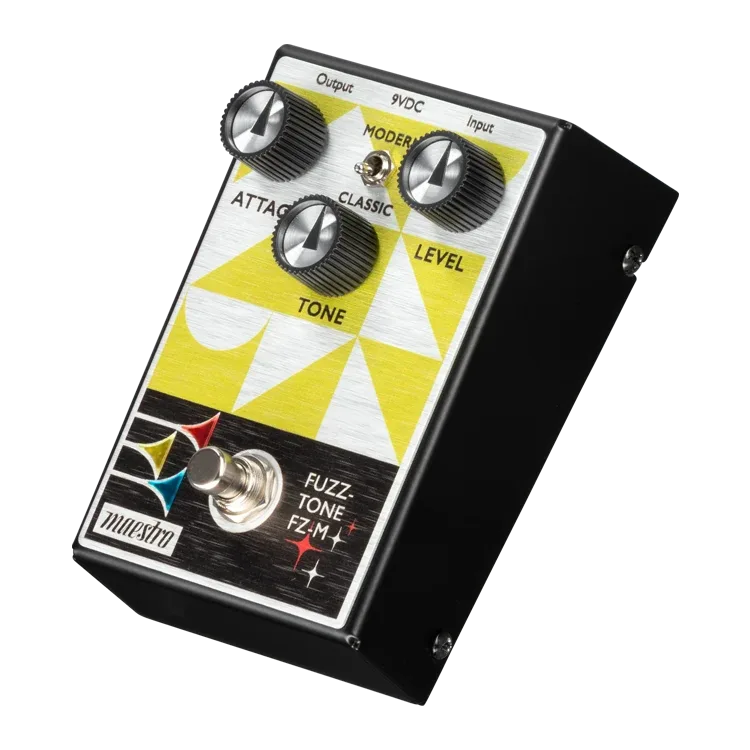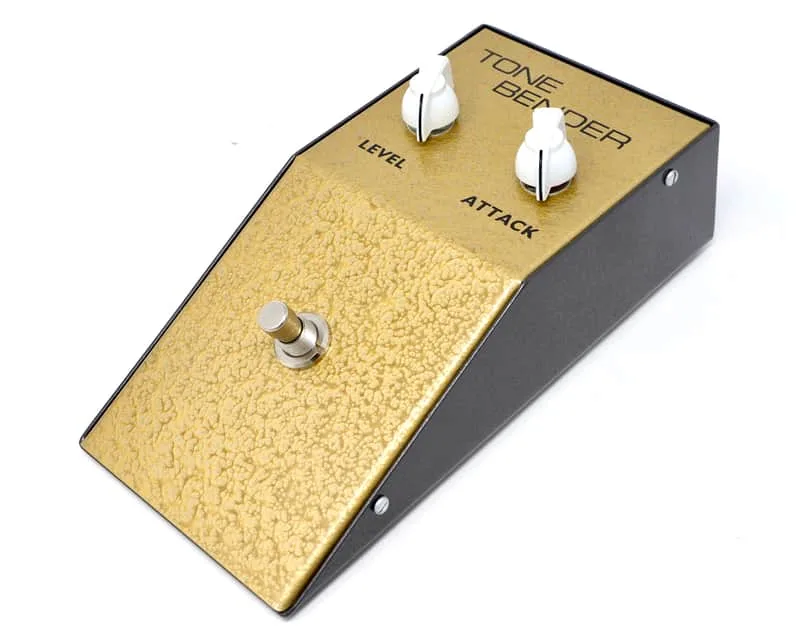


The Sola Sound Tone Bender MKI is a three-transistor germanium fuzz box, first built in 1965, and one of the very first commercial effects pedals available in England12. It was designed by Gary Hurst, a former Vox technician, as the British engineered answer to the American-made Gibson Maestro Fuzz-Tone, with the circuit modified to produce more sustain than its American counterpart34. GuitarPlayer describes its character as "often choppy" with a high output, and Guitar World notes the MkI "sounds quite loud compared with the other Tone Benders"53.
For a player today, the MKI matters as the starting point of the whole Tone Bender family: the fuzz that Paul McCartney used on the bass track of the Beatles' "Think for Yourself", that Mick Ronson carried from Hull into David Bowie's Spiders from Mars, and that Jimmy Page was photographed using during the Yardbirds years1.
What the Tone Bender MKI does
The MKI takes a guitar signal and drives it into a clipped, sustaining fuzz voice built from three germanium transistors. Hurst's design was a modified version of Gibson's 1962 Maestro Fuzz-Tone circuit, changed to produce more sustain than the American pedal9. The result, in GuitarPlayer's words, is a fuzz with an "often choppy character and high output"5, and Guitar World's David Main and Rod Brakes found it "quite loud compared with the other Tone Benders, which is surprising considering it's the first in the line"3.
"The MK I sounds quite loud compared with the other Tone Benders, which is surprising considering it's the first in the line."
The pedal runs on nine volts, where the Maestro FZ-1 it descended from ran on three3. Stompboxes.co.uk notes the MKI "bares some tonal traits of its origins, the Maestro FZ-1"10.
Three germanium transistors in wood, steel and cast aluminum
The MKI's circuit is a simple three-transistor germanium design. Guitar World's history describes it as using "normally two Mullard OC75s and one Texas Instruments TI2G381"3, while stompboxes.co.uk describes the MKI circuit as loaded with "a single Mullard OC75 and two Texas Instruments 2G381 devices"8. One documented early unit, the Bill Puplett example, is notable for a very unusual 4μF input capacitor and an Impex S3-1T transistor in the second position9.
The earliest examples were built into wooden enclosures, with the electronics assembled on stripboard, also known as Vero board, and three black glass Mullard germanium transistors9. Guitar World describes these first units as having "the classic cheese-wedge kind of shape, but are made of wood and were pretty fragile"3. Hurst soon moved to folded steel enclosures, and later examples appear in cast aluminum, with the parts assembled on perforated circuit board rather than stripboard, and still later units built point-to-point on a dedicated board9.
| Enclosure era | Construction | Notes |
|---|---|---|
| Earliest | Wooden, cheese-wedge shape, stripboard (Vero board) | Three black glass Mullard germanium transistors; fragile93 |
| Early metal | Folded steel | Letraset lettering applied by Hurst's then-girlfriend, niece of Larry and Joe Macari, coated with clear lacquer9 |
| Later | Cast aluminum | Perforated circuit board; then point-to-point on a dedicated board9 |
The first few Tone Benders were sold as Gary Hurst designed units, with hand-applied dry letter transfers, and were not sold as Sola Sound pedals; the final version of the MKI carried the silk screening of "Sola Sounds Ltd" and was sold as a Sola Sound product8.
History: Gary Hurst's answer to the Maestro Fuzz-Tone
Gary Hurst, a former Vox technician, began experimenting with fuzz circuits in 1964, and Tom Jennings of Vox was not interested, so Hurst teamed with the Macari brothers7. The first Tone Bender, later christened the MKI, was based on Hurst's modified Maestro fuzz11, essentially a modified Maestro FZ-1 designed in 19653. JHS Pedals describes the arrival plainly:
"In 1965 a new fuzz circuit called the Sola Sound Tone Bender MKI arrived on the booming London music scene."
The MKI was one of the very first commercial effects pedals available in England1, and by 1969 several versions and variations existed, with copies produced by Vox, Jennings, Coloursound and JMI2.
Later versions, from the MK1.5 to the Mk. IV
The Tone Bender line evolved quickly after the MKI, with circuit alterations continuing into the so-called MkVI versions of the 1970s12.
- MK1.5: A two-transistor transitional model between the MKI and the Professional MKII, built by Sola Sound in the mid-1960s and typically fitted with two Mullard OC75 germanium transistors, though some early examples carried Impex S3-1T transistors. It was sold at a variety of shops across the UK, including by Jennings in Dartford, and was discontinued by Sola Sound later in 1966. The "MK1.5" name was applied by collectors in modern times, not by Sola Sound. Over 40 original pedals are known to have survived13.
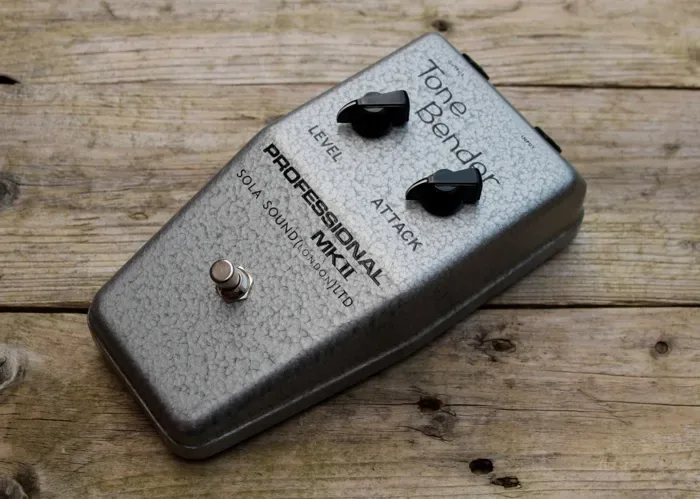
- Professional MKII: Introduced around 1966, a three-transistor circuit (OC75) based on the MK1.5 version with an additional amplifier gain stage1415. The Vox Tone Bender Professional MKII was supplied by Sola Sound via Macari's Musical Exchange and became one of the best-known versions16. The MKII circuit was discontinued in 196814.
- MKIII: The demise of the MKII resulted in Sola Sound's invention of the Vox Tone Bender MKIII16, and Sola Sound continued to supply Vox with the MKIII until well into the 1970s17.
- MKIV: The same circuit as the MKIII in a smaller enclosure, differing only in enclosure and graphics at launch18. From approximately 1971 the model designation was removed and the pedal was known simply as the Sola Sound Tone Bender; it was discontinued in the late 1970s18.
Later Tone Benders such as the Supa Tone Bender from 1973 and the Jumbo Tone Bender from 1976 were silicon Big Muff clones unrelated to the earlier Tone Benders19.
Who used the Tone Bender MKI
The MKI's user list is remarkable given how few pedals survive. Fuzzboxes.org calls it "the only vintage effects pedal (of any sort) where there are actually more confirmed examples of notable artists using it than surviving examples of the pedal"1.
- Paul McCartney used the MKI on the bass track of the Beatles recording "Think for Yourself"8, a use Aclam Guitars also documents20.
- Mick Ronson first acquired the model during the 1960s while a member of the Rats in Hull, and continued using the MKI on stage with David Bowie's Spiders from Mars in the early 1970s1. Guitar World notes he used a MkI Tone Bender throughout his years with Bowie7.
- Jimmy Page was photographed on several occasions during the Yardbirds years using a Tone Bender in a very early cast aluminum enclosure1. His later Led Zeppelin fuzz work is associated with the MkII, which GuitarPlayer says he used on his early recordings with the band12.
- Barry Stedman acquired a gold Tone Bender MKI after hearing Jeff Beck using one on "Heart Full of Soul"1.
- Hume Paton was photographed using a Tone Bender MKI during a performance with the Poets, from Glasgow1.
Videos
pinstripedclips
pinstripedclips
Eric Ohana
Questions
How many original Tone Bender MKI pedals survive?
Very few. Fuzzboxes.org notes the MKI is the only vintage effects pedal of any sort with more confirmed notable artists using it than surviving examples of the pedal itself. Only a single wooden Tone Bender is known to have survived over the decades, and early cast aluminium examples are rare enough that individual units can be traced to named players.
What transistors are in a Tone Bender MKI?
The MKI uses a three-transistor germanium circuit. Guitar World's history says it normally held two Mullard OC75s and one Texas Instruments TI2G381, while stompboxes.co.uk describes one example with a single Mullard OC75 and two Texas Instruments 2G381 devices. One early unit also carried an Impex S3-1T transistor in the second position.
Did Jimmy Page use a Tone Bender MKI?
Yes, in the Yardbirds years. Fuzzboxes.org documents that Page was photographed on several occasions using a Tone Bender in a very early cast aluminium enclosure during that period. His later Led Zeppelin fuzz work is associated with the MkII, which GuitarPlayer says he used on his early Zeppelin recordings.
What is the difference between the Tone Bender MKI and MKII?
The MKI is a three-transistor circuit derived from the Gibson Maestro Fuzz-Tone, with a choppy character and high output. The MKII, introduced around 1966, is also a three-transistor design but based on the two-transistor MK1.5 with an additional amplifier gain stage, giving the sweet, sustaining tone and powerful midrange it is known for.
Did Paul McCartney use a Tone Bender on Think for Yourself?
Yes. Stompboxes.co.uk states that Paul McCartney used the MKI on the bass track of the Beatles recording Think for Yourself, and Aclam Guitars likewise says he used the model to record the fuzz bass line on that song.
Sources (20)
- Tone Bender 'MKI' players list • Fuzzboxes, fuzzboxes.org, 2026-02-22
- FIREFLY HAND PAINT, JHS Pedals
- The history of the Sola Sound Tone Bender, Guitar World, 2021-03-26
- Wooden Case Prototype MKI Tone Bender, British Pedal Company
- ThorpyFx Squeezes All Tone Bender Variants into One Germanium Fuzz Pedal with the Boneyard, GuitarPlayer, 2022-03-02
- FIREFLY - JHS Pedals, JHS Pedals, 1965
- Fuzz pedals: how the wildest drive of all conquered the radio, Guitar World, 2023-06-14
- A Little History, www.stompboxes.co.uk, 2017
- Gary Hurst Tone Bender 'MKI' • Fuzzboxes, fuzzboxes.org, 2021-05-20
- 1965, stompboxes.co.uk, 2025
- Stompbox Classics: Tone Bender, Premier Guitar, 2009-09-18
- The Sola Sound Tone Bender and the Early Evolution of the Fuzz Pedal, GuitarPlayer (www.guitarplayer.com), 2020-07-27
- Sola Sound Tone Bender 'MK1.5' • Fuzzboxes, Fuzzboxes.org, 2021-05-18
- Sola Sound Tone Bender Professional MKII • Fuzzboxes, Fuzzboxes.org, 2021-05-18
- TONEHOME, TONEHOME - the World of Vintage Guitar Effects Pedals
- Vox Tone Bender Professional MKII • Fuzzboxes, Fuzzboxes.org, 2021-05-20
- Vox Tone Bender MKIII • Fuzzboxes, Fuzzboxes.org, 2021-05-30
- Sola Sound Tone Bender MKIV • Fuzzboxes, Fuzzboxes.org, 2021-06-03
- Phobos Germanium Fuzz / Tone Bender Mk. III, Aion FX, 2020-07-03
- Ultimate tone research, sounding like the Beatles, Aclam Guitars, 2021-04-27