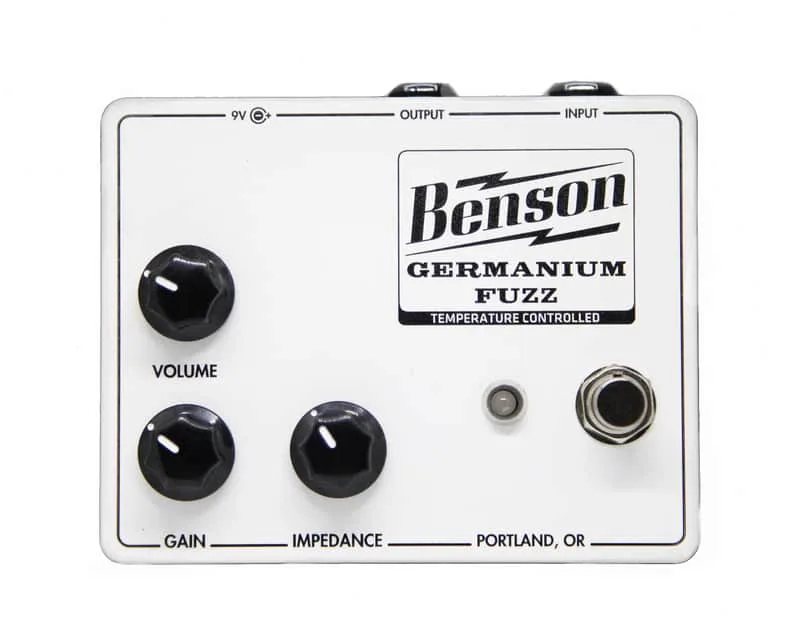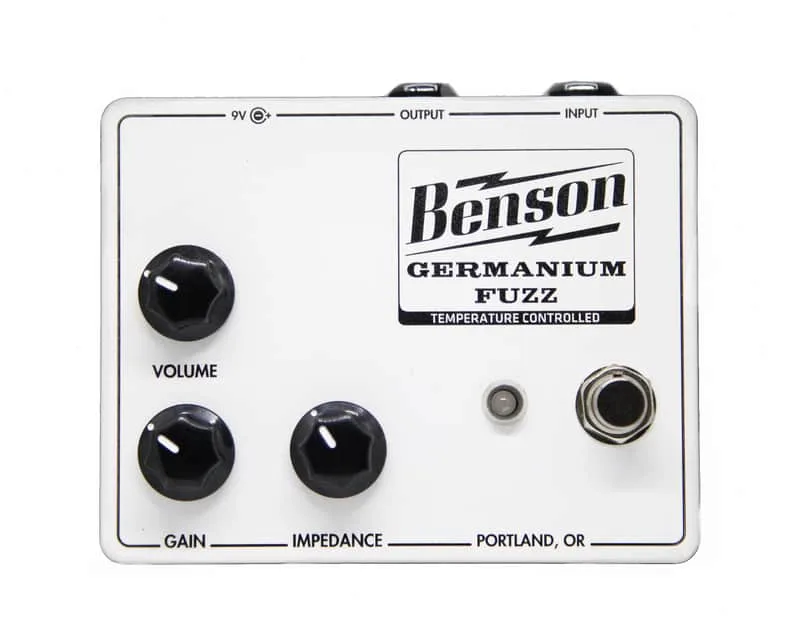


The Benson Amps Germanium Fuzz is an analog fuzz pedal built around two germanium transistors, announced in February 2021 with a list price of $2991. What sets it apart from vintage-style germanium fuzzes is a temperature-regulation circuit, patent applied for, that heats and biases the transistors so the pedal sounds the same regardless of the weather or the stage12.
The circuit has been tuned to cover a wide range: Delicious Audio describes it as usable as "a rich sounding clean boost, an overdrive, all the way up to an aggressive fuzz with some octave overtones"3. MusicRadar's Rob Laing made the same point at launch: "It's not a gnarly gain station; It can be used as a premium clean boost, overdrive and aggressive fuzz" depending on the impedance and gain settings4.
Clean boost, overdrive and fuzz in one pedal
The Germanium Fuzz is not only a fuzz. Because the Gain and Impedance controls are highly interactive, the pedal sweeps from a clean boost through overdrive into full fuzz. Pedal of the Day noted that "the fuzz tone is not spitty or harsh, and more often sounds like an overdrive or distortion until the gain is turned all the way up"7.
A Class A buffer sits at the very input of the pedal, feeding a passive guitar pickup simulator78. Guitar.com's reviewer, Michael Watts, highlighted this in his 2021 review: the buffer means the pedal behaves consistently wherever it sits on your board, rather than reacting unpredictably to what comes before it, which is the classic problem with vintage germanium fuzzes9.
The controls are simple:
| Control | What it does |
|---|---|
| Volume | Sets the output volume1 |
| Gain | Sets the amount of drive, from clean boost to aggressive fuzz; very interactive with Impedance3 |
| Impedance | Simulates rolling down your guitar volume for a tight, sparkly sound; bypassable3 |
| LED | Orange while the transistors warm up, green when bias and gain are set3 |
Germanium transistors and the thermal bias circuit
The pedal is designed around two germanium transistors, 2N527 or 2N404 types, set up in what RockBoard's product page calls "the ubiquitous 60's circular fuzz topology"5. Benson grades the transistors for gain and leakage and matches them so they sound their best5. Premier Guitar's press release noted at launch that "the correct germanium transistors are difficult to source," which is part of why matched, stable germanium fuzzes are rare2.
The innovation is the heater. When the LED is orange, the transistors are warming up to increase their hFE (transistor gain) and shift the bias point to the correct voltage; when the LED is green, the correct bias and gain are set and the warmer is off, toggling back and forth as needed while the pedal runs37. Gearnews described this as "patent-applied-for tech" that could make a real difference for players seeking vintage germanium fuzz tone without the usual inconsistency1.
On That Pedal Show, Chris Benson explained the practical side: "it takes three three or four minutes for it to fully heat up depending on the ambient temperature," and "when heater's on it's Amber and when it's off it's green"10. Delicious Audio and MusicRadar both put the average wait at 2 to 3 minutes after plugging in before the pedal sounds correct34.
There is no battery, and the power input is 9V DC center negative only, drawing 100mA538. Give it a few minutes after power-up before judging the tone.
The thermal-bias idea came first in this pedal, and Premier Guitar reported that "the Germanium Fuzz is just the first in line," with more applications planned2. An error-correction circuit tried during the Fuzz's development did not work for the fuzz itself, but it became the basis of the companion one-knob Benson Germanium Boost, a clean boost pedal that also plays well in front of Fuzz Face style fuzzes11.
Colors and related pedals
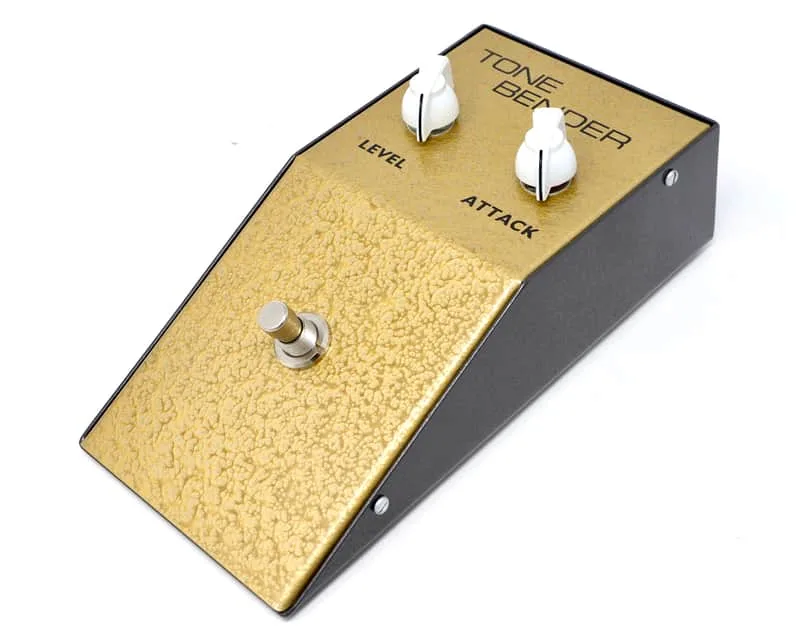
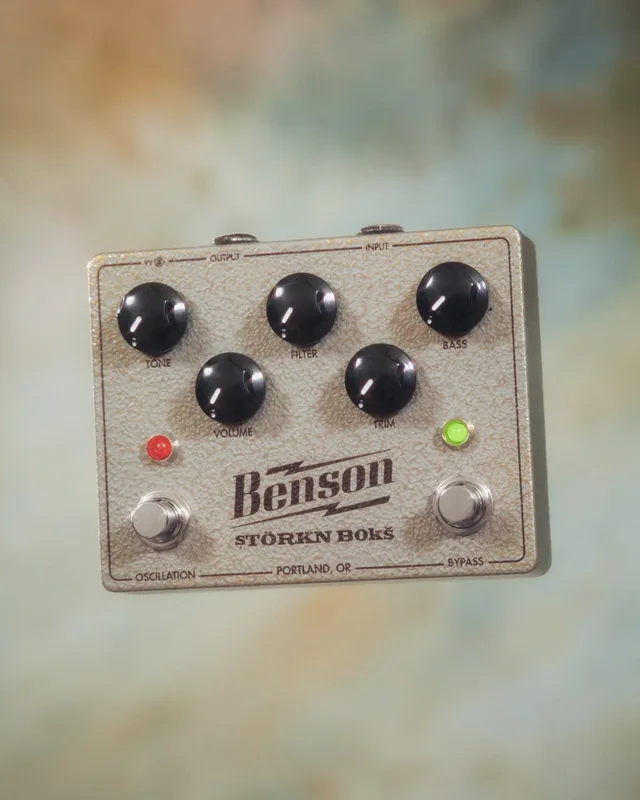
The Germanium Fuzz shipped in two finishes, Studio Black and Solar White6. It sits in a small family of Benson germanium gain pedals:
What reviewers said
In the JHS video, Josh runs the pedal with Chris Benson of Benson Amps on hand, walking through the thermal bias behavior and where the circuit sits between a Fuzz Face and a Tone Bender Mark 1.512.
On That Pedal Show, Chris Benson talked through the heater circuit, the warm-up time, and the LED colors, along with the wider Benson pedal lineup10.
Videos
Benson Amps
AndyDemos
Mike Hermans
Questions
Does the Benson Germanium Fuzz need a warm-up time?
Yes. After you plug it into power it takes 2 to 3 minutes on average before it sounds correct, and Chris Benson has said it can take three or four minutes to fully heat up depending on the ambient temperature. The LED tells you where it is in the process: orange while the transistors warm up, green when the correct bias and gain are set.
What does the LED color mean on the Benson Germanium Fuzz?
The LED shows the state of the transistor heater. When it is orange or amber, the transistors are warming up to increase their hFE (transistor gain) and shift the bias point to the correct voltage. When it turns green, the correct bias and gain are set and the heater is off. It can toggle back and forth while the pedal is on.
What does the Impedance control do?
The Impedance control simulates rolling down your guitar's volume knob, giving that tight, sparkly cleaned-up sound without touching the volume control on your instrument. It is bypassable, and it is very interactive with the Gain control, so the two together offer many colors of tone from clean boost to aggressive fuzz.
What power supply does the Benson Germanium Fuzz need?
It needs a 9V DC center negative power supply and draws 100mA. There is no battery option, so it must run from a mains adapter. The warm-up behavior after plugging in is normal: give it a few minutes before judging the tone.
Does the Benson Germanium Fuzz run on a battery?
No. There is no battery in the pedal. It runs on a 9V DC center negative power input only, drawing 100mA, which is part of why the heater circuit can keep the transistors at their correct operating point.
What transistors are inside the Benson Germanium Fuzz?
It is designed around two germanium transistors, 2N527 or 2N404 types, set up in the classic 1960s circular fuzz topology. Benson grades them for gain and leakage and matches them so they sound their best, which matters because germanium transistors are difficult to source with consistent characteristics.
Sources (12)
- Benson Amps' Germanium Fuzz uses thermal biassing for consistent '60s fuzz tones, gearnews.com, 2021-02-03
- Benson Amps Releases New Germanium Fuzz, Premier Guitar, 2021-02-02
- Benson Germanium Fuzz, Delicious Audio, 2023-04-20
- Central heating in a fuzz pedal? Benson's new Germanium Fuzz sounds interesting!, MusicRadar, 2021-02-03
- Germanium Fuzz by Benson Amps, RockBoard PedalPedia, 2026
- Benson Amps introduces innovative temperature-regulated, buffer-friendly Germanium Fuzz pedal, Guitar World, 2021-02-03
- Benson Amps Germanium Fuzz, Pedal of the Day, 2021-11-01
- Benson Germanium Fuzz Review: Benson’s new fuzz pedal is a temperature-controlled game-changer, guitar.com, 2021-04-19
- Benson Amps launches second automatic thermally bias fuzz pedal, the Stonkbox, Guitar.com, 2023-05-17
- Chris Benson Of Benson Amps & Pedals At TPS! Preamps, Fuzzes, Delay, Surf's Up & Florist, That Pedal Show (YouTube), 2024-05-16
- Benson Amps Germanium Boost, Pedal of the Day, 2022-04-06
- Temperature Controlled Fuzz!? (Benson Stonk Box Germanium Tonenbender MK1 Zonk Machine Fuzz), JHS Pedals (YouTube), 2023-06-14