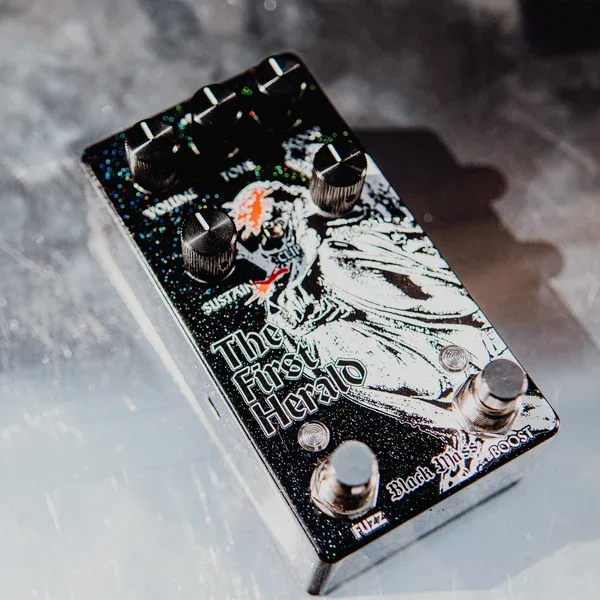


The First Herald is an analog fuzz and boost pedal from Black Mass Electronics, built as two independent circuits in one box: a fuzz side with a modernized tone stack and selectable clipping, and a discrete boost side. What sets it apart from most two-in-one pedals is that the two circuits are reversible, so a switch decides whether the fuzz feeds the boost or the boost drives the fuzz1.
The circuit has a family resemblance to a classic. Black Mass says the company began as an attempt to clone the maker's father's '73 Rams Head Big Muff, but that when work started on The First Herald, the pedal was redesigned from scratch. The topology remains similar to the Rams Head, while the maker describes the resulting sound as "modern, decisive, and unmistakably malicious"1.
Controls and the order switch
The fuzz side carries three knobs and a clipping toggle, and the boost side has its own level control. The order of the two sides is set by the side switch1.
| Control | What it does |
|---|---|
| Volume | Output level of the fuzz circuit1 |
| Sustain | Amount of fuzz saturation and sustain2 |
| Tone | Mix of high cut and low cut circuits; clockwise for more treble and less bass, counterclockwise for less treble and more bass1 |
| Boost | Level of the independent boost circuit1 |
| Side switch | Order reverse switch; left runs fuzz into boost, right runs boost into fuzz1 |
| Clip | Selects the clipping mode of the fuzz circuit1 |
The order switch is where the two circuits interact. Left, the fuzz runs into the boost, which the maker suggests for lead boosts. Right, the boost runs into the fuzz; RockBoard's listing describes this position as giving extra thick fuzz saturation, and notes the boost can also be used after the fuzz to drive an amp harder or as a solo level boost14.
Three clipping modes
The Clip toggle changes the diodes used in the fuzz's two soft-clipping stages, and the blocking capacitor values, which determine clipping frequencies, were chosen for each mode and change with the switch position1.
- Left: Both soft-clipping stages use a hybrid MOSFET/LED combo, which the maker describes as a modern and aggressive, huge, open, cutting fuzz1.
- Right: Both clipping stages use traditional silicon diodes, for extra compression and a smooth, squashed, vintage sound1.
The Big Box version's listing on RockBoard describes the same two positions, with the fuzz side taking advantage of a modernized tone stack and three distinct clipping modes4.
The boost side
The boost is a simple discrete circuit with a single level knob. Black Mass is direct about its character412:
"This is not a clean boost, it adds some color, grit, and tons of volume"
That makes it a different tool from a transparent volume booster: it is voiced to push the fuzz side or an amp rather than to leave the core tone untouched. Players comparing it with a dedicated boost pedal should expect the boost to contribute its own character14.
Power and switching
The First Herald runs on 9V DC only, through a standard 2.1mm center negative connector, and the maker says not to run it at higher voltages. RockBoard lists its current draw at 100mA13.
Black Mass specifies an isolated power supply for The First Herald. With a 100mA draw and a 9V-only requirement, it is not a candidate for higher-voltage experimentation or sharing a non-isolated daisy chain13.
Switching is true bypass and relay based, and the pedal defaults to bypass in case of power failure, so a lost power connection drops the signal path rather than killing it1.
The Big Box version
Black Mass also makes a larger version, The First Herald Big Box, shown in Etched and Rainbow Flake finishes. It carries the same core design: two independent and reversible circuits, the same Volume, Sustain, Tone, and Boost controls, the same clipping options, and the same 9V DC, 2.1mm center negative, isolated-supply power requirements2.
One difference is in the switching. The Big Box listing notes that as of September 12, 2025 it used standard true bypass with click switching, while the current listing for both versions describes relay-based true bypass that defaults to bypass on power failure12.
| The First Herald | The First Herald Big Box | |
|---|---|---|
| Circuits | Fuzz and boost, reversible1 | Fuzz and boost, reversible2 |
| Clipping | MOSFET/LED hybrid or silicon diodes1 | MOSFET/LED hybrid or silicon diodes2 |
| Bypass | Relay based true bypass1 | Standard true bypass with click switching as of 9/12/25; relay based true bypass on current listing2 |
| Power | 9V DC only, 2.1mm center negative, isolated supply1 | 9V DC only, 2.1mm center negative, isolated supply2 |
| Finishes | Standard enclosure | Etched and Rainbow Flake shown2 |
Where it came from
The First Herald's origin story is tied to the Rams Head Big Muff. Black Mass says the company started with an attempt to clone the maker's father's '73 Rams Head pedal, and that when work began on The First Herald the decision was made to design from scratch rather than copy it. The result keeps a similar topology to the Rams Head but with the modernized tone stack, selectable clipping, and the added boost circuit1. Players interested in the broader category can compare it against other fuzz pedals.
Videos
ambienttrash
collector//emitter
Noise Generator
Questions
Is The First Herald a Big Muff clone?
No. Black Mass Electronics says the company started as an attempt to clone the maker's father's 1973 Rams Head Big Muff, but The First Herald was designed from scratch. The topology remains similar to a Rams Head, though the maker describes the sound as modern rather than a reproduction.
Can you change the order of the fuzz and boost on The First Herald?
Yes. A side switch reverses the order of the two circuits. Left runs the fuzz into the boost, which the maker suggests for lead boosts. Right runs the boost into the fuzz, which RockBoard's listing describes as giving extra thick fuzz saturation.
Is the boost on The First Herald a clean boost?
No. Black Mass Electronics describes the boost side as a simple discrete circuit and says it is not a clean boost. It adds some color, grit, and a large amount of volume, which the maker positions as a companion to the fuzz side.
Is The First Herald true bypass?
Yes. The standard version uses relay-based true bypass switching that defaults to bypass in case of power failure. The Big Box version used standard true bypass with click switching as of September 12, 2025, and relay-based true bypass on its current listing.
Sources (4)
- The First Herald, Black Mass Electronics
- The First Herald (Big Box), Black Mass Electronics, 2025-09-12
- The First Herald by Black Mass Electronics, RockBoard PedalPedia, 2026
- The First Herald Big Box by Black Mass Electronics, RockBoard PedalPedia, 2026