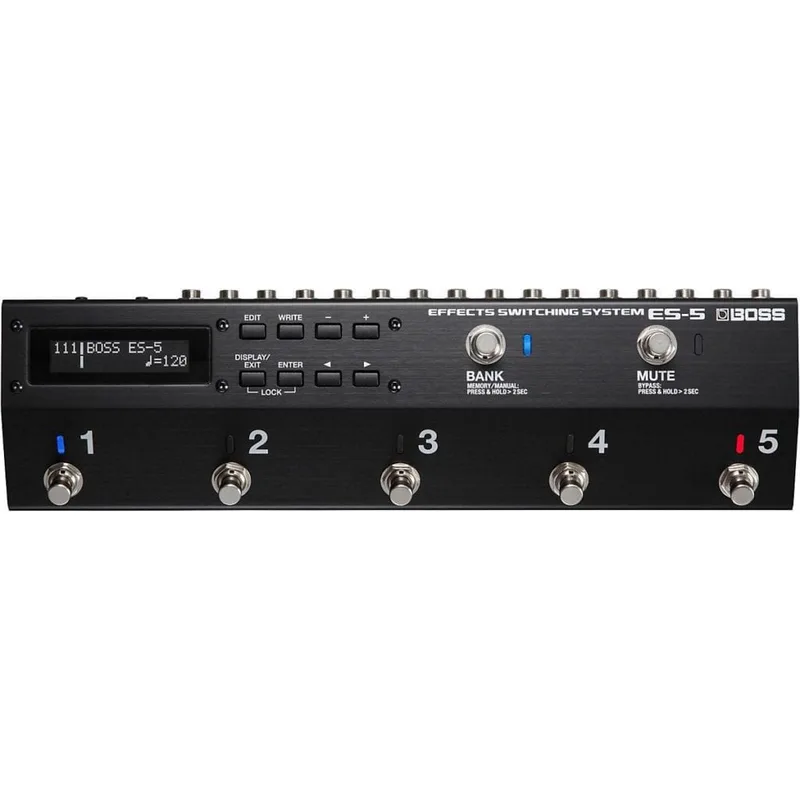


The Boss ES-5 is an effects switching system: a floor unit that takes over the job of stomping individual pedals on and off. You plug up to five pedals into its loops, and its five footswitches then recall whole pedal combinations, in any order, from 200 stored patches. Boss describes it as "a powerful and versatile effects switching system that gives you complete control over a pedalboard"1.
It was announced at NAMM in January 2016 as a smaller version of Boss's flagship ES-8, carrying the same idea in a smaller, cheaper package: five audio loops, real-time control, MIDI and more2. Performer Magazine's review put its street price at $399 at the time3.
A five-loop effects switching system
The core idea is routing flexibility. One of the ES-5's key features, in Boss's words, is "innovative routing flexibility, which provides the ability to easily rearrange the order" of a chain of stompbox effects1. The on/off state and connection order of the audio loops can be stored in 200 patch memories for instant recall2, so one press can bring in your overdrive and delay while reordering what feeds what.
The audio path itself was developed for pure signal transfer to preserve tone2. Boss says the ES-5 "is designed in a way that does not contribute to sound deterioration, keeping your tone pure and free of noise"1. It is built with durable mechanical functions in a road-tough design1.
Each loop can be set for buffered or true bypass, and the input and output buffers can be switched on or off as needed per patch32. That means you can run the whole thing true bypass, keep buffers on to drive long cable runs, or mix the two per patch.
What the ES-5 gives you, in short:
- Five 1/4" audio loops for your pedals3
- 200 patch memories storing loop on/off state and connection order2
- Routing flexibility to rearrange the order of your effect chain1
- Per-loop buffered or true bypass, with switchable input and output buffers32
- Five fully assignable footswitches13
- MIDI for controlling MIDI-equipped pedals1
Performer Magazine's reviewers summed up their verdict in the review's pros list: "Master control over pedalboard & amp, plenty of tonal possibilities"3.
"With a street price of $399, the ES-5 can give players looking to really get everything out of their pedalboard and amp"3
Inputs, outputs and control jacks
The ES-5's connections, as listed in Performer Magazine's review3:
| Connection | Type |
|---|---|
| Inputs | 1 x 1/4" (instrument), 1 x 1/4" (tuner) |
| Outputs | 1 x 1/4" (main out) |
| Effects loops | 5 x 1/4" |
| Other I/O | 2 x 1/4" TRS (external control), 1 x 1/4" TRS (expression/control) |
The two TRS control output jacks serve as external controls, for example for an amp's channel switching, and the TRS control/expression input takes an expression pedal or two footswitches for further real-time control132. There is also a tuner out, so you can leave a tuner connected and out of the audio path3.
Amp channel switching and MIDI
The two TRS control outputs are what let the ES-5 reach beyond the pedalboard. Performer Magazine's review describes the external controls as usable "for an amp's channel switching, for example"3, so a patch can change your amp's channel at the same time as it changes your pedals.
MIDI capability is included for integrating with MIDI-controlled stomp effects1. When the ES-5 was announced, Guitar.com's press coverage noted this covers pedals like the Boss DD-500 delay2. For more on that side of things, see MIDI pedals.
ES-5 Ver.2 is not compatible with ES-5 Ver.1 MIDI system exclusive parameters4. If you are moving settings between units on different firmware versions, the system exclusive data will not transfer.
ES-5 versus ES-8
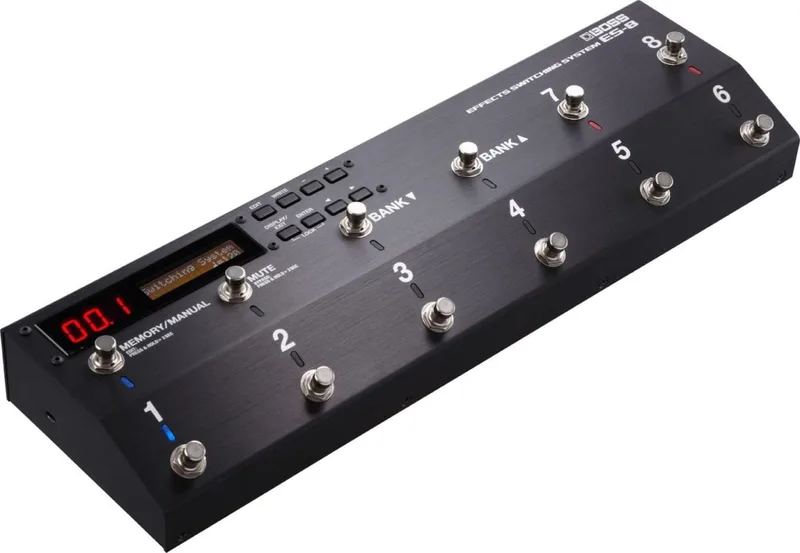
The ES-5 is a smaller version of Boss's flagship model, the ES-82. The ES-8, announced in January 20155, is also an effects switching system, but bigger: eight effect loops, three TRS control output jacks and two TRS control/expression input jacks, against the ES-5's five loops, two control outputs and one control/expression input1. Both share the assignable footswitches, patch memory approach and MIDI integration.
Firmware: checking and updating
To check which firmware version your ES-5 has, hold down the EDIT button and connect the AC adaptor; the version is shown on the LCD screen4. Version 2.03 or later is the latest version, so if the display shows 2.03 or higher there is no need to update4.
If you do need to update, the process is:
- Gather the equipment: the ES-5, a USB-MIDI interface (such as a Roland UM-ONE mk2), a personal computer that can run Boss's UpdSMF updater, and a MIDI cable4.
- Hold down the DISPLAY/EXIT button and the RIGHT arrow button on the ES-5, then connect the AC adaptor to start the update4.
- Send the update files, named "001UPD.mid" and "002APP.mid" in the "es5_sys_v203" folder, to the ES-54.
- When the message ok appears on the display, the update has finished4.
Never power off the ES-5 while the update is in progress, or servicing will be required4.
The firmware history includes Ver.2.00 (April 2017), which added a Link function, "Patch MIDI" as an assign target, new patch and system parameters, and support for the ES-5 Editor; Ver.2.01 (August 2017), a bug fix revising the ES-5's parameters; and Ver.2.03 (August 2020), which updated the factory-default test program with no effect on actual product operation4.
Videos
BOSSchannel
BOSSchannel
BOSSchannel
Questions
How do I update the firmware on a Boss ES-5?
Hold down the DISPLAY/EXIT button and the RIGHT arrow button, then connect the AC adaptor to start the update. You need a USB-MIDI interface such as a Roland UM-ONE mk2, a computer running Boss's UpdSMF updater, and a MIDI cable. Never power off the ES-5 while the update is in progress, or servicing will be required. When the message ok appears on the display, the update has finished.
How do I check which firmware version my ES-5 has?
Hold down the EDIT button and connect the AC adaptor. The version is displayed on the LCD screen. Version 2.03 or later is the latest firmware; if your ES-5 shows 2.03 or higher, there is no need to update it.
What is the difference between the Boss ES-5 and ES-8?
The ES-5 is a smaller version of Boss's flagship ES-8. The ES-5 has five audio loops, two TRS control output jacks and one TRS control/expression input, while the ES-8 has eight loops, three TRS control outputs and two TRS control/expression inputs. Both are effects switching systems with assignable footswitches and MIDI.
Can the ES-5 switch amp channels?
Yes. The ES-5 has two TRS control output jacks that can be used as external controls, for example to switch an amp's channels. Performer Magazine's review lists external controls for amp channel switching among its features.
Does the ES-5 work with MIDI pedals?
Yes. Boss says MIDI capability is included for integrating with MIDI-controlled stomp effects, such as the Boss DD-500. Note that ES-5 Ver.2 is not compatible with Ver.1 MIDI system exclusive parameters.
Is the Boss ES-5 true bypass?
Each of the five loops can be set for buffered or true bypass, and the input and output buffers can be turned on and off independently per patch. So the ES-5 can run true bypass, buffered, or a mix, depending on how you configure it.
Sources (5)
- BOSS - ES-5 | Effects Switching System, boss.info
- NAMM 2016: Boss Announces ES-5 Effects Switching System, Guitar.com, 2016-01-19
- Boss ES-5 Effects Switching System Review, Performer Magazine, 2016-06-28
- BOSS - Support - ES-5 - Updates & Drivers, boss.info, 2017
- Boss Unveils ES-8 Effects Switcher & BB-1X Bass Driver, Premier Guitar, 2015-01-22