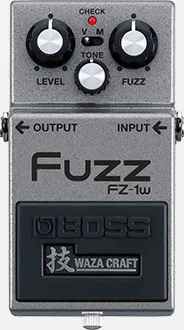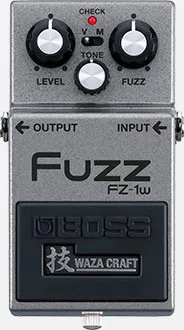


The Boss FZ-1W is a fuzz pedal from Boss, part of the company's Waza Craft series of premium pedals built in Japan. It is an all-analog pedal built around silicon transistors, with two modes selected by a switch: Vintage, which Boss describes as a retro fuzz experience with aggressive tone, dynamic touch response and extreme sensitivity to input volume, and Modern, which the company says provides a fatter sound and more mid focus to suit a wider range of music styles1.
It was announced in November 2021 and is a regular production model, not a limited release2. Boss states that, unlike previous Waza Craft models, the FZ-1W does not reproduce a past design: it is a modern interpretation of vintage fuzz built on an original circuit1.
What the two modes do
The mode switch, labeled "V" and "M", selects between the two voices5.
- Vintage mode delivers what Boss calls "the classic fuzz voice with more gain and wider expressive range… raspy and assertive without being harsh"5. The company says you can smoothly transition from heavy fuzz to crunch to crystal clean simply by riding your guitar's volume knob1.
- Modern mode delivers, in Boss's words, "a more refined and versatile fuzz voice with focused midrange and fatter tone, making it ideal for all types of current music styles"5. Its gain range is even wider than Vintage mode's1.
Guitar World's buying guide describes the modern mode as voiced for a bright, articulate sound with a significant amount of gain, while the vintage setting delivers classic tones of the early '60s6. Premier Guitar's reviewer characterized the modern mode as one that adds body and midrange presence7.
The controls: Level, Tone, Fuzz and the mode switch
The pedal has three knobs plus the mode switch3. Each knob behaves differently depending on the mode selected.
| Control | Vintage mode | Modern mode |
|---|---|---|
| Fuzz | Sets the fuzz amount; turning it down reduces fuzz | Turning it down reduces fuzz; past three o'clock Boss says it conjures rich, singing sustain for solo playing1 |
| Tone | Acts in the traditional way, simultaneously adjusting high and low frequencies to dial in different fuzz colors18 | A different tuning that lets you tweak brightness without altering the midrange1 |
| Level | Sets output level; cranking it with Fuzz down turns the pedal into a boost1 | Sets output level |
| Mode switch | Selects Vintage ("V") or Modern ("M")5 | Same switch |
The boost trick is worth noting for players who also want a boost pedal: Boss says that by turning down the Fuzz knob and cranking the Level, the FZ-1W works great as a boost for your amp and other gain pedals1.
Bypass, power and build
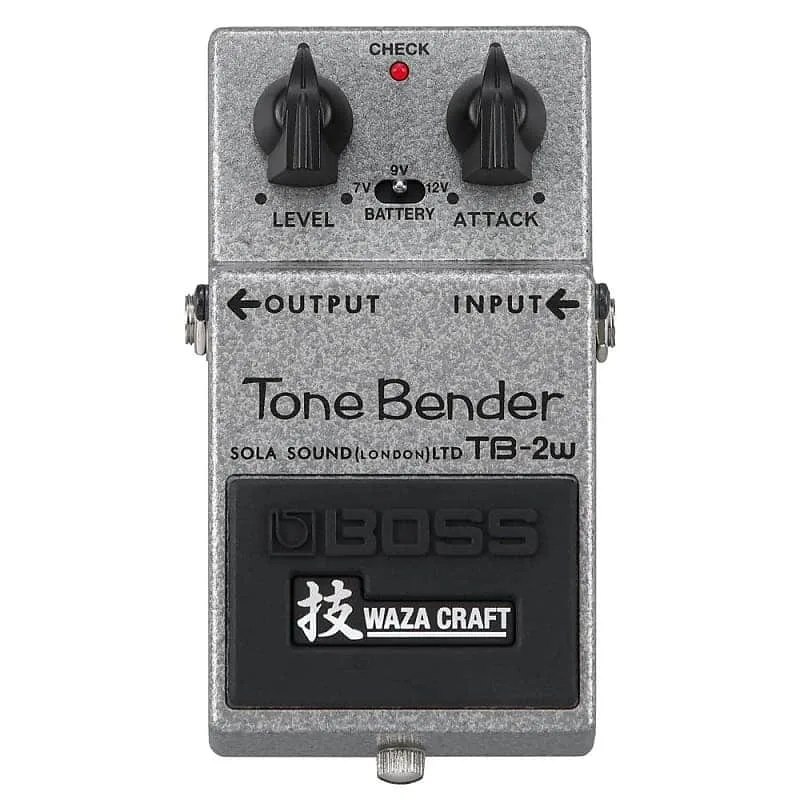
The FZ-1W uses buffered bypass only, with a high-quality buffer for clean and clear tone when bypassed1. Guitar World's buying guide called the lack of true bypass disappointing6. This is a difference from Boss's own TB-2W Tone Bender, released earlier in 2021, which offers selectable true or buffered bypass5910.
Power comes from a 9-volt mains supply only, not supplied, with no battery operation3. The enclosure is a chunky metal box with side-mounted sockets, three knobs at the top and a soft-action footswitch, with a battery compartment beneath it3. GuitarPlayer described it as a rock-solid circuit in a virtually bulletproof enclosure, noting that the silicon circuitry limits vintage fuzz frustrations such as component tolerances, battery type and air temperature5. It carries the Boss five-year warranty1.
The FZ-1W runs on a 9V mains supply only, so it cannot run on a battery despite having a battery compartment in the enclosure3.
History: a new Waza Craft design, not a reissue
The FZ-1W followed the TB-2W Tone Bender in the Waza Craft series, released earlier in 20215. MusicRadar was clear that "this isn't the return of the much-loved Boss FZ-2 Hyper Fuzz, the FZ-1W is something" new, reporting that it came from a "deep analysis of many legendary fuzz pedals"8. GuitarPlayer reported that Boss analyzed several vintage fuzz circuits, including vintage Sola Sound Tone Bender units, to create the FZ-1W11.
Boss itself states that unlike previous Waza Craft models, the FZ-1W does not provide a reproduction of a past design, and that it carries the number "1" in its name out of respect for the classic fuzz circuits that helped shape the sound of rock guitar1. Delicious Audio likewise describes it as sporting an original circuit that's not directly inspired by existing vintage ones4.
Premier Guitar's review adds detail on the lineage: Boss is quick to point out that the FZ-1W is an original design, but also says much of the inspiration and practical development came from the Tone Bender MkII work behind the TB-2W7. Guitar World notes that Boss's use of silicon circuitry is less traditional compared to the original Tone Bender it's aiming for6.
How it differs from the FZ-2 Hyper Fuzz
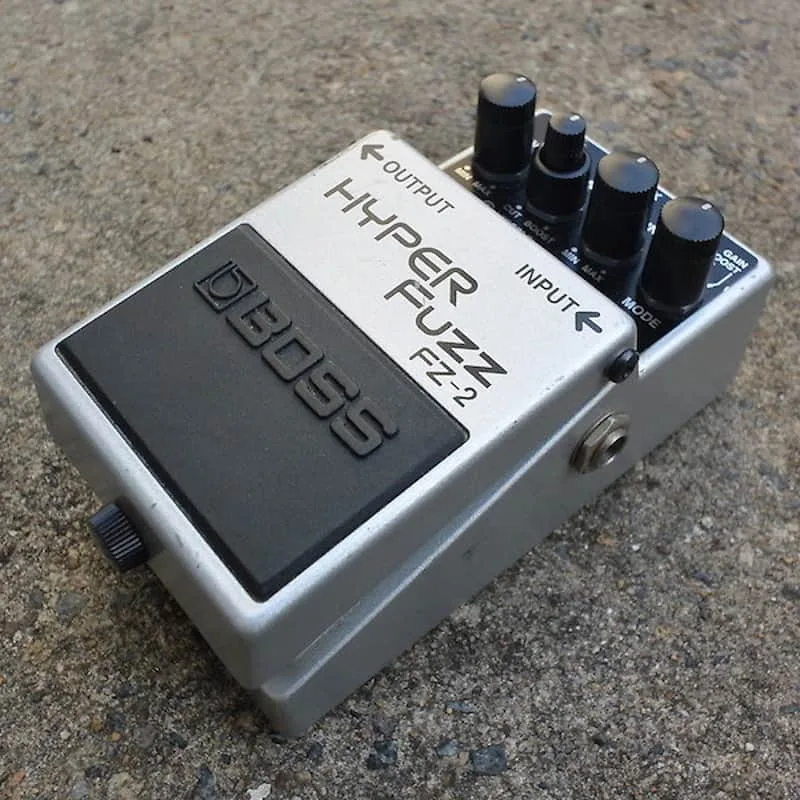
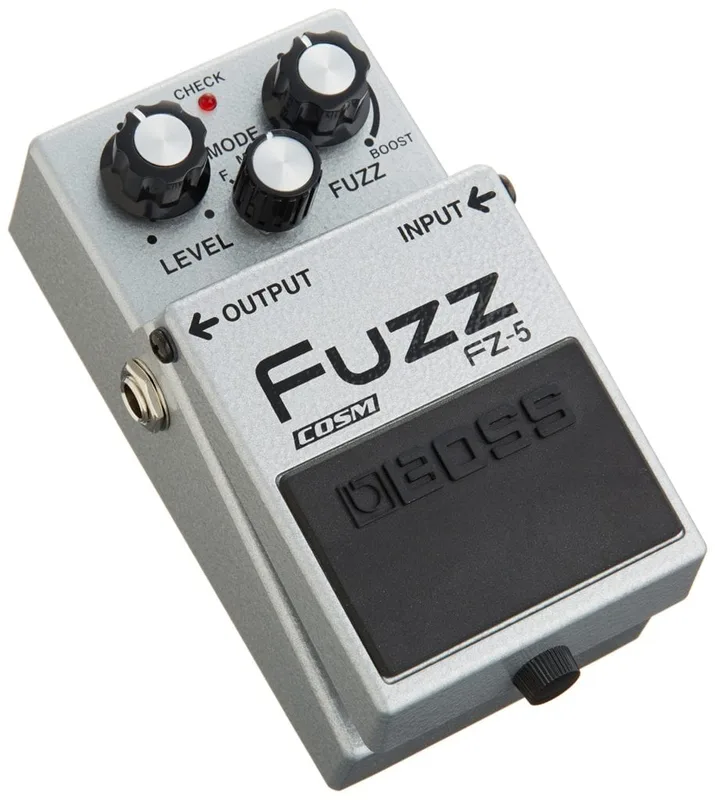
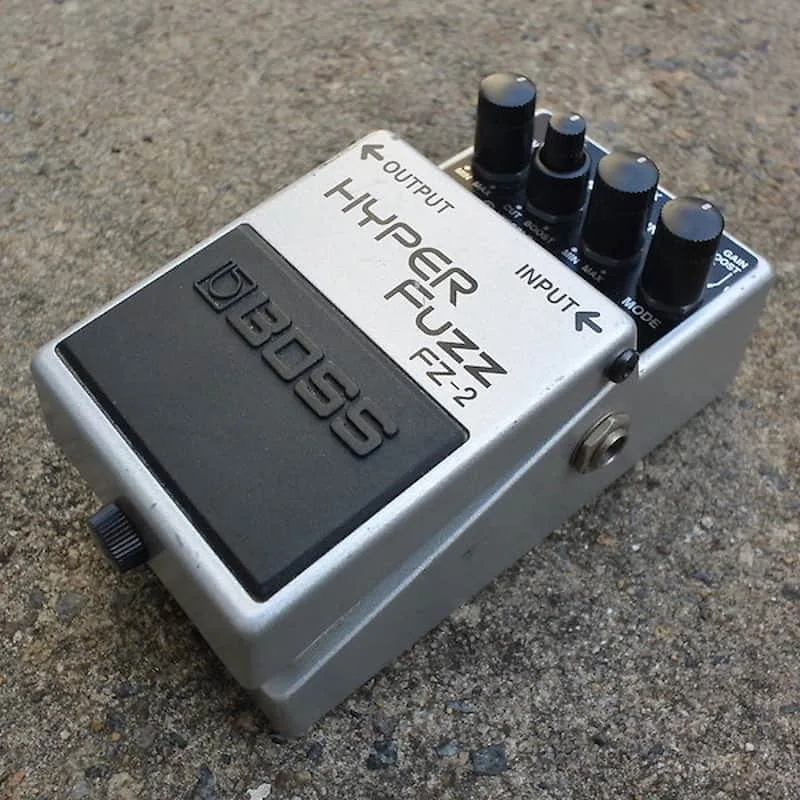
Players sometimes assume the FZ-1W revives the FZ-2 Hyper Fuzz, Boss's gray fuzz from 1993121. It does not. The FZ-2 was an enormous circuit broken into four distinct parts, boost, fuzz, filter and tone, derived from the Superfuzz with an input boost and tone stack added1213. The FZ-1W is instead a compact three-knob silicon fuzz with two modes, built as a new design34.
What reviewers said
Guitar.com's review rated the pedal 9 out of 10 and concluded:
"Forget the vintage reference points, this is simply a smartly designed new pedal offering assorted flavours of thick, buttery fuzz"3
Richard Purvis, Guitar.com3
The same review found the mids even more pronounced in Modern mode, for a rich and raunchy but fundamentally contained sound, something like a fuzz equivalent of Boss's own SD-1 overdrive3. Premier Guitar's reviewer found that played alongside authentic clones of various Tone Bender versions, the FZ-1W's voice is unquestionably unique, though easy to hear the Tone Bender influence, with similarities shining through against Tone Bender clones7. That review also noted the practical trade-off of silicon: the FZ-1W won't be as dynamically responsive to volume attenuation as a germanium Fuzz Face7.
Videos
Sweetwater
Premier Guitar
BOSSchannel
News
Questions
Is the Boss FZ-1W a Fuzz Face clone?
No. Boss states the FZ-1W is an original circuit, not a reproduction of a past design. It is a silicon fuzz built after analysis of several vintage circuits, including Sola Sound Tone Bender units, and Premier Guitar's reviewer found its voice unique even played alongside authentic Tone Bender clones. Its silicon transistors also make it less like a germanium Fuzz Face in feel.
Does the Boss FZ-1W take a battery?
No. Guitar.com's review lists it as powered by a 9-volt mains supply only, with the supply not included. The enclosure does have a battery compartment beneath the footswitch, but the stated power requirement is a 9V supply.
Is the Boss FZ-1W true bypass?
No. The pedal uses a high-quality buffer for clean and clear tone when bypassed, and offers buffered bypass only. Guitar World's buying guide called the absence of true bypass disappointing. This differs from Boss's TB-2W Tone Bender, which has selectable true or buffered bypass.
Does the FZ-1W clean up with the guitar volume knob?
In Vintage mode, yes. Boss says you can smoothly transition from heavy fuzz to crunch to crystal clean by riding your guitar's volume, and the mode is extremely sensitive to input volume. Premier Guitar notes that its silicon circuitry makes it less dynamically responsive to volume roll-off than a germanium Fuzz Face.
What is the difference between the FZ-1W and the FZ-2 Hyper Fuzz?
The FZ-1W is not a return of the FZ-2 Hyper Fuzz. MusicRadar reported it as a new design, and Boss describes it as an original circuit rather than a reproduction. The FZ-2, released in 1993, was a large four-stage circuit derived from the Superfuzz, while the FZ-1W is a compact three-kob silicon fuzz with Vintage and Modern modes.
Can the Boss FZ-1W be used as a boost?
Yes. Boss says that by turning down the Fuzz knob and cranking the Level, the FZ-1W works great as a boost for your amp and other gain pedals. This applies in Vintage mode, where the Fuzz knob sets the fuzz amount.
Sources (13)
- BOSS - FZ-1W | Fuzz, boss.info
- Boss Releases the FZ-1w Waza Craft Fuzz, Premier Guitar, 2021-11-04
- Boss FZ-1W Fuzz review: a new addition to the Boss fuzz family with no shortage of attitude, Guitar.com, 2021-12-13
- BOSS FZ-1w Fuzz, Delicious Audio, 2024-04-08
- Boss Unveils New Vintage-Style Analog Fuzz Pedal for Guitarists, GuitarPlayer, 2021-11-04
- Best fuzz pedals 2026: add some filth to your sound with these essential pedalboard effects, Guitar World, 2022-06-09
- Boss FZ-1W Waza Craft Fuzz Review, Premier Guitar, 2022-02-07
- Boss reveals a new fuzz pedal: the FZ-1W, MusicRadar, 2021-11-04
- BOSS TB-2W Tone Bender, Delicious Audio, 2024-10-03
- The 3 Best Fuzz Pedals Per Type, In 2023, Delicious Audio, 2022-09-15
- 10 New Gain Pedals You Need to Know About, GuitarPlayer (www.guitarplayer.com), 2022-03-03
- Hypercube Fuzz Distortion / BOSS® FZ-2 Hyper Fuzz, Aion FX, 2021-05-28
- Argent Silicon Fuzz / BOSS FZ-3, Aion FX, 2021-11-23