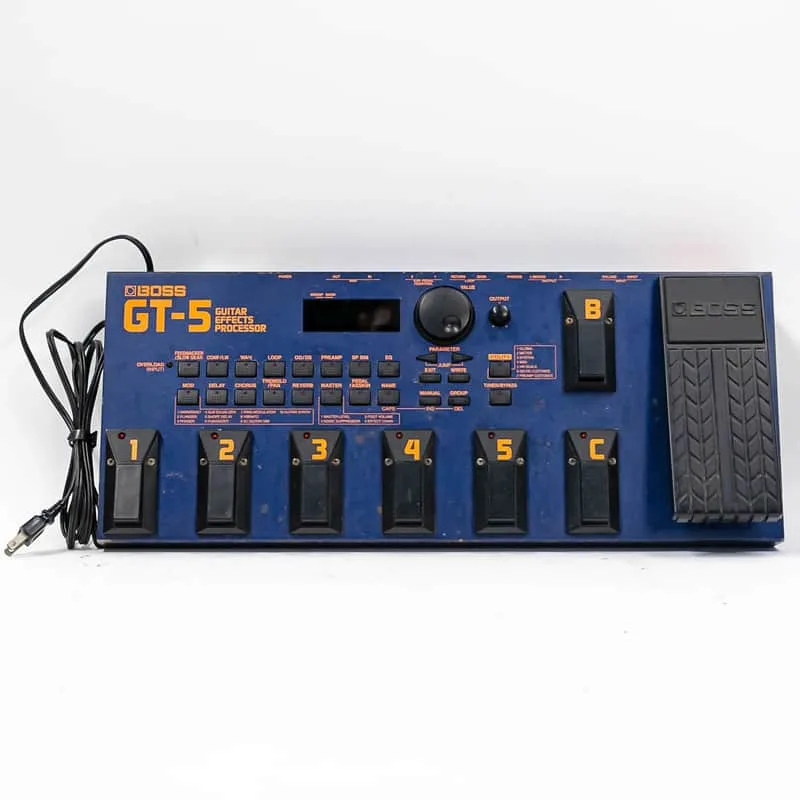


The Boss GT-5 is a guitar effects processor in floor unit form, launched in 1996 as the first model in Boss's long-running GT series of multi-effects pedals. It puts 28 different effect types, including stereo reverb, delay, modulation effects and pitch shifting, under a bank of footswitches and a built-in expression pedal, and it was the first unit to include Boss's COSM digital processing technology 1 2.
Where it came from
The GT series began with the GT-5. Boss's own buying guide states that "The BOSS GT series was first launched in 1996 with the introduction of the GT-5," and that "It was the first unit to include the BOSS COSM digital processing technology," the modeling approach developed by Boss's parent company Roland 2. Paul White's review in Sound On Stage noted that Boss "remains one of the biggest, if not the biggest, names in effects pedals," and that the company's COSM modeling technology features in the GT-5 1.
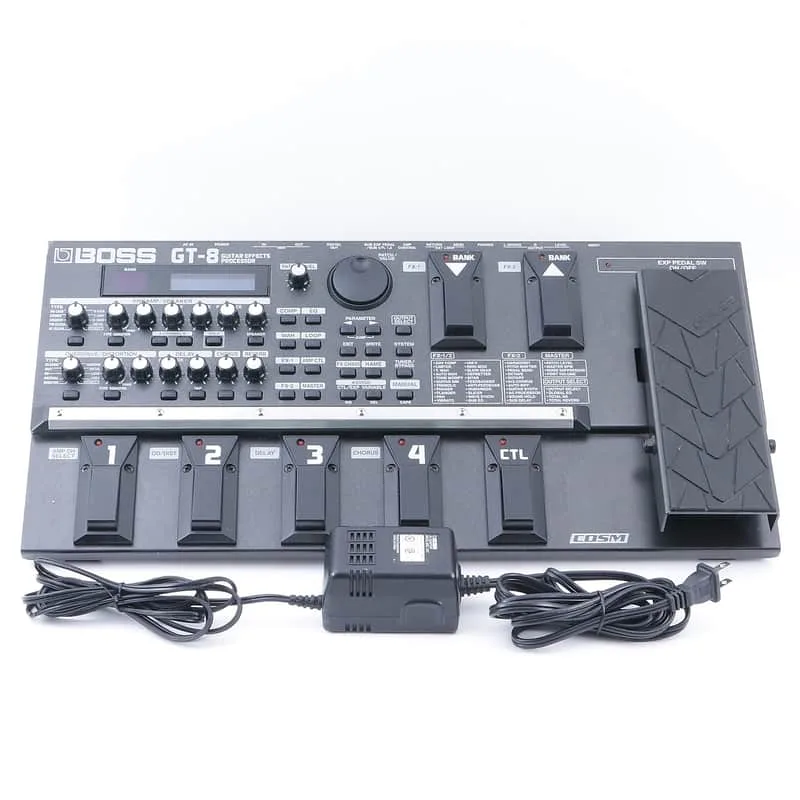
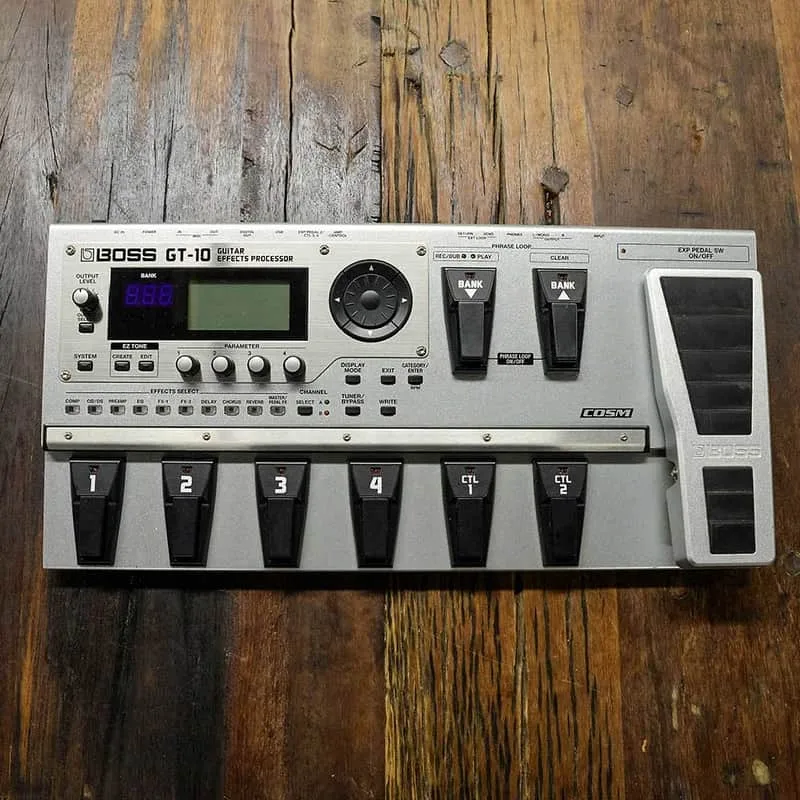
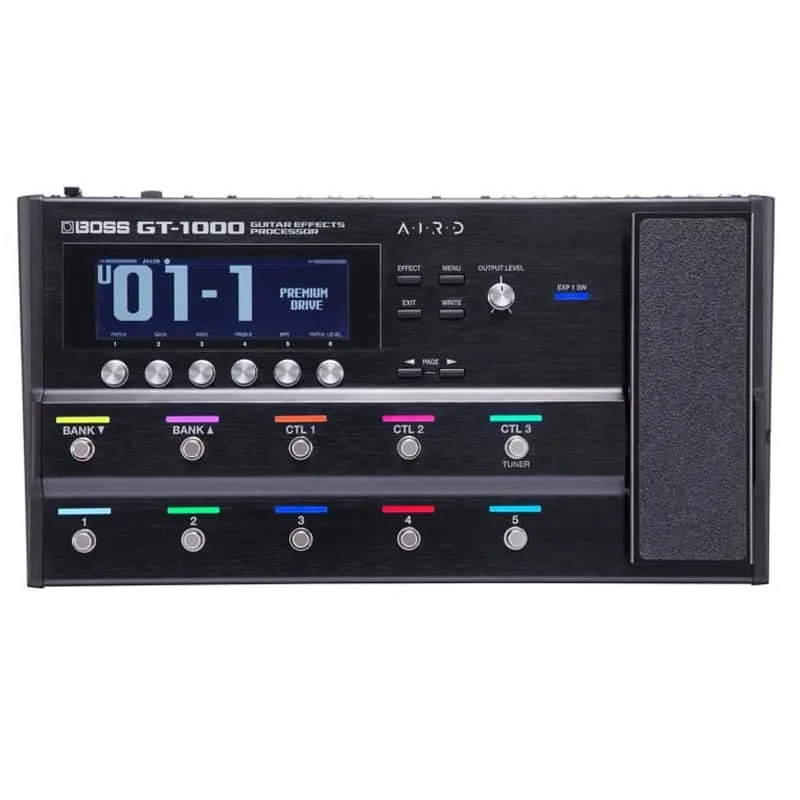
The series the GT-5 started runs through later floor units such as the Boss GT-8, Boss GT-10 and Boss GT-1000, and remains the backbone of Boss's multi-effects range2.
How it works
The GT-5 combines analog and digital stages. A combination of analog overdrive and digital preamp technology is used at the front end to provide a wide range of boost and drive tones, while the effects that follow are fully digital 1. An input gain trim on the rear panel allows the circuit gain to be matched to any type of guitar pick-up, which matters because a low-output single coil and a hot humbucker need very different amounts of drive.
The unit also adapts to how you amplify. You can tell the GT-5 whether you use a combo, a stack, or whether you want to DI using the in-built amp/speaker simulator, so the output voicing suits the rig downstream 1.
Patches and controls
The floor panel carries five numbered footswitches, a single Control switch, a Bank switch, and an expression pedal, with a real-time control switch alongside the pedal 1.
| Control | What it does |
|---|---|
| Five numbered footswitches | Select sounds directly within the current bank |
| Bank switch | Moves between the ten Groups of banks |
| Control switch | Real-time control switching during performance |
| Expression pedal | Onboard real-time control pedal |
Patch organization is two-level. Five banks of five sounds may be accessed directly from the switches, giving a choice of 25 patches, and there are ten Groups of banks, giving 250 patches in total 1.
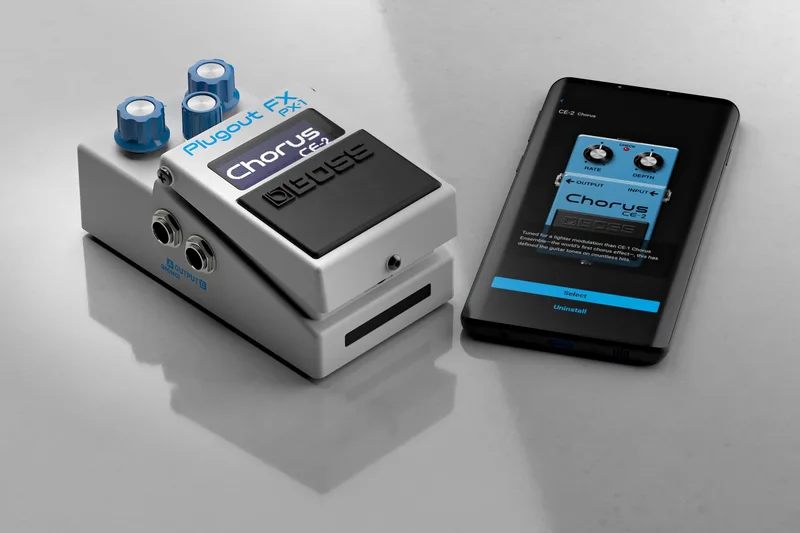
The effects menu offers 28 different types, including high quality stereo reverb, delay, the usual modulation effects and pitch shifting. In the delay section, delay times may also be tapped in by foot to set up tempo-related delays during performance 1. Of the chorus, Paul White wrote: "This is very reminiscent of the old Boss CE-2 blue chorus pedal, but with the benefit of true stereo operation."
Paul White, Sound On Stage, 1996 1
Inputs, outputs and MIDI
The rear panel carries the connections that make the GT-5 usable in a rig:
- Sound output in either mono or stereo, plus a phones output useful for practice 1
- Effects loop jacks, allowing an external processor to be integrated into the on-board patches 1
- Two rear panel sockets for the connection of further expression pedals 1
- MIDI out for program change and control change data, enabling external MIDI devices to be controlled 1
The MIDI output is worth noting for players with mixed rigs: patch changes on the GT-5 can switch sounds on connected MIDI gear at the same time, which was a practical way to run a rack processor alongside a floorboard in 1996 and still works with MIDI-switchable equipment today1.
Power and build
Power comes from a captive mains lead, not a separate PSU, so the GT-5 plugs straight into the wall and needs no adapter 1.
Because the GT-5 runs from mains via a captive lead, it cannot be powered from a battery or a pedalboard power supply. Plan your board around that.
The build is described as reassuringly solid, made from steel plate, and fitted with the same tough plastic switches used on previous Boss and Roland units 1.
What reviewers said
Paul White's 1996 review in Sound On Stage summed up the GT-5's operation in three words: "Surprisingly easy to operate." 1 For a unit with 28 effect types and 250 patches, that verdict speaks to how the front panel and footswitch layout were organized. The review's price at the time was £659 inc VAT in the UK 1.
Videos
Gearfacts
Duncan Flight
Gearfacts
Questions
How many patches does the Boss GT-5 hold?
Five banks of five sounds can be accessed directly from the footswitches, giving 25 patches at your feet. There are ten Groups of banks, for a total of 250 patches. The Bank switch moves between groups, and the five numbered footswitches select sounds within the bank you are in.
Does the Boss GT-5 need an external power supply?
No. The GT-5 runs from a captive mains lead rather than a separate power supply, so there is no wall wart to lose or replace. That also means it is not a pedal you can run from a battery or a pedalboard power brick.
Does the Boss GT-5 have stereo outputs?
Yes. The sound output can be taken in either mono or stereo, and there is also a phones output that Paul White found useful for practice. The stereo operation is a real benefit in effects such as the chorus, which he compared to the old Boss CE-2 but with true stereo.
Can the GT-5 control other MIDI devices?
Yes. As well as receiving MIDI itself, the GT-5 can output MIDI program change and control change data, which lets it control external MIDI devices such as switchable preamps or rack processors from its patch changes.
Can I add expression pedals to the GT-5?
Yes. Alongside the built-in expression pedal, two rear panel sockets are provided for connecting further expression pedals, giving you additional real-time control over effects parameters while you play.
Does the GT-5 have an effects loop?
Yes. Effects loop jacks allow an external processor to be integrated into the on-board patches, so you can place your own pedal or rack unit inside the GT-5's signal chain rather than before or after the whole unit.
Sources (2)
- Boss GT-5 Guitar Effects Processor (STG Dec 96), Sound On Stage (SOS Publications Ltd.), republished by mu:zines, 1996-12
- The Complete Guide to the BOSS GT Multi-Effects Series, articles.boss.info (BOSS), 2025-04-28