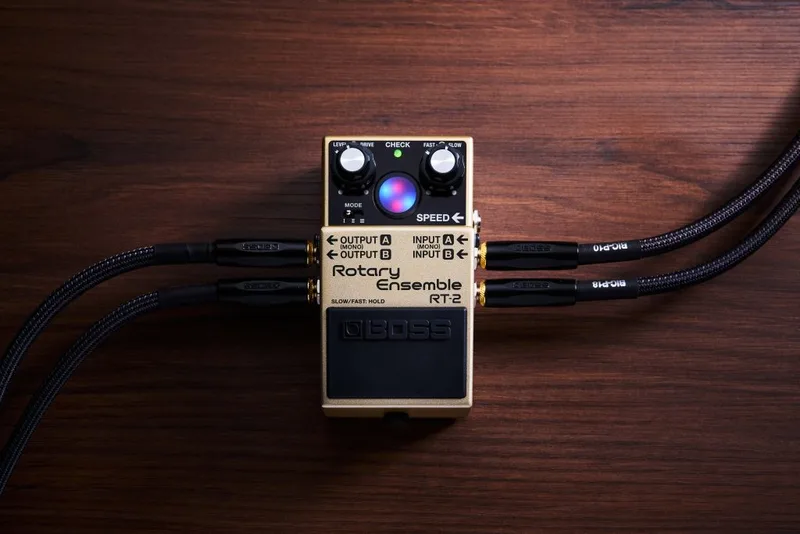


The Boss RT-2 Rotary Ensemble is a rotary speaker effect in a Boss compact pedal, released in 2025. It recreates the sound and behavior of a spinning speaker cabinet, the effect most players know from organ records and psychedelic guitar, without the weight, cost or maintenance of the real thing. Boss says it drew on "cutting-edge DSP and an intensive study of the revered Leslie 122 cabinet" to build its most faithful rotary emulation yet1.
A real Leslie cabinet uses a rotating treble horn and a rotating bass rotor to throw sound around a room, producing the characteristic doppler swirl. The RT-2 condenses that into a standard compact Boss enclosure, with a virtual rotor display of lights showing the treble and bass rotor speeds, stereo outputs, and a Drive knob that adds the tube-amp saturation a real Leslie's amplifier contributes2.
A Leslie 122 in a compact pedal
Boss describes the RT-2 as delivering "authentic rotary speaker sounds and behaviors condensed into a space-saving BOSS compact pedal"6. The starting point is Mode I, which Boss calls a faithful reproduction of the most famous vintage rotary speaker design, realized with its latest modeling technology, and intended for guitar, bass, organs, electric pianos, synthesizers and more2.
For players who have considered an actual Leslie, Pedal of the Day put the practical case plainly: the RT-2 is "about $2000 cheaper and weighs roughly 5% of a real Leslie cabinet, so transportation and maintenance are a cinch"7.
The pedal offers two stereo output modes: standard stereo (the default) or individual wet and dry outputs, which lets you keep a clean signal path alongside the effect2.
The controls: Mode, Drive, Rise/Fall and Balance
The RT-2 keeps the control set small, in keeping with the compact format. Three modes cover the tonal ground, and a handful of knobs and switches shape the response28.
| Control | What it does |
|---|---|
| Mode | Selects one of three sound modes (see below)2 |
| Drive knob | Adds vintage tube saturation, from mild to gritty, inspired by the tube amplification circuits in vintage rotary speakers2 |
| Drive/Balance switch | Assigns the Drive knob to control either the saturation amount or the volume balance between the treble and bass rotors2 |
| Rise/Fall Time switch | Adjusts the transition time between slow and fast rotor speeds2 |
| Pedal switch | Four selectable operation modes for bypassing the effect and controlling rotor speed while performing2 |
The three modes each take the rotary sound in a different direction2:
- Mode I: A faithful reproduction of the most famous vintage rotary speaker design. Guitar World's Jonathan Horsley called it "straight-up vintage, which gives us strong Leslie vibes"3.
- Mode II: The vintage sound with a wider tonal range, giving increased spatial performance when paired with overdrive and distortion pedals. Horsley noted it "opens up the tonal range"3.
- Mode III: Enhanced definition with intense modulation and drive settings, adding power and presence to arpeggio playing and solos2.
The Rise/Fall control matters because the transition between slow and fast rotor speeds is a big part of how a rotary speaker feels to play: a real Leslie's rotors take time to spin up and down, and shaping that ramp changes the character of the swell. Delicious Audio notes users can adjust rotor balance and speed transition times for customized response9.
Boss's own articles suggest pushing the Drive control "to conjure a more harmonically saturated sound redolent of psychedelic rock and amped-up acid jazz"1011, and remind readers the pedal "isn't made solely for guitarists; it combines beautifully with synths, strings, and even vocals"11.
External control
Beyond the onboard switches, the RT-2 supports advanced control with external footswitches or an expression pedal for speed, brake and other functions2. Guitar World's Alex Lynham found this is where the pedal earns its keep for vibe-style playing: "It's possible to attach an expression pedal to control the rate. Doing so results in something that can replace a Uni-Vibe on your board"5.
History: from the RT-20 to the RT-2
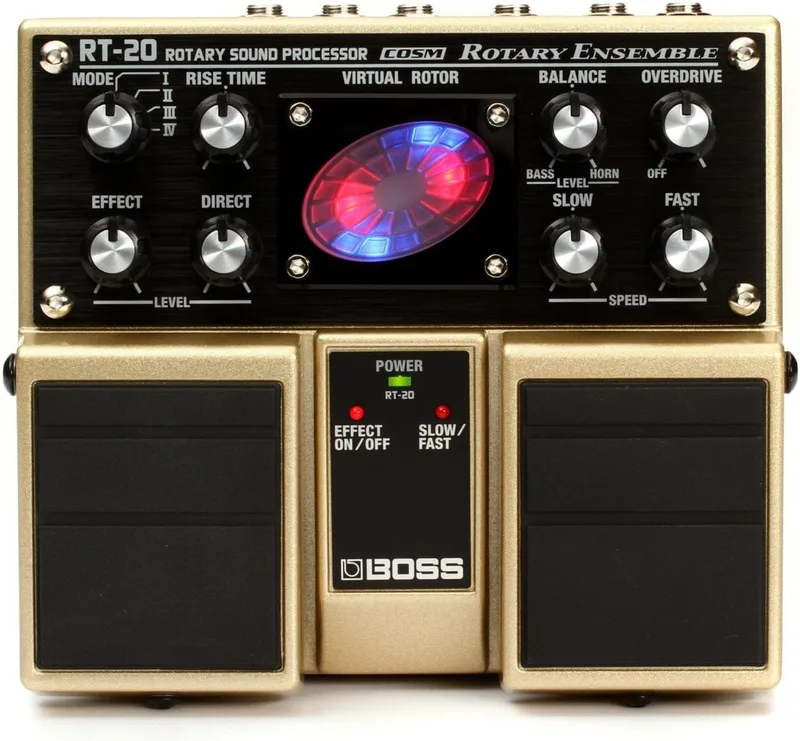
The RT-2 is a return to a concept Boss had already visited. The RT-20 Rotary Ensemble, launched in 2005 as part of the Twin Pedal Series, brought the swirling sound of a rotary speaker into pedalboard reach, and stayed in production until 20191. Guitar.com reported the original was discontinued in 2019 and that Boss "has revisited the concept now in classic compact" form8.
Much of the RT-2's tonal DNA traces directly back to the RT-201. The two differ in format and features: the RT-20 was a larger twin-pedal unit with four modes, three classic Leslie rotary speaker cabinet tones plus a sound based around the Uni-Vibe, and an input for the optional EV-5 expression pedal for manual speed changes12. It also ran on six AA-size alkaline batteries12. The RT-2 drops the dedicated Uni-Vibe mode, moves to the compact single-pedal format, and runs on a single 9V battery or adapter5.
The RT-2 draws 115mA4, which is high for a compact pedal. Players running it on a shared daisy-chain supply should check that the supply can deliver the current, and battery life will be shorter than on a typical compact analog pedal.
What reviewers said
Guitar World's Alex Lynham reviewed the RT-2 and summed up both its strengths and its limits5:
"It's a best-in-class rotary emulation and a serviceable Uni-Vibe style effect."
Alex Lynham, Guitar World5
His verdict list praised the "excellent sounding rotary effect" and noted that "it is not cheap but has everything you'd want from a compact rotating speaker emulator," while his criticism was that "more notable differences between the modes would be welcome"5. The review also records the pedal as made in Malaysia5.
At launch, Guitar World's Jonathan Horsley confirmed availability and the $239 price3, and MusicRadar reported the same US price with a UK price of £22913. Guitar.com's launch coverage gave the retail price as $239.998; the two figures differ only in the cents, and both date from July 2025.
Videos
BOSSchannel
Let's Play All
Brett Kingman
Questions
Can the Boss RT-2 sound like a Uni-Vibe?
Not exactly, but it can stand in for one. Guitar World's reviewer found it a serviceable Uni-Vibe style effect that can cover for a Uni-Vibe if you squint, and noted that attaching an expression pedal to control the rate results in something that can replace a Uni-Vibe on your board. Unlike the earlier RT-20, it has no dedicated Uni-Vibe mode.
Does the Boss RT-2 take a 9V battery?
Yes. It runs on a 9V battery or 9V DC center-negative power. Note the current draw of 115mA, which is high for a compact pedal, so an alkaline battery will not last long and a daisy chain shared with other pedals may struggle. The earlier RT-20 ran on six AA batteries instead.
Is the Boss RT-2 true bypass?
Yes. RockBoard's listing describes it as built with true bypass and stereo I/O, so it integrates into a pedalboard or stereo rig without coloring the bypassed signal. It carries the standard Boss five-year warranty.
Can you control the RT-2 rotor speed with an expression pedal?
Yes. Boss specifies support for external footswitches or an expression pedal for speed, brake and other functions. Guitar World's reviewer found that using an expression pedal to control the rate makes the pedal something that can replace a Uni-Vibe on your board.
Does the RT-2 work with keyboards and vocals?
Yes. Boss says Mode I is a faithful reproduction of the most famous vintage rotary speaker design for guitar, bass, organs, electric pianos, synthesizers and more, and its own articles note the pedal combines beautifully with synths, strings and even vocals.
Sources (13)
- Whirled Class: From Spinning Speaker Cabs to the RT-2 Rotary Ensemble, BOSS Articles (articles.boss.info), 2025-07-17
- BOSS - RT-2 | Rotary Ensemble, BOSS
- Boss RT-2 Rotary Ensemble: Leslie mojo in a compact pedal, Guitar World, 2025-07-18
- RT-2 Rotary Ensemble by BOSS, RockBoard (rockboard.de PedalPedia), 2026
- Boss RT-2 Rotary Ensemble pedal review, Guitar World, 2025-09-08
- BOSS - RT-2 | Rotary Ensemble, BOSS (boss.info)
- Boss RT-2 Rotary Ensemble, Pedal of the Day, 2025-09-28
- BOSS’s RT-2 Rotary Ensemble pedal offers classic rotary speaker sounds in a compact footprint, Guitar.com, 2025-07-17
- BOSS RT-2 Rotary Ensemble, Delicious Audio, 2025-12-19
- Pedal Partners: Combining the RT-2 Rotary Ensemble with Other Effects, BOSS (articles.boss.info), 2025-07-17
- Five Creative Ways to Use the RT-2 Rotary Ensemble, BOSS (articles.boss.info), 2025-07-17
- Boss RT-20 Rotary Ensemble review, MusicRadar, 2007-12-11
- “This powerhouse pedal authentically recreates the complex sonic magic of its inspiration”: Boss puts psychedelic Hendrix and Gilmour rotating speaker sounds on the menu with the RT-2 Rotary Ensemble, MusicRadar, 2025-07-17