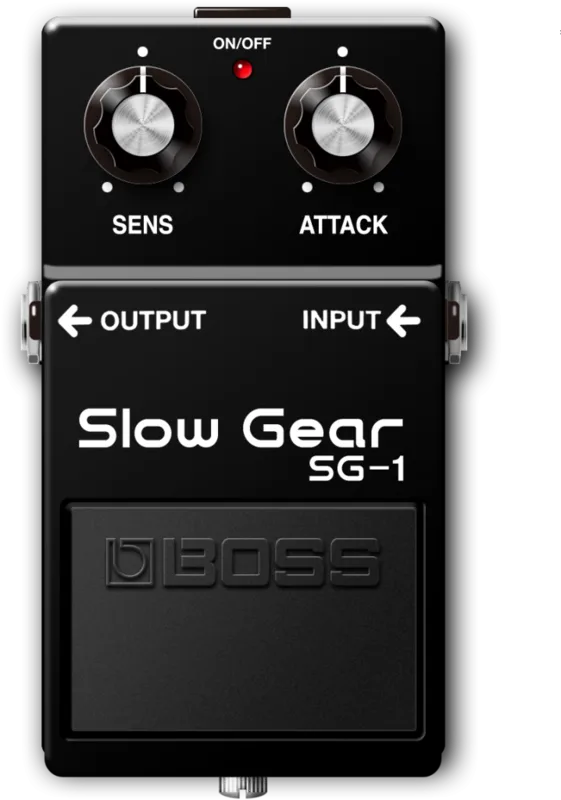


The Boss SG-1 Slow Gear is a volume swell pedal made by Boss in Japan between 1979 and 19821. Instead of shaping tone, it reshapes the attack of each note: the initial pick attack is filtered out and the volume then rises gradually, so notes bloom in like a bowed violin rather than starting with a strike. Boss describes it as a pedal that "reshapes the note attack to create violin-like swell tones"2. Griffin Effects puts it more bluntly: "The Boss SG-1 is a volume swell pedal. Basically it's a reverse noise gate"3.
Boss notes that the SG-1 is "particularly effective when crafting ambient sounds with delays and reverbs"2, which is how most players use it: into long delay and reverb, it turns single notes into slow, swelling pads.
Controls
The SG-1 keeps it simple with only two controls5:
| Control | What it does |
|---|---|
| Attack | Controls the speed of the volume swells4 |
| Sens | Sets sensitivity, how readily the pedal responds to your playing4 |
That two-knob layout is part of the pedal's character. Guitar Pedal X's Stefan Karlsson, reviewing a modern evolution of the circuit, pointed out that "The SG-1 and CE-2 had just 2 controls each"5, grouping it with the CE-2 Chorus as an example of Boss's stripped-down early design philosophy.
Power and connections
The SG-1 runs on DC 9V and draws about 4 mA4. Its rear panel carries three connections: an input jack, an output jack, and an AC adaptor jack4. No battery or bypass details are given here, so treat the power requirements above as the whole picture.
History and the NF-1 Noise Gate
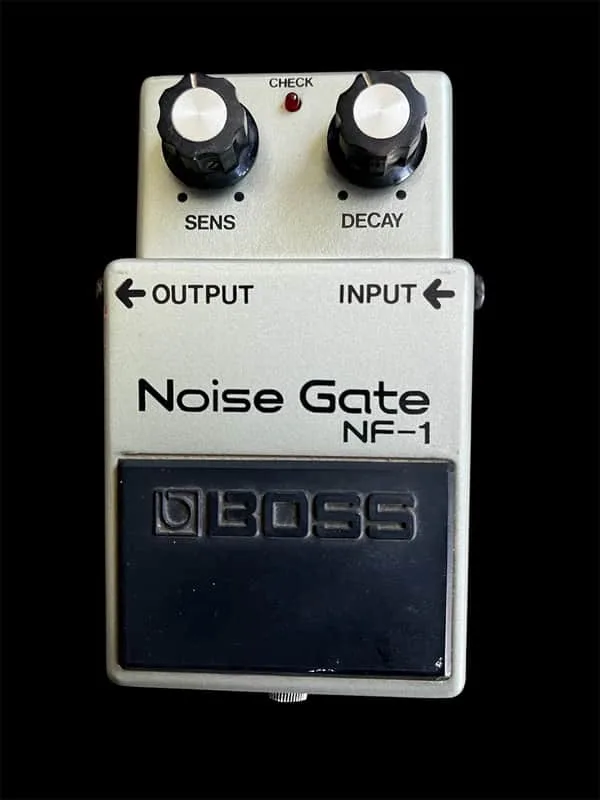
The SG-1's circuit is derived from another 1979 Boss pedal, the NF-1 Noise Gate. Rod Brakes, writing on Boss's own site, describes the SG-1 as a "unique circuit, derived from 1979's NF-1 Noise Gate"1. The NF-1 was made in Japan from 1979 to 198846 and, according to TONEHOME, Boss's classification scheme should have named it NG-1, but NG could be read as "No Good," so NF-1, for Noise Filter, was chosen instead46.
The two pedals work as mirror images of each other4:
- NF-1 Noise Gate: the sound decays away naturally but is cut off when it falls below a threshold4. Its single Decay knob sets how fast the signal fades out6.
- SG-1 Slow Gear: the attack is filtered out, then the sound increases gradually4.
Because the circuits are so closely related, Griffin Effects offers a modification service that converts an NF-1 into an SG-1 Slow Gear3, a practical route for players who find an NF-1 more easily than the rarer SG-1.
Who has used it
Aion FX notes that the SG-1 "has notably been used by Adam Granduciel (The War on Drugs) and Billy Corgan among others"7. Mattias Johansson, interviewed on Boss's site about touring with The Cure, Dinosaur Jr. and The Black Crowes, said of a possible reissue: "if BOSS ever released a version of the Slow Gear, I would be first in line to get one. That's top of the list for me"8.
"if BOSS ever released a version of the Slow Gear, I would be first in line to get one. That's top of the list for me."
The SG-1 today
The SG-1 has been out of production since 1982, but its circuit has not disappeared1:
Originals now command collector prices. Griffin Effects says "SG-1's go for $400 plus these days"3, and Guitar World's review of the PX-1 reports that "the 1979 Slow Gear SG-1 filter pedal can sell for well over $400 used at the time of writing"910.
Videos
Dennis Kayzer
Pepe Music
Cameron Johnson
Questions
Is the Boss SG-1 Slow Gear still made?
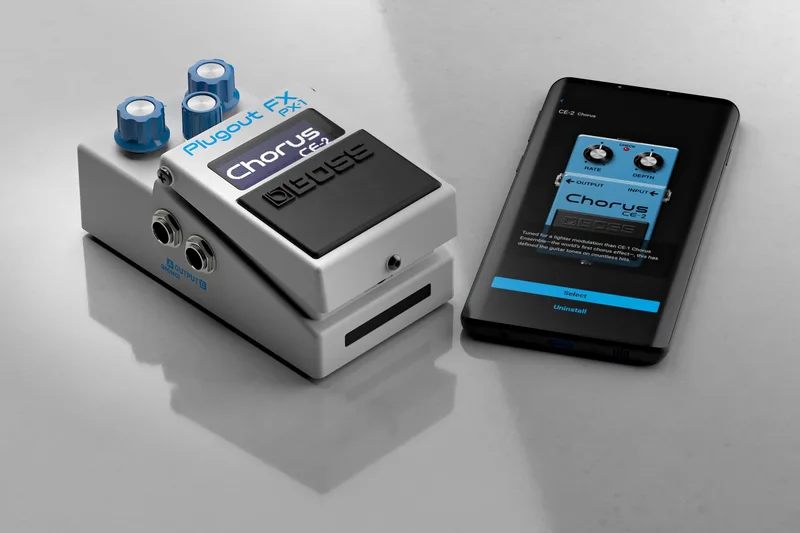
No. Boss made the SG-1 in Japan between 1979 and 1982 and it has long been discontinued. Boss has not reissued it, though the effect lives on inside the PX-1 Plugout pedal and in modern clones and mods.
How is the SG-1 different from the NF-1 Noise Gate?
Both share the same circuit family. With the NF-1 the sound decays away but is cut off when it falls below a threshold. With the SG-1 the attack is filtered out and the sound then increases gradually, producing a volume swell instead of a cut.
How many controls does the Boss SG-1 have?
Two. The Attack knob controls the speed of the volume swells, and the Sens knob sets the sensitivity, that is, how readily the pedal reacts to your picking. That simplicity is part of its appeal.
What power does the Boss SG-1 use?
It runs on DC 9V with a current draw of about 4 mA, and it connects through an AC adaptor jack alongside its input and output jacks. No battery figure is given.
Who has used the Boss SG-1 Slow Gear?
Aion FX notes that it has notably been used by Adam Granduciel of The War on Drugs and Billy Corgan, among others. Its swells pair well with delay and reverb for ambient playing.
How much does an SG-1 cost now?
Originals are collector items. Griffin Effects says SG-1s go for $400 plus these days, and Guitar World reports the 1979 pedal can sell for well over $400 used at the time of writing.
Sources (10)
- The PX-1 Plugout FX: Timeless BOSS Pedals Reborn, BOSS (articles.boss.info), 2025-06-06
- BOSS - PX-1 | Plugout FX, BOSS (www.boss.info)
- Boss NF-1 Slow Gear Modificaion Service, griffineffects.com
- TONEHOME, TONEHOME, 1979
- Guitar Pedal X, Guitar Pedal X, 2026-06-05
- TONEHOME, TONEHOME
- Onyx Volume Swell / BOSS® SG-1 Slow Gear, Aion FX, 2023-09-08
- Behind the Board: Mattias Johansson With The Cure, Dinosaur Jr., and The Black Crowes, BOSS (articles.boss.info), 2025-12-18
- Boss PX-1 Plugout FX pedal review, Guitar World, 2025-10-24
- BOSS - PX-1 | Plugout FX, BOSS (boss.info)