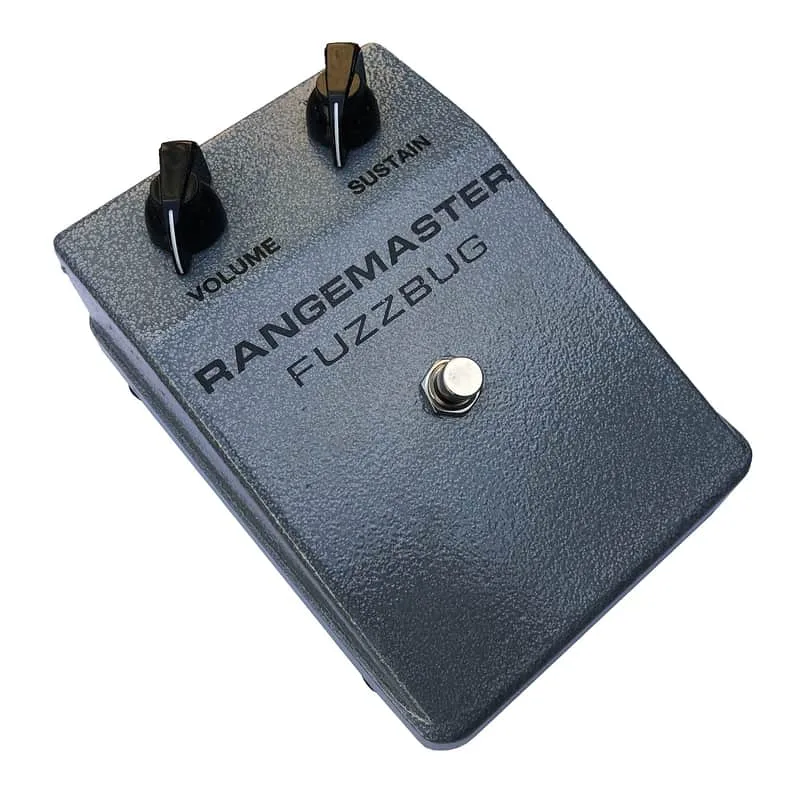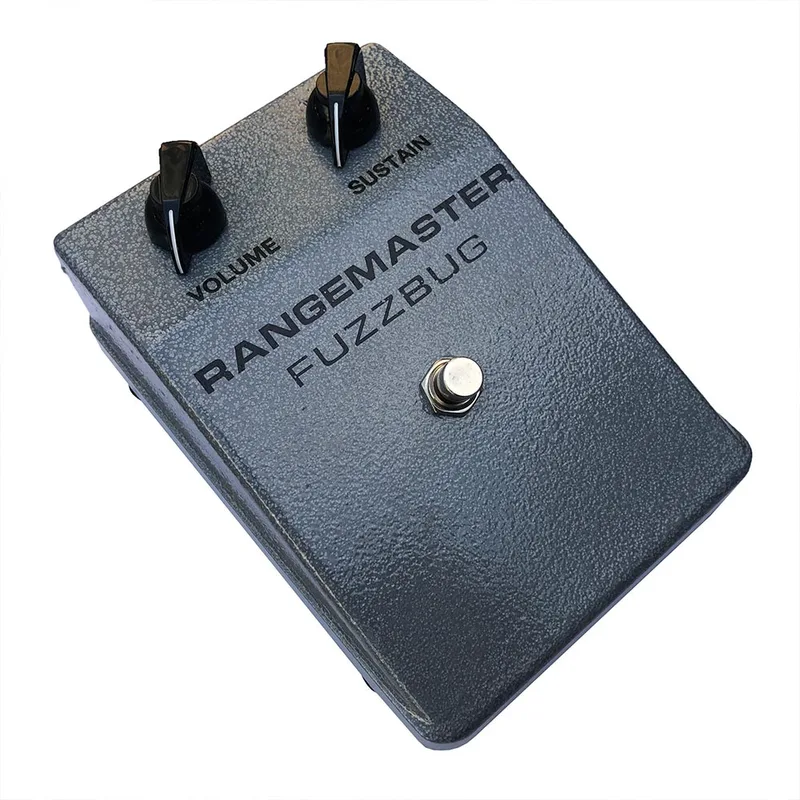
The British Pedal Company Rangemaster Fuzzbug MKII is a limited edition fuzz pedal that recreates one of the rarest British fuzzes of the 1960s. The original Rangemaster Fuzzbug was released in late 1966 by Sola Sound as a competitor to the already popular range of Tone Bender pedals, and only a small handful of those prototype pedals were ever produced12. The MKII reissue brings back the three-transistor version of that circuit, built with OC81D germanium transistors in a cast aluminum casing3.
It is a strictly limited run: 25 units worldwide, each signed and numbered from 1 to 25, and handbuilt in the UK3. The maker's listed price is £329.004.
What it is and what it does
The Rangemaster Fuzzbug MKII is the British Pedal Company's take on the three-transistor Fuzzbug circuit. The maker describes the pedal's character through its transistors: "OC81D: Smooth gain lots of saturation"3. In practice that means a vintage germanium fuzz voice, with two controls on the outside, Volume and Sustain, setting the output level and the amount of fuzz3.
The pedal runs on a 9V battery, which the maker lists as its power source3. There is no DC power supply specification on the product page, so players should expect to power it the way 1960s fuzzes were powered.
The Rangemaster Fuzzbug MKII is a limited edition of 25 units worldwide, each signed and numbered3. The related MKI.5 version is also offered by the maker1.
The original 1966 Fuzzbug
The Rangemaster Fuzzbug was released in late 1966 as a competitor to the already popular range of Tone Bender pedals1. Fuzzbugs were built by Sola Sound, and surviving examples were fitted with the various different electronic circuits the company was developing at the time2. Only a small handful of these original prototype pedals were produced5.
Surviving originals fall into two circuit variants, which the British Pedal Company identifies as the MKI.5 two-transistor circuit and the MKII three-transistor circuit5. The independent history site Fuzzboxes.org, which has examined surviving examples, breaks the story down further:
| Original Fuzzbug version | Circuit | Finish | Dating |
|---|---|---|---|
| Blue two-transistor | Two-transistor "MK1.5" Tone Bender circuit | Hammered blue | Not before May 1966, per potentiometer date codes2 |
| Blue three-transistor | Tone Bender Professional MKII circuit, a very early three-transistor Tone Bender MKII | Hammered blue | Mid-to-late 1966, possibly into 19672 |
| Gray three-transistor | Tone Bender MKII circuit, parts identical to SupaFuzz pedals of the period | Gray | Approximately late 1966 to early 19672 |
Fuzzboxes.org also notes a rumor of a version that was not formally branded as a "Rangemaster" pedal, though no such Fuzzbug has resurfaced2.
How the MKII reissue differs from the MKI.5
The British Pedal Company has reissued both circuit variants. The MKII covered here uses the three-transistor circuit with three OC81D transistors3. The Rangemaster Fuzzbug MKI.5 uses the two-transistor circuit and is built around an OC75 transistor instead1. Both are fuzz pedals in the same limited-edition series1.
The choice of transistor matters to players chasing particular vintage voices: the OC81D is the transistor family associated with the later three-transistor Tone Bender designs, while the OC75 belongs to the earlier two-transistor era31.
Where it came from
The British Pedal Company builds its range around reissues of rare 1960s British fuzzes, including the King of Fuzz Tone Bender and the Buzzaround Fuzz. The Rangemaster Fuzzbug MKII is described by the maker as a 1966 reissue, breathing new life into a fuzz so rare that only a small handful of originals exist35.
Questions
Does the Rangemaster Fuzzbug MKII use a battery?
Yes. The British Pedal Company lists a 9V battery as the power source for the Rangemaster Fuzzbug MKII. The maker's product page gives no DC power supply specification, so a 9V battery is the stated way to run the pedal.
How many Rangemaster Fuzzbug MKII pedals were made?
The Rangemaster Fuzzbug MKII is a limited edition of 25 units worldwide. Each pedal is signed and numbered from 1 to 25, and all of them are handbuilt in the UK by the British Pedal Company.
Where is the British Pedal Company Fuzzbug handbuilt?
The British Pedal Company states that the Rangemaster Fuzzbug MKII is handbuilt in the UK. The company reissues vintage British fuzz designs, and this pedal is its recreation of the original 1966 Rangemaster Fuzzbug.
What transistors are inside the Fuzzbug MKII?
The Fuzzbug MKII uses three OC81D germanium transistors, matching the three-transistor circuit of the original MKII Fuzzbug. The British Pedal Company describes the OC81D as delivering smooth gain with lots of saturation.
Sources (5)
- Rangemaster Fuzzbug MKI.5, britishpedalcompany.com
- Rangemaster Fuzzbug • Fuzzboxes, Fuzzboxes.org, 2021-05-20
- Rangemaster Fuzzbug MKII, British Pedal Company
- Search British Pedal Company, British Pedal Company
- Rangemaster Fuzzbug MKI.5, British Pedal Company