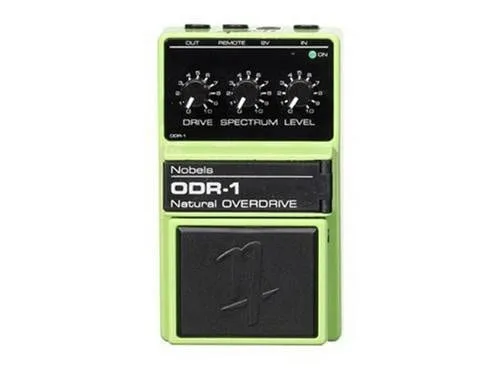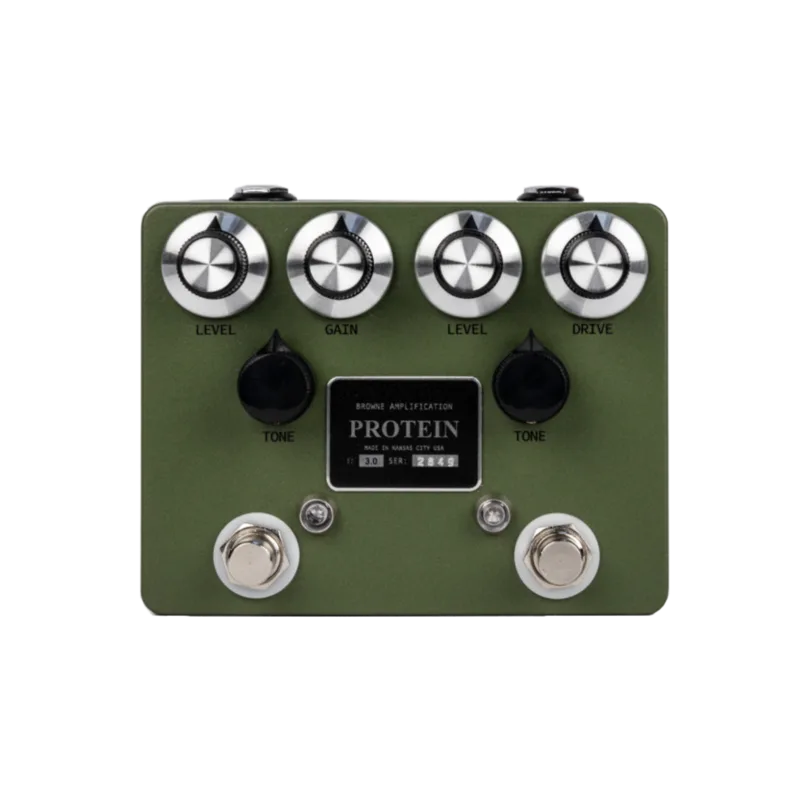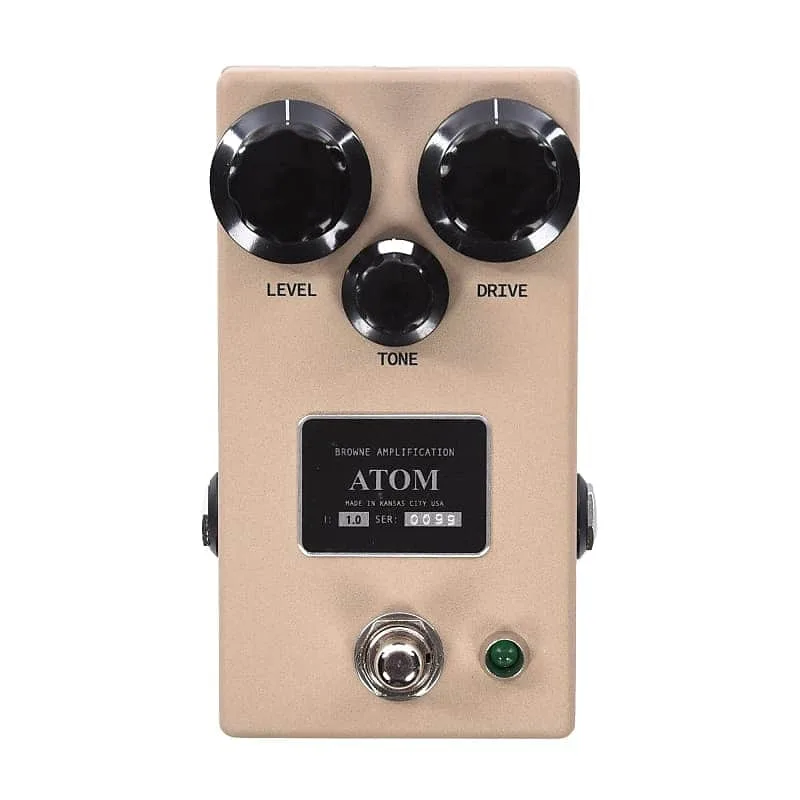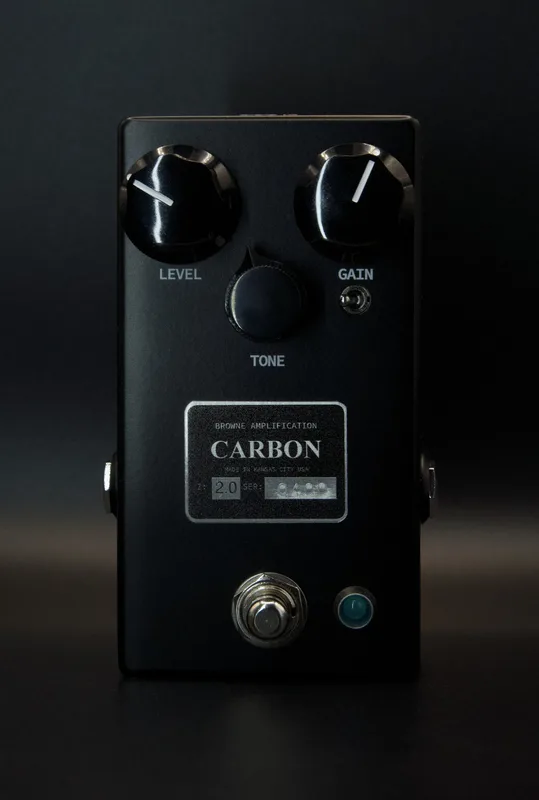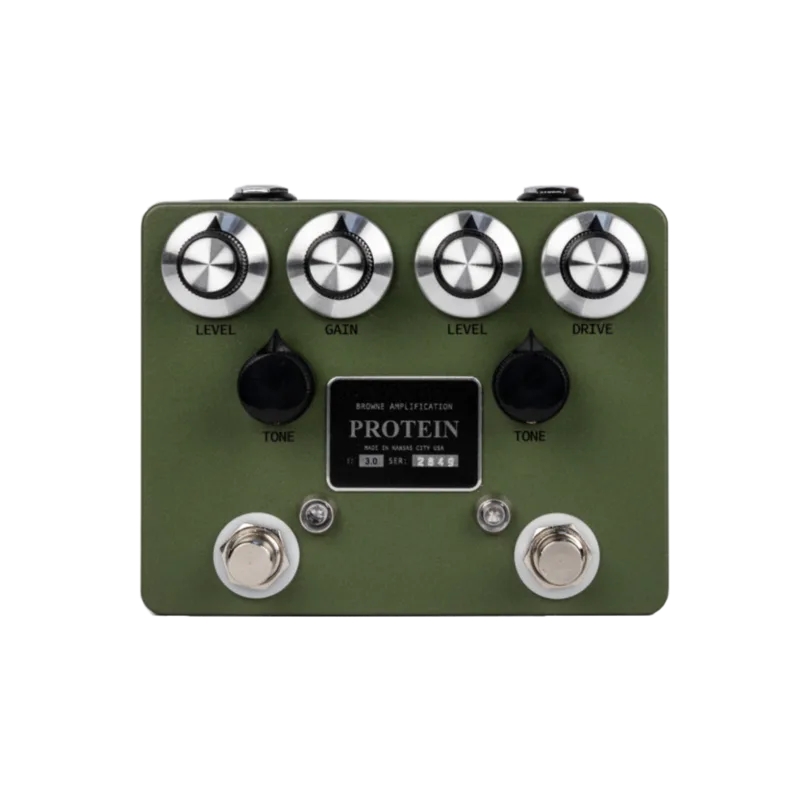


The Browne Amplification Protein is a dual overdrive pedal: two independent drive circuits in one enclosure, each with its own on/off footswitch, that can be used separately or stacked into what the maker calls a third channel12. The blue side, on the left, is a take on the 1990s Marshall Bluesbreaker circuit with modifications and an added output section3. The green side, on the right, is a higher gain overdrive inspired by the classic "Nashville" sound, which in practice means the Nobels ODR-12.
The pedal was designed to sound great with any backline, after years on the road and in the studio using backline amps that could be very inconsistent2. Browne Amplification has been very busy hand-building pedals since the introduction of their Protein Dual Overdrive2.
Two overdrives in one: Bluesbreaker and Nashville-style
The blue side is what most players come to the Protein for. Browne describes it as "a Bluesbreaker circuit with modifications and an added output section"8. Guitar World's reviewer put it as "based on a 1990's Marshall Bluesbreaker but has a tweaked tone control and extra output"3, and Guitar.com called it "an almost HD take on the old 1990s Marshall Bluesbreaker"4. The original Bluesbreaker circuit was used famously by John Mayer on the Continuum album, a lineage Pedal of the Day notes in its review of the blue side1.
The green side is the utility overdrive. Browne describes it as "the Nashville inspired ATOM, a higher gain overdrive with beautiful singing mids," the same circuit later released as the standalone Atom pedal9. Delicious Audio explains the voicing work: "We lowered the amount of gain (distortion) to make it usable through the entire sweep of the pedal, added some of the mids back," eliminating woofiness in the low end and adding low mid "beef" without becoming muddy2. The blue side's low gain and high headroom also became a standalone pedal, The Carbon9.
Each side has its own footswitch, so the two circuits work together and separately210. When both are on, the green side runs into the blue side, and that is the only possible stacking order82.
The controls and stacking order
Both sides carry three knobs and a bypass footswitch: Level, Gain and Tone on the blue side, Level, Drive and Tone on the green side73.
| Control | Side | What it does |
|---|---|---|
| Level | Blue | Output volume, left is less, right is more; this side has a lot of output11 |
| Gain | Blue | Amount of drive, like a tube amp cranked at high volumes; turning it up also adds brightness11 |
| Tone | Blue | Brightness, right is brighter, left is darker; active and highly interactive with the pedal11 |
| Level | Green | Output volume3 |
| Drive | Green | Amount of drive3 |
| Tone | Green | Tone shaping3 |
The V4 adds internal switches on the green side8:
- Asymmetrical clipping switch: up is stock symmetrical soft clipping, down is asymmetrical soft clipping, which Browne says lets the green side open up with more punch and less compression11.
- MORE CLIP switch: access to a set of hard clipping diodes that add bite, aggression and gain while lowering output volume; up is more clip, down is stock11.
- LOW CUT switch: rolls off some low end if the green side has slightly too much bass; up is stock, down is low cut enabled11.
The V4 also introduces a three-way Hi-Cut switch on the blue side for more tonal options12. Browne recommends starting with all blue side controls at noon, and the green side Level at 1 o'clock, Tone at noon, Gain at 11 o'clock11. The maker recommends the Protein last in a chain of drives11.
Power and connections
The V4 runs on 9V DC at 130mA through a standard adapter, which is not supplied, with 1/4 inch input and output jacks on the top of the pedal133. Browne recommends a high-quality isolated power supply and warns against 18V11. There is no battery option: Guitar.com's review notes "the Protein is mains only"4. Earlier reviews list 9V DC center negative4.
The Protein cannot run on a battery, and the manual's recommendation of isolated power means a daisy chain is not the intended supply. Budget a 9V output delivering at least 130mA on a pedalboard power supply.
For loop switcher users, the TRS sockets allow independent connection of each side. With the internal switch flipped to the split position, the input jack's tip acts as input/send and ring as output/return for the green side, and the output jack does the same for the blue side27. On the V3, a single internal switch handles split mode; reaching it means removing the four screws from the back panel29.
History and versions
The Protein has gone through V2.2, V3 and V414. The V3 update brought top-mounted jacks, soft switching and a single internal switch for split mode2. The V4 added the three-way Hi-Cut switch on the blue side and the extra clipping options on the green side128. Browne sells a V3 to V4 upgrade, which adds asymmetrical clipping and a little more gain; it is available only for the V3, not the V2.2 or earlier models14. The V3 is listed as sold out at the maker's store9.
The pedal began as a practical request. David Brown told guitar.com: "We kind of went down the rabbit hole of 'How do we make both these pedals perfect for what you're doing, and then put them together,'" combining two pedals a client was using live into one enclosure15. After player requests, Brown said the blue side would be released as a standalone pedal, which became The Carbon15.
What reviewers said
Reviews have been consistently positive across the pedal's life. Guitar.com's 2021 review concluded: "Two classy voices in one superbly made unit. Impressive stuff."4 MusicRadar's review called it "a great all-round drive with something a little different to offer, with a fantastic utility overdrive on the green side and a cleverly refined take on the Bluesbreaker on the other," adding that it works well with whatever combination of guitar and amplifier you use7.
Pedal of the Day found each side sounds great alone and better as a team, calling it "a must-have for any overdrive fan," and noting the stacked mode delivers more gain and fullness "without sacrificing note clarity or getting that 'mushiness' that can happen while stacking some overdrives"1. Guitar World's 2025 roundup of the best new pedals of the 2020s wrote that "the Protein retains a full-bodied low-end while keeping note articulation intact, and never becomes overly compressed"12.
Who uses it
Browne says the green side "has been used on the pedals boards of session greats from Tim Pierce to Jerry McPherson"9. Drew Shirley of Switchfoot tried one and wanted it on his board, according to David Brown15.
Videos
Browne Amplification
Browne Amplification
Ben Neal
Questions
Can you use the Protein's two sides in separate loops?
Yes. With the internal switch set to the split position, the TRS sockets let you route each side into its own loop on a switcher. On the input jack, the tip acts as the input or send and the ring as the output or return for the green side; on the output jack, the same arrangement carries the blue side. You need TRS cables and access to the inside of the pedal.
Can the Protein run on a battery?
No. The Protein is mains only, running on a 9V DC adapter that is not supplied with the pedal. Browne recommends a high-quality isolated power supply, and the manual warns against running it at 18V, so plan on a proper pedalboard power source rather than a battery or a daisy chain.
Is the Browne Protein true bypass?
Yes. Reviews from Guitar.com and MusicRadar both list true bypass switching among the pedal's features. Each side also has its own on/off footswitch, so you can run either overdrive on its own or both stacked together.
Which side of the Protein is the Bluesbreaker?
The blue side, on the left. It is based on the 1990s Marshall Bluesbreaker circuit, with modifications that include an added output section, a tweaked tone control, and increased output levels. The green side on the right is the Nashville-style circuit, voiced after the Nobels ODR-1.
Sources (15)
- Browne Amplification Protein Dual Overdrive, Pedal of the Day, 2022-01-12
- Browne Amplification Protein V3 Dual Overdrive, Delicious Audio, 2025-07-15
- Browne Amplification Protein Dual Overdrive review, Guitar World, 2021-11-11
- Review: Browne Amplification Protein Dual Overdrive, Guitar.com, 2021-03-10
- The Carbon, Browne Amplification
- T-Rex TwinBlaze review, Guitar.com, 2026-08-28
- Browne Amplification Protein Dual Overdrive and T4 Fuzz review, MusicRadar, 2021-11-23
- The Protein Dual Overdrive Pedal, Browne Amplification
- Protein Dual Overdrive V3, Browne Amplification
- Browne Amplification The Fixer and The Carbon review, Guitar World, 2023-04-26
- Protein_V4_Manual, Browne Amplification, 2025-05
- Guitar World's 30 favorite guitar pedals from the past 5 years, Guitar World, 2025-06-02
- Protein Dual Overdrive V4, Browne Amplification
- V3 to V4 Protein Upgrade, Browne Amplification
- Browne Amplification’s David Brown on how he came up with the pedal that’s appearing on pro boards all over the world, guitar.com, 2021-05-19
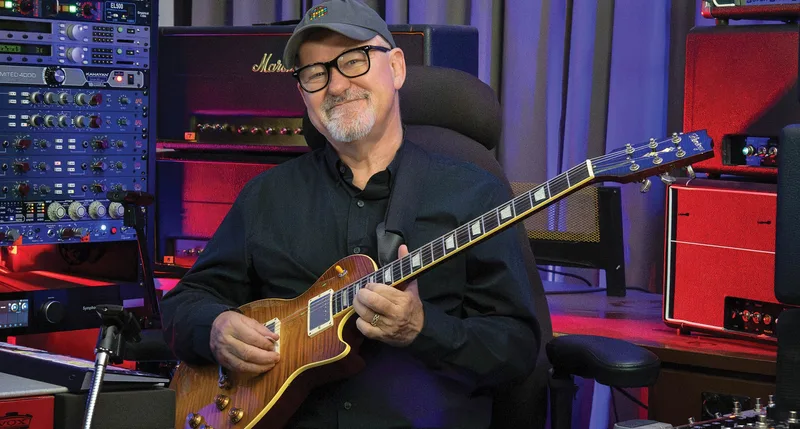 Tim Pierce
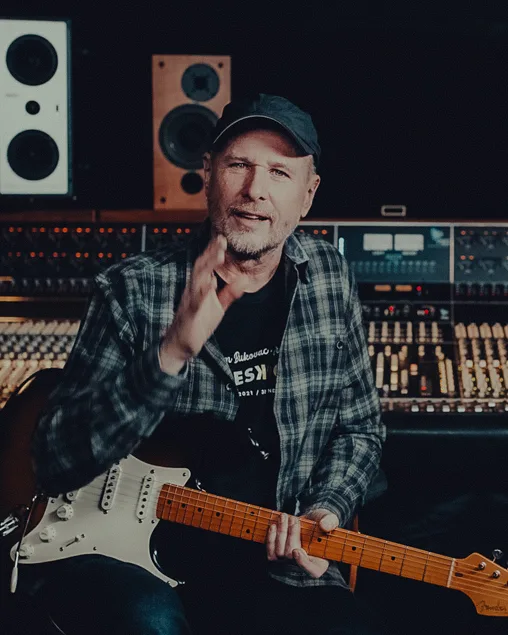 Jerry McPherson