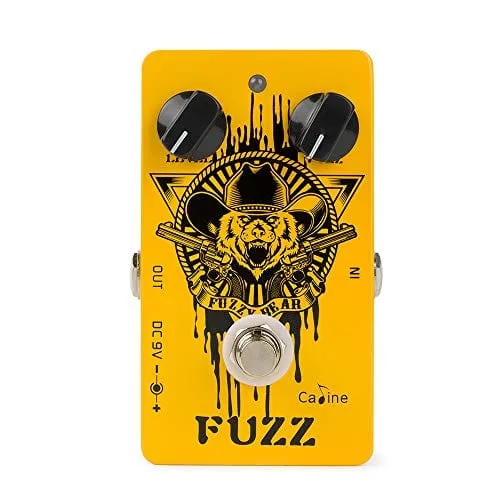



The Caline Fuzz Bear, sold as the Caline G-014 Nasty Bear Fuzz, is a compact fuzz pedal from Caline, part of a small-format lineup the company launched alongside the G-001 Tiger Eye Distortion1. It is a three-knob fuzz aimed at players who want a thick, saturated fuzz sound without a large or expensive box on the board.
Pedal of the Day described its character plainly: the G-014 is "a thick, saturated and chewy, just like a good fuzz should sound and inspired by a classic heard on dozens of iconic album releases"1.
What it does
A fuzz pedal pushes your guitar signal into hard clipping, producing a dense, sustaining tone that sits at the aggressive end of the gain spectrum, beyond overdrive and distortion. The Nasty Bear delivers that effect in a small pedalboard-friendly enclosure, with the classic fuzz recipe of level, tone and fuzz-intensity controls1.
According to Pedal of the Day's review, the sound is thick and saturated, with the fuzz character inspired by a classic fuzz sound heard across many well-known albums1. For bass players, a fuzz of this type can push a bass signal into a growling, compressed sustain; the pedal's Tone control lets you keep some brightness in the signal so the fuzz does not turn to mud1.
Controls
The G-014 keeps its control set simple, with three knobs:
| Control | What it does |
|---|---|
| Tone | Controls the overall brightness of your signal1 |
| Sustain | Adjusts the degree of fuzz sound1 |
The Sustain knob is the fuzz-intensity control: lower settings give a lighter fuzz, while turning it up increases the saturation and thickness of the effect1. Tone then shapes where the fuzz sits, brightening or darkening the overall signal1.
Power, size and build
The Nasty Bear runs on a 9V DC center negative supply, the standard plug arrangement used by most modern pedals, and draws 50 mA1. That current draw is modest, so it can share a daisy chain or a single isolated output with other compact pedals without straining a typical power supply.
The 9V DC center negative requirement means the pedal needs a power supply with the standard 2.1mm barrel plug, center negative. Check your power supply's polarity markings before plugging in.
The enclosure is aluminum alloy rather than plastic, the same construction Caline uses across this small-pedal lineup, and the pedal measures 11 by 6.6 by 2.3 cm with a package weight of 340g1. That footprint fits easily alongside other mini pedals on a crowded board.
The pedal uses true bypass switching, so when it is off your signal passes through without the fuzz circuit loading it1.
How it compares
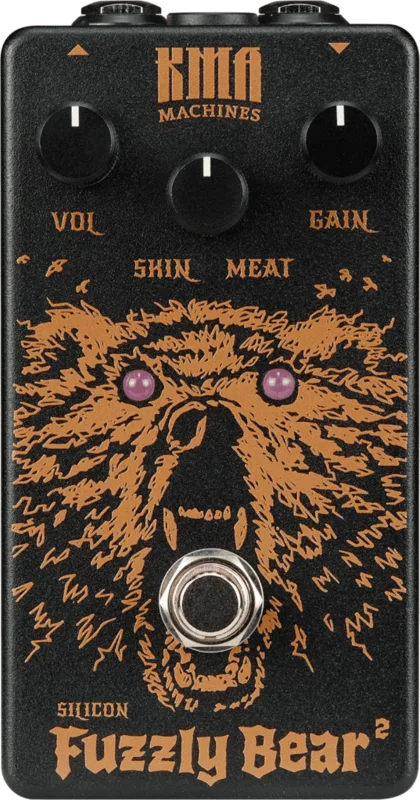
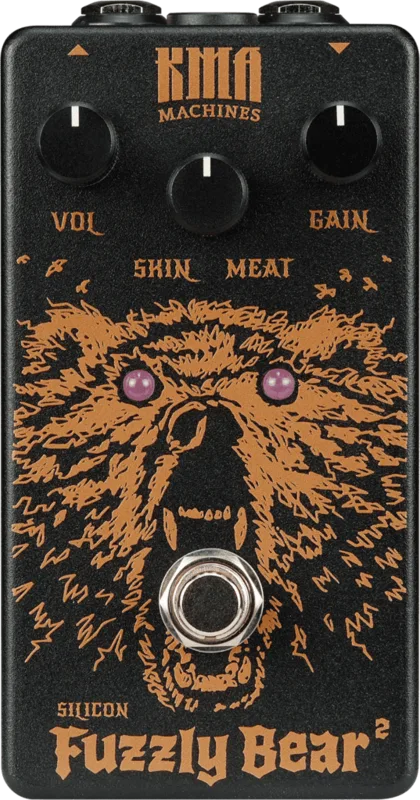
Within the fuzz world, the Nasty Bear sits at the simple, compact end of the spectrum. Other bear-named fuzzes show how much further the format can go. KMA Machines' Fuzzly Bear Silicium Fuzz, for example, adds a Skin/Meat knob that controls the bias of the fuzz circuit, moving from a sharper, finer fuzz to a big, thick tone, and its Gain control ranges from deep low-end drive to classic-rock fuzz tones2. Its successor, the Fuzzly Bear 2, keeps that bias control and adds true bypass with silent relay-based soft switching in a top-jack enclosure3.
By comparison, the Caline G-014 offers the basic three-knob fuzz recipe in a smaller and simpler package: no bias control, no relay switching, but the same true bypass and standard power arrangement1. For a player who wants a straightforward fuzz to stack with other bass pedals, that simplicity is the point; for a player who wants to shape the fuzz's internal character more deeply, a pedal like the Fuzzly Bear line offers more to turn.
Videos
intheblues
Chris Mann
Guitarworks1000
Questions
Is the Caline Nasty Bear Fuzz true bypass?
Yes. The G-014 Nasty Bear Fuzz uses true bypass circuitry, so with the pedal switched off your signal passes through without the circuit coloring it. That makes it safe to leave on a pedalboard between songs or when you are running other effects after it.
What power supply does the Caline G-014 need?
It runs on 9V DC with a center negative plug, the standard arrangement for most modern pedal power supplies, and draws 50 mA. That is low enough to share an isolated output or a daisy chain with plenty of other compact pedals on a typical board.
What does the Sustain knob do on the Nasty Bear?
Sustain sets the degree of fuzz. Turned down it gives a lighter fuzz character; turned up it increases the intensity and saturation of the fuzz effect, letting you dial from a touch of grit to a thick, chewy fuzz sound.
How big is the Caline G-014 Nasty Bear?
The pedal measures 11 by 6.6 by 2.3 cm, which puts it in the compact mini-pedal size class. Its package weight, including the box, is 340g, so the pedal itself is a light addition to a pedalboard.
Is the Caline G-014 case metal?
Yes. The Nasty Bear Fuzz comes in an aluminum alloy casing rather than plastic, which is the same construction Caline uses across this small-pedal lineup and helps it hold up to being stomped on a board.
Sources (3)
- Caline G-001 Tiger Eye Distortion / G-014 Nasty Bear Fuzz, Pedal of the Day, 2023-01-04
- KMA Machines Fuzzly Bear Silicium Fuzz, Pedal of the Day, 2015-06-14
- FUZZLY BEAR 2, KMA Machines