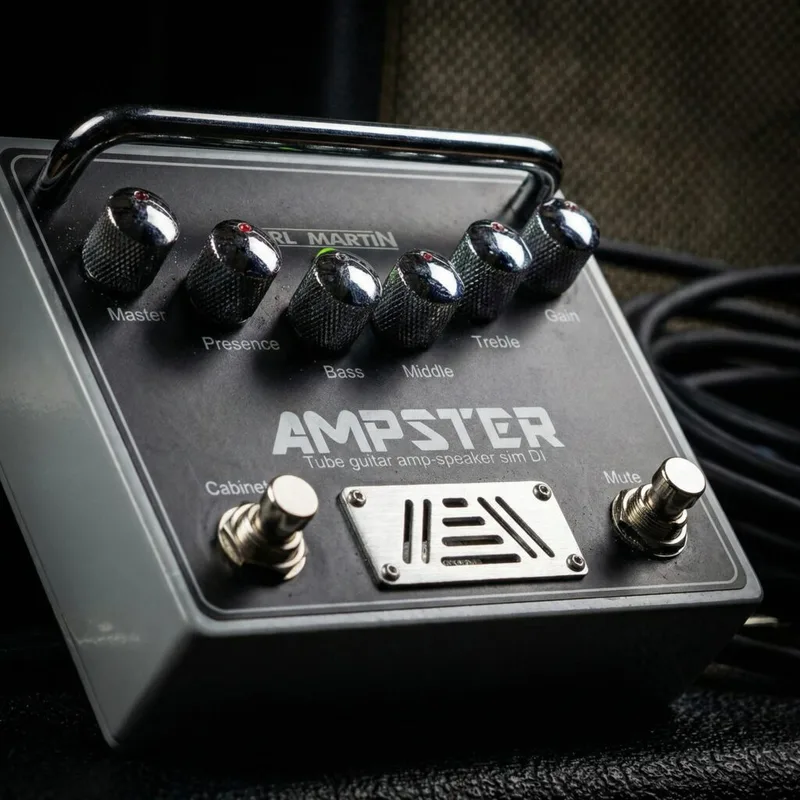


The Carl Martin Ampster is a single-tube analog amp and speaker simulator in a pedal, with a fully analog signal path that provides touch-sensitive dynamics and immediate response reacting naturally to playing style1. Carl Martin describes the result as a full, rounded clean sound with natural depth that moves smoothly into a distinctly British-voiced overdrive shaped by the guitar and pickup1. It carries a recommended retail price of USD 299, EUR 299, GBP 2392, and GuitarPlayer's Rod Brakes noted it is "far more than just a regular 'Marshall-in-a-box' pedal"3.
For a player, the idea is simple: the Ampster replaces the preamp section of an amplifier on your pedalboard, adds a speaker simulation so the output sounds like a guitar cab rather than a raw line signal, and gives you a balanced XLR output so you can plug straight into a PA, a powered cab, or a recording interface. It sits in the same family of gear as other preamp pedals and speaker simulation pedals, but with a real tube in the signal path and no digital processing at all451.
What it does to your sound
Carl Martin says the Ampster produces "a full, rounded clean sound with natural depth" that moves smoothly, as the Gain control is increased, into a distinctly British-voiced overdrive shaped by the guitar and pickup1. The maker also describes touch-sensitive dynamics and immediate response from the fully analog single-tube signal path, reacting naturally to playing style1.
MusicRadar described it as a single-channel pedal with "a set of familiar amp channel controls," which is the practical point: if you have ever dialed in a tube amp, the control set reads the same way4. GuitarPlayer framed it as more than a "Marshall-in-a-box," positioning it as a full amp-and-speaker solution rather than a simple overdrive pedal3.
Controls
The control set follows the layout of a single-channel amplifier head14.
| Control | What it does |
|---|---|
| Gain | Sets the amount of overdrive, moving from clean into British-voiced drive1 |
| Treble | Adjusts high-frequency content1 |
| Presence | Fine-tunes upper-frequency response1 |
| Master | Sets overall output level1 |
| Voicing Switch | Adjusts low-frequency contour1 |
| Cabinet Switch | Selects 2x12 or 4x12 speaker simulation14 |
| Ground Lift | Eliminates ground loop noise1 |
There are two footswitches. MusicRadar reported that these offer LED color-coded speaker emulation switching, red for the 2x12 and green for the 4x12, plus output muting4.
Cabinet simulations
The Ampster carries two switchable cabinet simulations: a 2x12 open-back and a 4x12 closed-back, with an LED indicating which is active14. You change between them either with the onboard footswitch or remotely (see below). Because the simulation is analog and built in, the XLR output can go straight to a desk without a separate cab sim or IR loader in the chain.
Connections and the effects loop
The rear panel carries the connections that make the Ampster work like a small amp head rather than a simple stompbox2.
- Input: guitar in, as on any pedal2
- Send / Return: an effects loop for post-preamp effects, so delay and reverb can sit after the drive stage1
- Balanced DI: XLR output to a mixer or interface1
- Link: passes the signal from the input out to another amp or device24
- Remote: an input for external foot-switching of the cabinet type14
The effects loop is the feature MusicRadar singled out, describing it as "effects send and return allowing you to route external pedals in the same way as an amp"4. In practice that means your delay and reverb pedals avoid being pushed into distortion by the preamp stage, the same reason amp heads have loops.
The balanced XLR direct output is what lets the Ampster connect straight to a PA or powered cab4, and the link output sends your guitar's dry signal to another amp or device if you want to run a real amp alongside the direct rig4. Carl Martin's own support material adds that when paired with a speaker simulator, IR loader, or recording interface with cab simulation, the Ampster also works well as a direct recording preamp5.
Remote cabinet switching
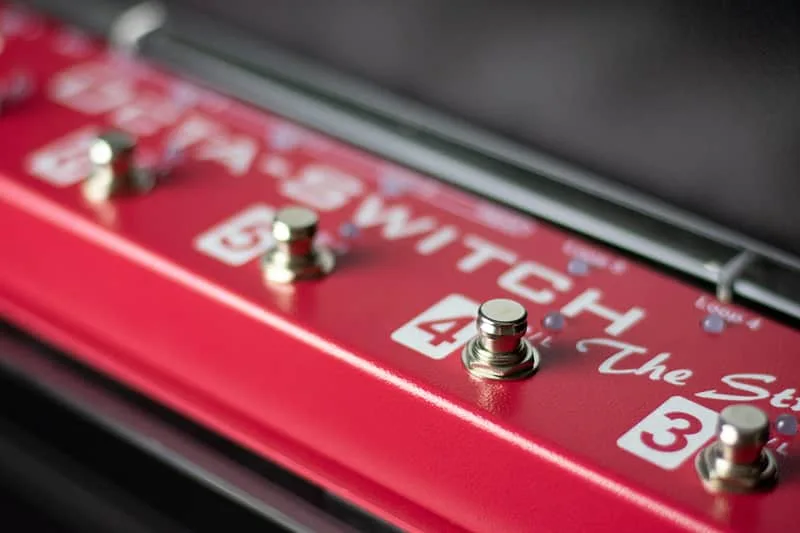
The remote input allows external foot-switching of the cabinet type4. Carl Martin lists it as compatible with external controllers like the Octa-Switch The Strip1, so a player with a larger switching system can change between the 2x12 and 4x12 simulations from a central controller rather than tapping the pedal itself.
Power
Power comes from a regulated 9V DC input, center negative, capable of delivering the current needed for the tube and analog circuitry1. Because the tube draws more current than a typical analog pedal, the maker specifies a regulated supply rather than a basic battery-style source.
Where it came from
The Ampster carries a recommended retail price of USD 299, EUR 299, GBP 2392, and Carl Martin's own product page lists it at 299,00 EUR1. Gearnews covered the release, noting the tube amplifier with built-in DI box and speaker emulation2, and MusicRadar also covered it2.
Players
Carl Martin's artist pages list Pete Thorn and Johnny Marr among the Ampster's users6.
Videos
Pete Thorn
Darrell Braun Guitar
Simon Gotthelf Music
Questions
Is the Carl Martin Ampster analog or digital?
It is fully analog. Carl Martin describes a single-tube analog signal path with no digital modeling involved and no latency, using discrete analog circuitry designed to behave like an amplifier's preamp section. The maker says this gives it touch-sensitive dynamics and immediate response that react naturally to your playing style.
Does the Ampster have an effects loop?
Yes. It has an effects send and return on the rear panel, letting you route external pedals after the preamp stage in the same way you would with a real amplifier. That means time-based effects like delay and reverb can sit after the Ampster's overdrive rather than feeding into it.
Can the Ampster connect directly to a PA?
Yes. It has a balanced XLR direct output for connecting straight to a PA or a powered cab, with a ground lift switch to eliminate ground loop noise. There is also a link output that passes your guitar's dry signal to another amp or device.
What cabinet simulations does the Ampster have?
A cabinet switch selects between a 2x12 open-back and a 4x12 closed-back speaker simulation, with an LED showing which is active. MusicRadar reported the footswitches are color-coded for this: red for the 2x12 and green for the 4x12.
Can you switch the Ampster's cabinet remotely?
Yes. The Ampster has a remote input for external foot-switching of the cabinet type, and Carl Martin says it is compatible with external controllers such as the Octa-Switch The Strip, so you can change cabinets from elsewhere on your board.
Sources (6)
- Ampster - Carl Martin, Carl Martin, 2026
- Carl Martin Ampster, gearnews.com, 2022-02-17
- Carl Martin's Long-Awaited Tube Amp/Speaker Sim Pedal, GuitarPlayer, 2022-02-16
- Carl Martin unveils the Ampster: a 100% analogue valve pedalboard preamp/DI, MusicRadar, 2022-02-17
- Support - Carl Martin, Carl Martin (carlmartin.com), 2026
- Artists - Carl Martin, Carl Martin (carlmartin.com), 2026