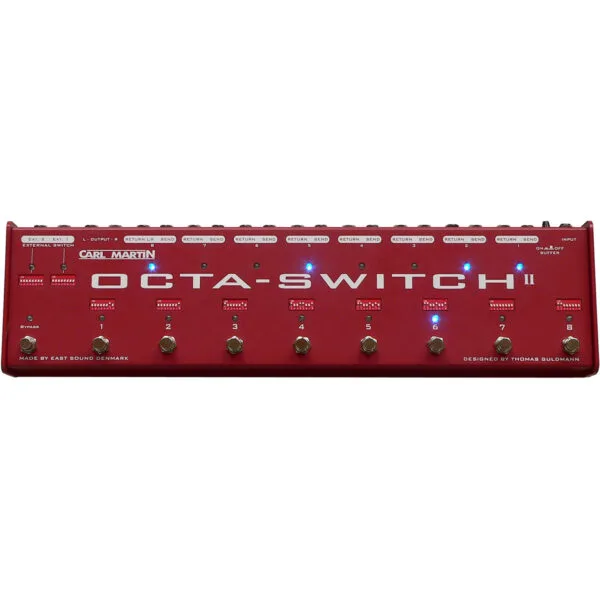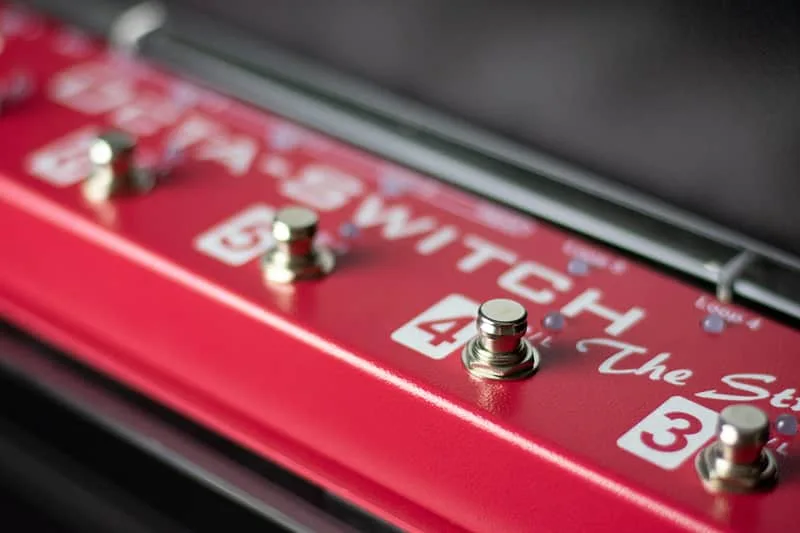


The Carl Martin Octa-Switch The Strip is a programmable, stage-friendly loop switcher built to simplify complex pedalboards. It gives you eight true-bypass relay loops and eight programmable presets, each recalled instantly with a single footswitch press, so a whole pedalboard can change configuration in one step instead of a row of taps1.
It is made by Carl Martin, designed and refined once again by Thomas Guldmann, and Carl Martin describes it as the most streamlined and advanced all-analog Octa-Switch they have built to date1. The enclosure is a low-profile strip designed to fit naturally along the front edge of a pedalboard, maximizing foot access while keeping the switching controls where your feet already are1.
Eight relay loops with eight presets
The core concept is unchanged from earlier Octa-Switches: eight true-bypass relay loops with impedance-free gold relays, which Carl Martin says ensures complete tone transparency and compatibility with any pedals you connect1. When a loop is off, its pedals are fully out of the signal path; when you recall a preset, the relays snap the right loops in and out at once.
Each of the eight preset footswitches recalls a stored loop combination, and Carl Martin calls these presets "banks"13. Preset LEDs show which preset is selected, and Loop LEDs indicate which effects loops are active, so you can see the state of the whole board at a glance1.
A useful live feature is Instant Access mode, which lets you temporarily add or remove loops inside a bank without overwriting the stored preset1. That covers the mid-song case where you want one extra effect for a phrase but want the preset to stay as programmed.
The input can be set to buffered or true bypass with the Input Buffer Switch, which adapts to pedalboard size and cable length and helps maintain signal stability over long cable runs1.
Controls and connections
| Control or jack | What it does |
|---|---|
| Preset Footswitches | Recall stored loop combinations1 |
| Preset LEDs | Show selected preset1 |
| Loop LEDs | Indicate active effects loops1 |
| Input Buffer Switch | Selects buffered or true-bypass input1 |
| Send / Return Jacks | Connect individual pedals to loops1 |
| External Switch Outputs | Control amps or external devices1 |
| Input | Accepts guitar signal1 |
| Output | Sends signal to amplifier1 |
Amp channel switching and stereo
Four external switching outputs enable direct control of amp channels, multiple amplifiers, and other external devices1. In practice this means a preset change on The Strip can also flip your amp from clean to dirty, or switch a second amp, without a separate footswitch.
Premier Guitar's review adds that The Strip provides a MIDI input, four external relay switches, and two outputs in case you want to run a dual amp rig3. The reviewer also noted a four-cable switching method: you can run loops 6, 7, and 8 via dedicated sends and returns, situating pedals before or after the preamp in the amp's effects loop3.
For stereo players, the two outputs can be used in stereo via the stereo return on loop 83. The loop count is sometimes listed as 7 mono loops plus 1 stereo loop, alongside the simpler description of 8 true-bypass relay loops4.
MIDI
The Strip supports MIDI, commonly listed as MIDI out sending program changes, which allows it to control or sync with MIDI-capable devices when you change banks14. So a single preset press can also send a program change to a MIDI-capable delay or multi-effects unit, keeping the whole rig moving together.
Power
The Strip does not have a built-in pedal power supply, and the adapter is not included. It runs on an external 9V DC regulated, center-negative adapter, and Carl Martin recommends planning for a supply that can deliver sufficient current, often stated around 600 mA14.
That current figure is worth attention: this is not a pedal that will run happily on a small daisy chain output. A dedicated 9V supply with headroom in the hundreds of milliamps is the practical requirement14.
History and versions
The Strip is the fourth version of the Octaswitch line, and RockBoard's PedalPedia entry describes it as the smallest and most advanced5. Carl Martin frames it the same way: the goal was to take everything learned from three generations of Octa-Switch and distill it into the most compact form, and The Strip is commonly described as a more modern, refined take on the Octa-Switch idea, adding practical live features1.
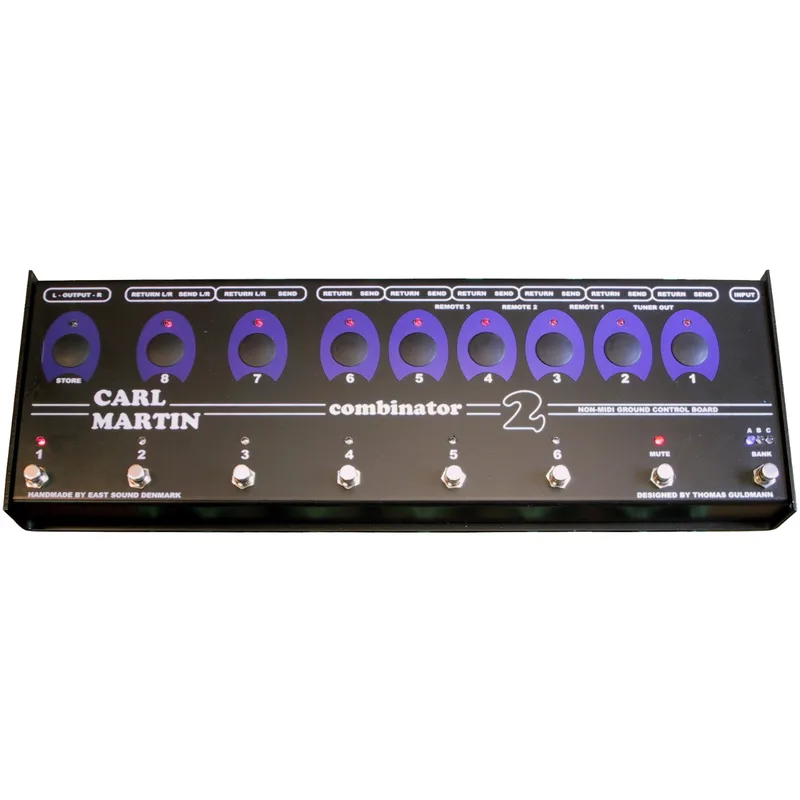
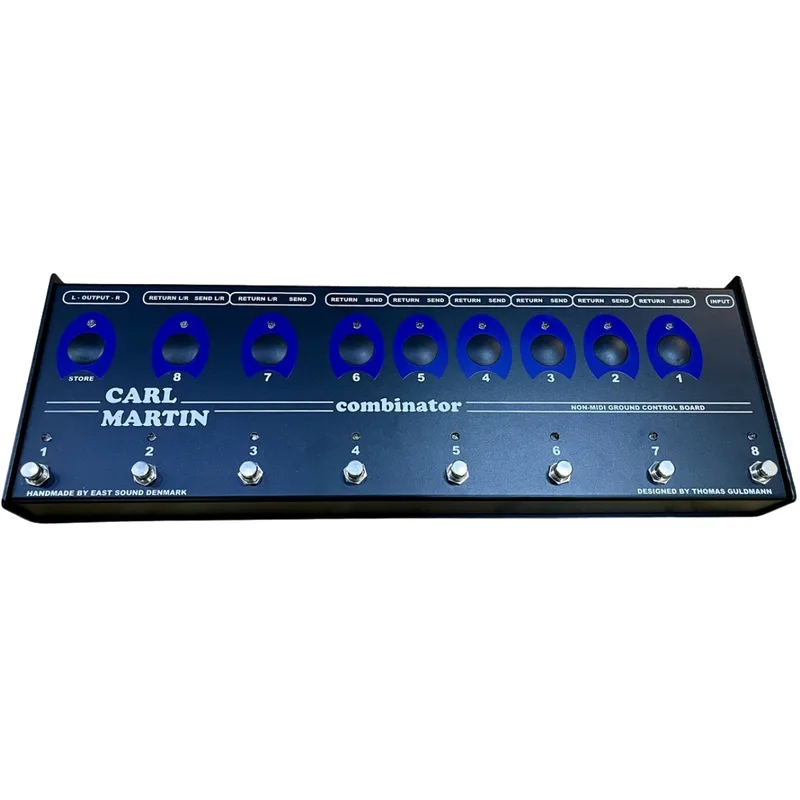
The previous version, the Carl Martin Octa-Switch MK3, offers eight loops (the last loop is stereo) and eight banks, with each of the eight footswitches representing a preset programmed via DIP switches: for every preset you choose which of the eight loops are active26. The MK3 runs on the same 9V DC center-negative power input2. Carl Martin's line also includes the Carl Martin Combinator 2, another take on the multi-loop switching idea7.
What reviewers said
Premier Guitar reviewed The Strip in September 2021 and was positive across the board3:
"It's intuitive, the build quality is top notch, the ease of programming is tough to beat"
The reviewer also found that the unit and its ease of operation reflect a thoughtful, user-oriented, real-world, stage-centric engineering sensibility3. On value, the verdict was that it warrants serious consideration as a pro-level solution for players without loads to spend3. RockBoard's PedalPedia entry calls it the most versatile and simplest all-analog switching pedal on the market5.
Who uses it
Carl Martin's artist pages list several players using The Strip8:
Players on the earlier MK3 include Rex Brown, Richard Z. Kruspe, Carmine Rojas, and Joe Hottinger28.
Videos
Pete Thorn
Michael Ryan Vance
EytschPi42
Questions
Does the Carl Martin Octa-Switch The Strip have MIDI?
Yes. The Strip supports MIDI, commonly listed as MIDI out sending program changes, so it can control or sync with MIDI-capable devices when you change banks. That lets one preset change also switch settings on MIDI gear elsewhere in the rig.
Can the Octa-Switch The Strip switch amp channels?
Yes. Four external switching outputs enable direct control of amp channels, multiple amplifiers, and other external devices. You connect these outputs to your amp's footswitch jacks and they switch along with your stored presets.
Does the Octa-Switch The Strip come with a power supply?
No. The Strip has no built-in pedal power supply and the adapter is not included. It runs on an external 9V DC regulated, center-negative adapter, and Carl Martin suggests planning for a supply that can deliver around 600 mA.
Can the Octa-Switch The Strip run in stereo?
Yes. Premier Guitar's reviewer noted that the two outputs can be used in stereo via the stereo return on loop 8. The Strip also has two outputs for running a dual amp rig.
How long is the Octa-Switch The Strip?
It is a 23-inch-long strip, which Premier Guitar noted will fit at the foot of a Pedaltrain Novo 24 pedalboard. The low-profile enclosure is designed to sit along the front edge of a pedalboard to maximize foot access.
Sources (8)
- Octa-Switch The Strip, Carl Martin (carlmartin.com), 2026
- Octa-Switch MK3, Carl Martin (carlmartin.com), 2026
- Carl Martin Octa-Switch The Strip Review, Premier Guitar, 2021-09-12
- Support - Carl Martin, Carl Martin (carlmartin.com), 2026
- Octa-Switch The Strip by Carl Martin, RockBoard PedalPedia, 2026
- The New Switcheroo: Three Loop Switchers Reviewed, Premier Guitar, 2016-01-08
- Combinator 2, carlmartin.com, 2026
- Artists - Carl Martin, Carl Martin (carlmartin.com), 2026