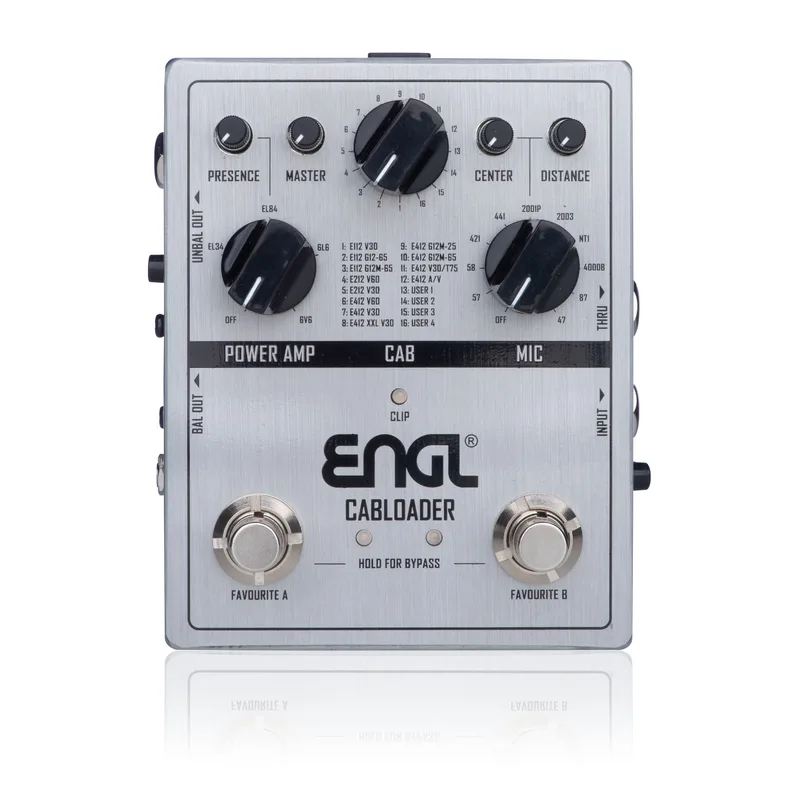

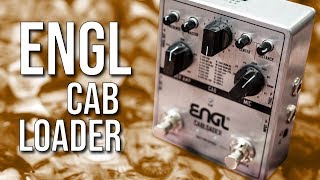

The Engl Cabloader is a pedal from ENGL Amplification that the maker describes as "a fully-featured speaker cabinet simulator, IR Loader and DI box." It uses IR-based digital cabinet simulation models, meaning impulse responses: short digital snapshots of how real cabinets and microphones respond, which shape your amp's output the way a miked speaker would. ENGL positions it as a way to "transform your pedalboard into a full DI rig," taking an amp or preamp signal and delivering a finished, miked-cabinet sound to a PA, interface or headphones without a microphone in front of a speaker.1
The controls: microphones, power amp and presets
The front panel is split into two simulation sections. The Microphone Section has a MIC selector with 10 microphone models plus a Microphone Off setting, and Center and Distance controls that adjust how the virtual microphone sits against the speaker, from on-axis center to further off and back. The Power Amp section has a POWER AMP selector with 4 power amp simulations plus a Poweramp Off setting, along with Presence and Master controls.1
For recall, two footswitches handle presets: a Favorite A footswitch to save and recall Preset A, and a Favorite B footswitch to save and recall Preset B. That gives you two cabinet and microphone setups you can switch between mid-song without bending down.1
Loading your own impulse responses
Beyond the 12 built-in ENGL cabinets, the Cabloader holds 4 user or third-party slots, accessible via USB. A Micro USB port handles IR loading from a PC or Mac, so you can drop in impulse responses from other makers and keep the ENGL cabinet models alongside them.1
Outputs and connections
The jack field covers the DI-box side of the design:
- Input jack with an Instrument / Line level adjustment switch
- Thru jack, for passing your signal onward untouched
- Unbalanced Out jack
- Balanced Out Jack (XLR), for long runs to a mixer or PA
- Headphones Out, for silent practice
- Micro USB port for IR loading (PC and Mac)1
The instrument/line switch on the input is what lets the Cabloader sit after a pedal preamp or a line-level source as well as directly after a guitar.1
Sampling specs
ENGL gives the digital side as 24-bit sampling accuracy, a 100dB signal to noise ratio, a sampling rate of at least 44.1kHz, and an IR sampling length of 1024 samples, which the maker states as 23.22ms. The 1024-sample length is on the shorter side for IRs, which keeps the processing light but means very long, room-heavy impulse responses will not load in full.1
The Cabloader draws 300mA at 9V DC, negative center. That is more than many one-spot style daisy chains supply per output, so plan your power supply accordingly.1
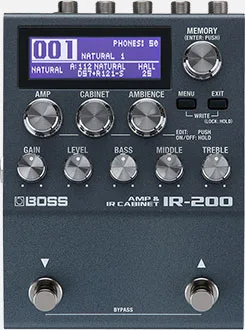
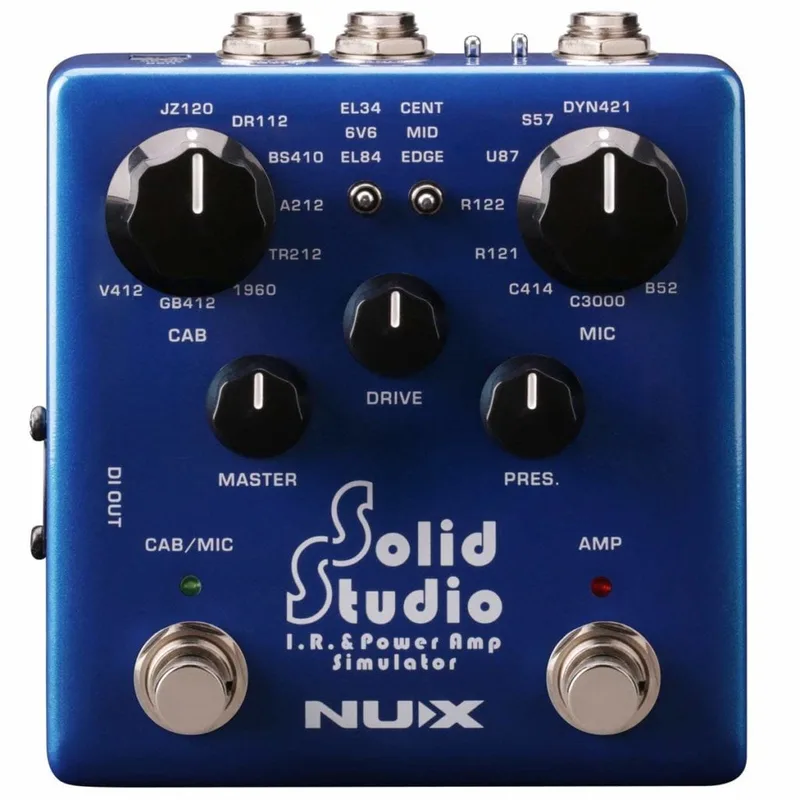
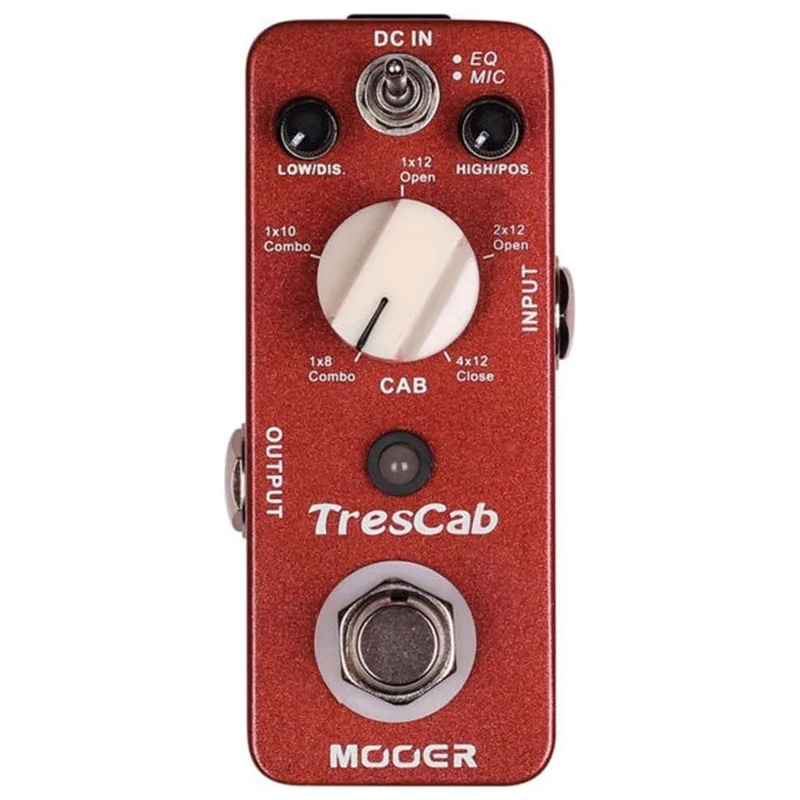
It sits in the same family of pedals as other IR-based cabinet simulators such as the BOSS IR-200, the NUX Solid Studio and the Mooer TresCab; see the full range on the Speaker Simulation Pedals page.
Videos
ENGL amps
EytschPi42
The Studio Rats
Questions
Is the Engl Cabloader true bypass?
Yes. ENGL's product page lists the Cabloader as True Bypass, so when the pedal is switched off your signal passes through without the cabinet simulation in the way. That matters if you run it on a pedalboard and only want the IR-based simulation engaged for direct recording or feeding a PA.
What power supply does the Engl Cabloader need?
The Cabloader runs on 9V DC at 300mA with negative center polarity. That current draw is higher than many compact pedals, so a standard low-current daisy-chain output may not be enough; a dedicated supply output rated for at least 300mA is the safer choice.
Can I load third-party impulse responses into the Engl Cabloader?
Yes. Alongside its 12 built-in ENGL cabinets, the Cabloader has 4 user slots for third-party impulse responses, loaded through the Micro USB port using a PC or Mac. The pedal is described by ENGL as an IR loader as well as a cabinet simulator, so custom IRs are a core part of its design.
Does the Engl Cabloader have an XLR output?
Yes. The Cabloader has a Balanced Out Jack on XLR, alongside an unbalanced output jack, a Thru jack, a headphones output, and an input jack with an instrument or line level adjustment switch. The balanced XLR output is what makes it usable as a DI box straight into a mixer or interface.
How many built-in cabinets does the Engl Cabloader have?
The Cabloader ships with 12 built-in ENGL cabinets. On top of those, it offers 4 user or third-party slots accessible via USB, and two footswitches let you save and recall a Favourite A and Favourite B preset for quick changes during a set.
Sources (1)
- Engl Cabloader, ENGL Amplification, 2026-04-22