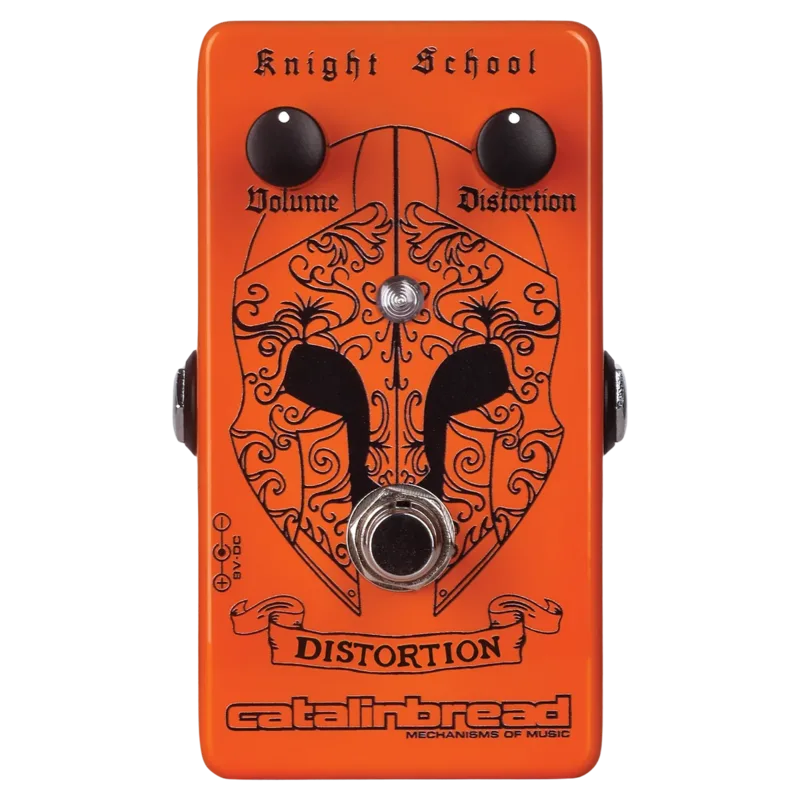

The Catalinbread Knight School Fuzz is a DIY fuzz pedal kit from Catalinbread: you solder it together yourself, or pay extra for a fully built version. The fuzz circuit is based on the Jordan Boss Tone fuzz, a vintage unit whose lineage runs through the same family of circuits that General Guitar Gadgets still offers as a clone kit12. Gearnews describes the resulting sound as "ripping, full, and throaty to sputtery and g[ated]" depending on settings1.
The pedal began as an instructional device for a local pedal-building class taught by a Catalinbread builder, and that teaching purpose shows in the design: the circuit board has every component labeled, and several parts are deliberately chosen so a builder can swap them and hear what changes31.
What it does
The Knight School Fuzz is a fuzz in the Boss Tone tradition rather than a modern high-gain design. The Jordan Boss Tone it descends from is a documented vintage fuzz: Premier Guitar notes that Gurley (of Paul Gurley, the player associated with the original) "did his work with a Jordan Boss Tone"2. General Guitar Gadgets keeps the same circuit alive as a DIY kit and PCB project for players who want the Boss Tone sound in build-it-yourself form4.
Catalinbread's version keeps that lineage but packages it as a teaching tool. Gearnews notes the DIY build option is around $50 cheaper than the built pedal and that "the circuit doesn't contain a huge amount of components," making it a way to teach yourself the basics of pedal building1. The build requires a soldering iron, and the supplied circuit board has every component labeled as to what part goes where35.
The controls
Three knobs, each doing something a player can hear:
| Control | What it does |
|---|---|
| Volume | Sets the output level3 |
| Gain | Wired like a volume control separating the guitar from the rest of the circuit; kept maxed, the level of gain can be controlled with the guitar's volume knob3 |
| Bias | Loads down the voltage from the supplied 9V all the way down to just under 5V, giving a leaner, smoother tone; maxed, it pushes the circuit into a sweet, sputtery texture that evokes slight octave-down tones3 |
The Gain control is the interesting one for players who ride their guitar's volume knob: because it sits between the guitar and the circuit, leaving it maxed turns the guitar's own volume control into the gain control, the same trick vintage fuzz players use with fuzzes that clean up when the guitar is turned down3.
The Bias knob ships as a stock A100K potentiometer, where "A" refers to the sweep of the potentiometer, and Catalinbread says you are welcome to swap it for a lower or higher value3.
Inside the circuit
The parts choices are where the kit earns its "school" name, because each one is a lesson:
- Transistor: a 2N5088, an NPN "medium-gain" device with around 400 hFE, which "does most of the heavy lifting in this circuit." On the board its pins, left to right, are emitter, base, collector3.
- Clipping: silicon diodes, 1N4148, included in the kit3.
- Swappable caps: both 100n capacitors in the circuit (the input and output caps) can be reduced or enlarged to suit your tastes. Smaller values yield less bass and slightly less gain; larger values give the converse3.
That last point is the practical payoff of building it yourself: a builder who wants a leaner, less bass-heavy fuzz can drop the cap values, and one who wants more bottom end can raise them, without touching anything else in the circuit3.
Power and the oscillation trick
The Knight School Fuzz accepts a center-negative DC power supply capable of supplying 9 volts and at least .5mA of current, with more current fine3.
If the Bias knob is maxed when the power cable is plugged in, the pedal will oscillate and provide synth and drone textures until stabilized by turning the Gain knob. This will not occur again until power is unplugged and plugged back in with Bias maxed3.
That behavior is a feature rather than a fault: power up with Bias dimed and you get a drone and synth texture machine, then dial in the Gain knob to bring it back to a normal fuzz3.
Price and the Knight School range
At launch in September 2023, the kit carried introductory pricing of $85, normally $99.99, with the fully built pedal adding $50 over the kit price1. The same kit-versus-built pricing structure appeared across the Knight School line: when Catalinbread launched the Knight School Overdrive in November 2023, Guitar World reported it as an $85 kit or a built pedal for $50 extra, that one based on the Tube Sound Fuzz circuit from Craig Anderton's Electronic Projects for Musicians5.
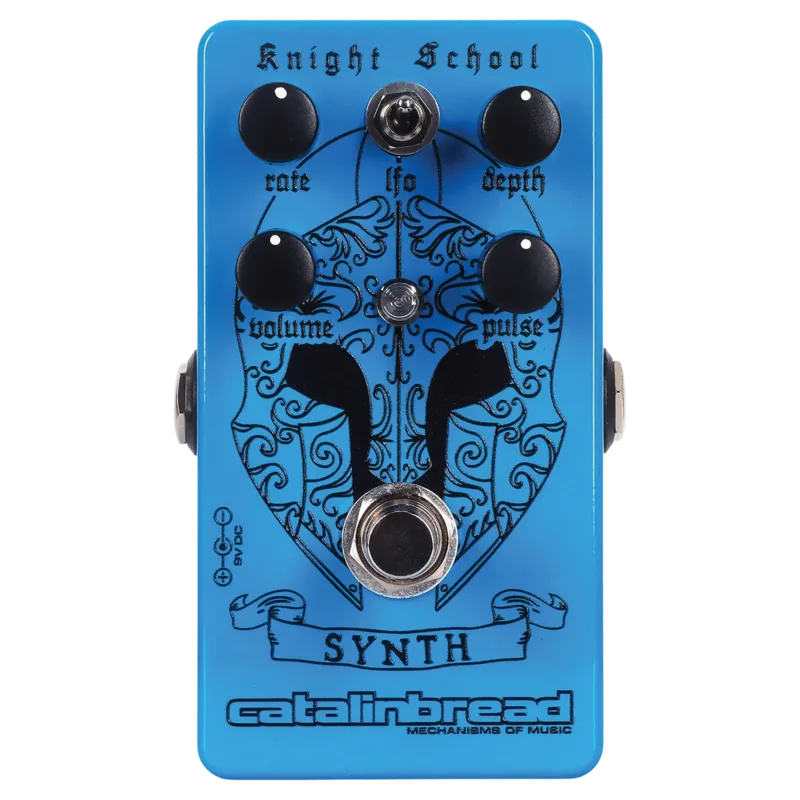
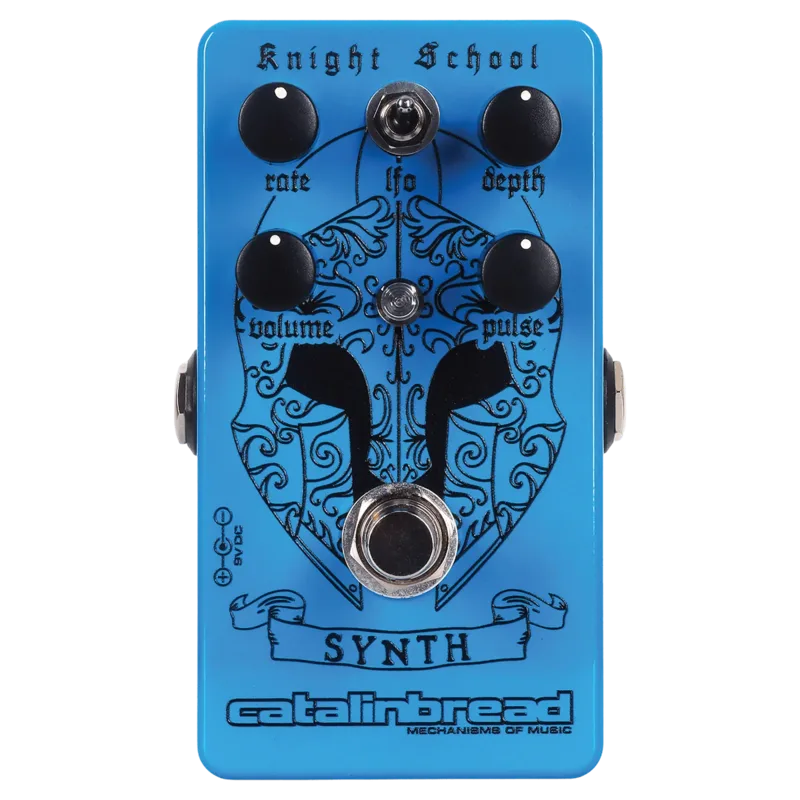
The Knight School family extends beyond fuzz, all of it in the same DIY kit format: a synth kit, a low-pass filter kit Catalinbread says sounds strong stacked with a dirt pedal, a bit crush kit, a trem, and the overdrive678. For players comparing finished pedals rather than kits, Catalinbread's built overdrive and fuzz range covers similar ground.
Videos
Bill's Guitar Garage - Bill Taylor
Questions
How much does the Knight School Fuzz cost built versus as a kit?
At its 2023 launch the kit carried introductory pricing of $85, against a normal price of $99.99, and a fully built pedal cost $50 more than the kit. The DIY option is around $50 cheaper than the assembled version, and since the circuit does not contain a huge number of components it doubles as a way to learn pedal building.
What power supply does the Knight School Fuzz need?
It accepts a center-negative DC power supply capable of supplying 9 volts and at least .5mA of current, with higher current supplies fine. Catalinbread notes that if the Bias knob is maxed when the power cable is plugged in, the pedal will oscillate until the Gain knob stabilizes it.
How do you get the Knight School Fuzz to oscillate?
Max the Bias knob before plugging in the power cable. On power-up the pedal will oscillate and produce synth and drone textures, and turning the Gain knob stabilizes it. The effect will not happen again until power is unplugged and plugged back in with Bias still maxed.
Is the Knight School Fuzz a good first pedal kit to build?
It suits a first build. The circuit does not contain a huge amount of components, the supplied circuit board has every component labeled, and the build requires only a soldering iron. The kit also teaches useful basics, since both 100n capacitors can be swapped for smaller or larger values to change bass and gain.
Sources (8)
- Catalinbread Knight School Fuzz DIY pedal kit, www.gearnews.com, 2023-09-21
- Ananashead Spirit Fuzz Review, Premier Guitar, 2025-05-06
- Knight School Fuzz (DIY Kit), Catalinbread Effects
- Jordan™ Bosstone™ Clone: DIY Fuzz Kit, PCB & Schematic, General Guitar Gadgets, 2014-05-14
- Catalinbread sees the JHS Pedals Notaklön and raises the Knight School Overdrive, Guitar World, 2023-11-28
- Knight School Filter DIY Kit, Catalinbread Effects
- Knight School Filter (Built Pedal), Catalinbread Effects
- Knight School Synth DIY Kit, Catalinbread Effects