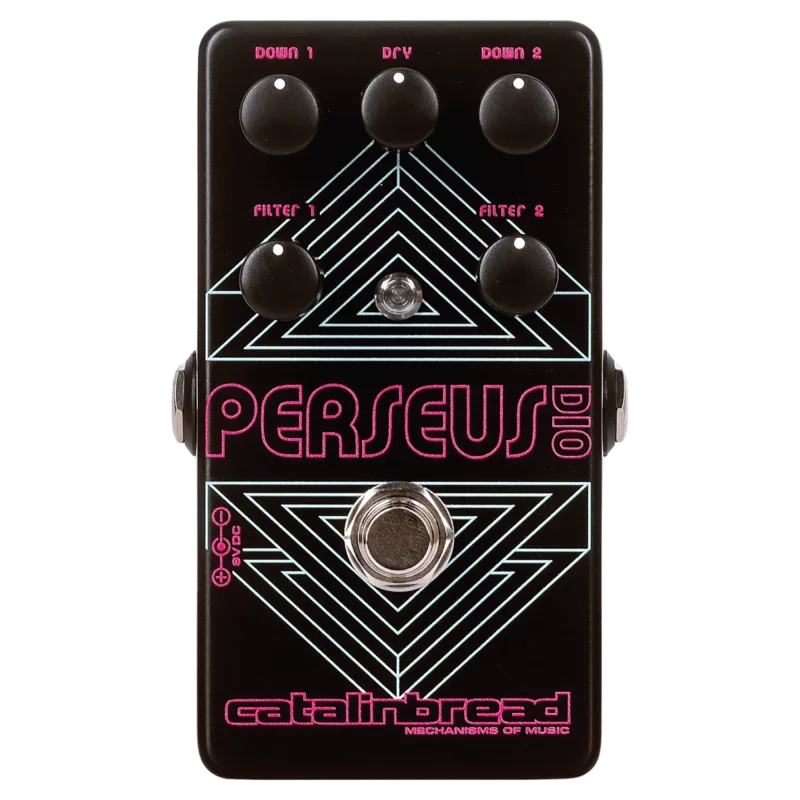


The Catalinbread Perseus DIO is a dual sub-octave square-wave fuzz pedal: it takes your guitar signal, divides it down one and two octaves, and lets you mix those square-wave sub voices with a dry signal of your own1. It is a reworked version of Catalinbread's original Perseus, which came out in the mid 2010s, keeping the same core circuit but replacing the control layout with a more granular set of knobs, including a dedicated low-pass filter for each sub-octave voice2. The result, by default, is what Guitar Pedal X's Stefan Karlsson called "somewhat 8-bit Nintendo sounds"1.
Where most octave and pitch pedals aim for a clean, faithful division of your note, the Perseus DIO leans into the square-wave character of analog octave division. Delicious Audio's Paolo De Gregorio framed it as a pedal for players chasing a synth-like tone rather than a transparent sub: "an octave-down fuzz, won't do that, but it will provide audacious guitarists with a unique synth tone for the ages"2.
What it does to your sound
The pedal is built around a 3-voice mixer: a 1-octave-down voice, a 2-octave-down voice, and a dry signal, each with its own level control2. The two sub-octave voices are square waves, which is what gives the pedal its buzzy, synthesized edge. Individually, De Gregorio notes, the three voices create a deep square-wave sound, and the two octaves can be combined or dialed out entirely via their respective Down controls21.
The filters are where the Perseus DIO departs from a plain fuzz with an octave stacked on top. Each sub-octave voice has its own low-pass filter, and Catalinbread describes what happens at the extremes12:
- Filter 1 at minimum: the cutoff sits around 7kHz, which Catalinbread says retains "all the harmonic richness and video game-esque qualities"3
- Filter 1 at maximum: the cutoff drops to around 280Hz, "giving you a clean octave down with bubbling harmonics lying underneath"3
- Filter 2 at maximum: the cutoff reaches around 140Hz, which Catalinbread says lets the "oomph" shine through at higher settings3
In practice, that means the same two octave voices can range from bright and chippy to deep and rounded, all from the filter knobs3.
The controls
| Control | What it does |
|---|---|
| Down 1 | Volume of the 1-octave-down signal3 |
| Down 2 | Volume of the 2-octave-down signal3 |
| Dry | Volume of the dry signal3 |
| Filter 1 | Cutoff for the low-pass filter on the Down 1 voice, 280Hz to 7kHz1 |
| Filter 2 | Cutoff for a deeper second-order low-pass filter on the Down 2 voice, 148Hz to 7kHz1 |
A few details worth knowing as you dial it in:
- Catalinbread says both Down controls have been tuned to provide the best possible tracking across all positions on the fretboard3.
- The Dry knob is not a true clean blend. Catalinbread describes it as a boosted version of your dry signal, chosen so it mixes better with the octaves, with "plenty of volume on tap" that "sounds great just by itself"3. De Gregorio adds that the Dry setting also introduces light distortion for a raw, biting sound2.
- Filter 2 is a deeper second-order low-pass filter than Filter 1, aimed at the lowest voice3.
Perseus vs. Perseus DIO
The original Perseus was released in the mid 2010s2. The Dio Edition, announced in June 2024, keeps the core sub-octave square-wave fuzz circuit but changes the control topology1. Where the original gave you fewer points of adjustment, the new version adds the dual low-pass filters so you can further modulate or clean up the octaves, plus separate level knobs for each voice1. It launched at $199 and was available for order from the Catalinbread Webstore at release1.
What reviewers said
Guitar Pedal X's Stefan Karlsson, reviewing the pedal at launch, placed it in context against another sub-octave pedal1:
"It obviously won't be as hard hitting as the Honey Badger, while it's a really elegantly textured sub octaves machine."
His overall take was that it is subtler in character than the Honey Badger, and he called it "a maybe at the moment" on his overall verdict1. Delicious Audio's coverage was more enthusiastic about its niche, positioning it as a unique synth-tone tool for adventurous players rather than a general-purpose octave pedal2.
Powering it
The Perseus DIO runs on a 9V DC power supply designed for use with effects pedals3. Catalinbread's guidance is simply to use a quality supply; no battery option or current draw figure is specified.
Videos
Simon Smith
Mike Hermans
Brett Kingman
News
Questions
Is the Perseus Dio analog?
Yes. Delicious Audio describes it as an all-analog circuit built around a 3-voice mixer section: a 1-octave down knob, a 2-octave down knob, and a Dry control. The octave voices are square-wave sub octaves, and the filtering that shapes them is done with low-pass filters rather than digital processing.
What is the difference between the Perseus and the Perseus Dio?
The Perseus Dio Edition keeps the same core circuit as the original Perseus, a sub-octave square-wave fuzz released in the mid 2010s, but gives it a different control topology. The new version adds dual low-pass filters, one per sub-octave voice, plus separate Down 1, Down 2 and Dry level controls for more granular shaping.
Does the Perseus Dio track well on the high strings?
Catalinbread says the Down 1 and Down 2 controls have been tuned to provide the best possible tracking across all positions on the fretboard, so the octave division is designed to hold up beyond the low strings. As with any analog octave divider, the strongest sub-octave results still come from the lower register.
Can you get a clean octave down from the Perseus Dio?
Yes. With Filter 1 at its maximum setting the cutoff point is around 280Hz, which Catalinbread says gives you a clean octave down with bubbling harmonics lying underneath. Rolling the filters back removes the upper harmonics, so the square-wave fuzz character can be dialed toward a cleaner sub-octave voice.
What power does the Perseus Dio need?
It runs on 9V DC. Catalinbread says you can power it with any 9V DC quality power supply designed for use with effects pedals. No current draw figure or polarity detail is given beyond that, so a standard pedal power supply is the intended source.
Sources (3)
- Guitar Pedal X, Guitar Pedal X, 2024-06-07
- New Pedal: Catalinbread Perseus Dio Octave Down Fuzz, Delicious Audio, 2024-06-06
- Perseus DIO, Catalinbread Effects