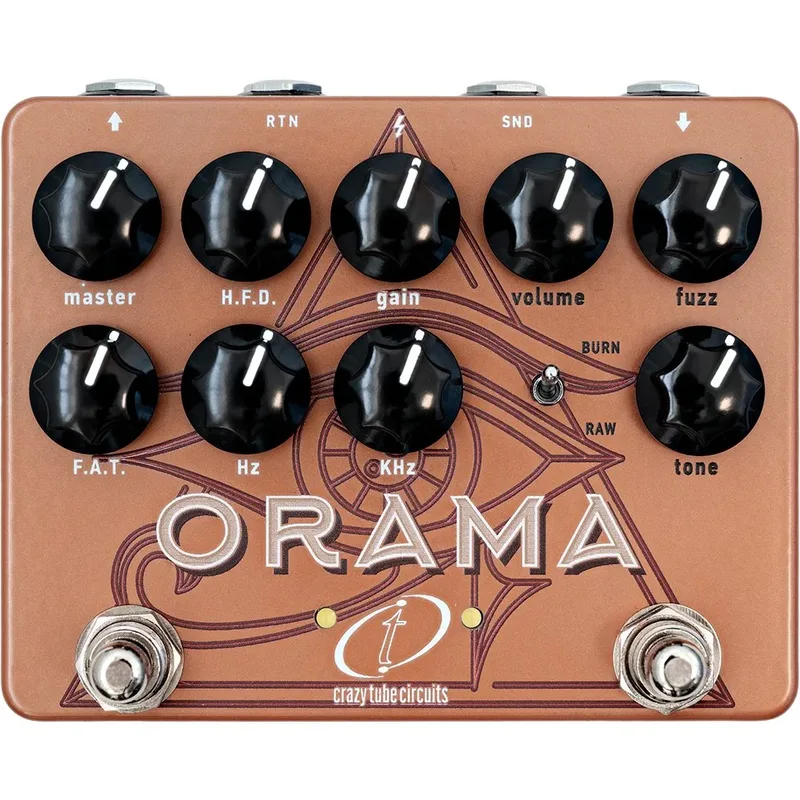


The Crazy Tube Circuits Orama is an analog gain pedal with two independent sections in one box: an AMP side and a FUZZ side. The name is Greek for "vision," and the maker describes it as its "vision in gain, uniting the unmistakable growl of classic British amplification" with a fuzz circuit1. Each side has its own footswitch and relay-based true bypass, so the two can be used separately or stacked, and a passive effects loop between them opens up further routing options12.
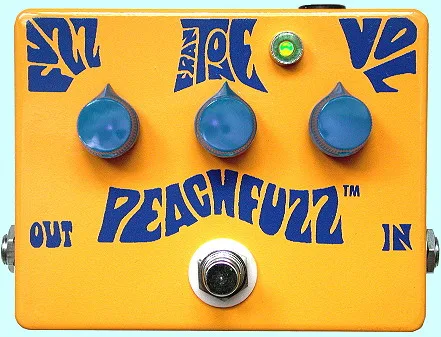
The AMP side is a JFET circuit modeled on a seminal British amplifier whose roots trace to the late 1960s and early 1970s. Guitar Pedal X identifies the reference amp as the Orange OR120, saying the section "captures the full gain range and harmonic complexity of the legendary Orange OR120"21. The FUZZ side takes its circuit from a landmark early boutique pedal of the 90s, driven by power-amp ICs rather than traditional transistor or diode clipping stages; Guitar Pedal X names the reference as the Frantone Peachfuzz12.
The AMP section
The AMP side runs on JFET circuitry at 34 V DC, raised from the incoming 9V DC supply by an internal voltage booster, which the maker says delivers a true amp-like response14. Crazy Tube Circuits describes its character as everything from bluesy breakup and Classic Rock crunch to Britpop sizzle, with colossal headroom, thick low end and what the maker calls "overwhelming, room-shaking authority," noting that Heavy Rock, Desert, Stoner and Doom players have long favored the original amp for those qualities1.
Two controls shape the drive beyond the basic gain and level settings:
| Control | What it does |
|---|---|
| F.A.T. (Fatness Adjustment Tweak) | Adjusts how bass and lower mids are fed into the gain stages, changing the drive voicing and overall feel; operates in the mirrored direction of the original amp's circuit1 |
| H.F.D. (High Frequency Dynamics) | Adds upper harmonic content, drive and presence2 |
The FUZZ section
The FUZZ side is a fine-tuned recreation of the Frantone Peachfuzz, a fuzz whose circuit is driven by power-amp ICs rather than transistors or diodes23. Crazy Tube Circuits says this design gives the fuzz "its distinctive voice: thick, powerful, and harmonically complex, yet capable of surprising smoothness and control," and describes the result as a full, amp-like roar that feels more like an overdriven output stage at the verge of explosion than a conventional fuzz1. The overall bass response has been slightly refined from the original circuit so it sits more naturally in a band mix without losing its thickness1.
Its controls and voicings:
| Control or switch | What it does |
|---|---|
| Fuzz | Adjustes intensity and saturation, from smooth to explosive2 |
| Volume | Controls the output level of the fuzz section2 |
| RAW/BURN toggle | Selects between the two voicings2 |
The two voicings extend the range from vintage-inspired textures to high-gain saturation1:
- RAW: a tighter, lower-gain, vintage-style fuzz with an open, dynamic response, tight low end and clear mids14
- BURN: the higher-gain setting, with deeper bass, more sustain and more low-end14
Stacking the two sides and the effects loop
Each section has its own footswitch and status LED, so the AMP and FUZZ sides can be engaged independently or together2. RockBoard's PedalPedia entry notes that players can run the sides independently or stacked for layered tones3. Between the two sections sits a passive effects loop, which the maker says gives greater routing freedom: other pedals can be inserted into the signal path after the amp-style drive and before the fuzz1.
Guitar Pedal X's reviewer, Stefan Karlsson, found the combination particularly effective, writing:
"The two voicings here combine really beautifully - adding further richer textures and harmonics into the mix2."
He called the pairing of the two circuits a smart one he had not seen before, and concluded that the sum of the parts is greater than the whole2.
Power and switching
The Orama runs on a 9V DC supply with a 2.1 mm x 5.5 mm center negative plug, drawing 82mA; the power supply is not included2. The AMP section's JFET circuitry runs at 34 V DC, raised from the 9V input by an internal voltage booster14. Both sections use click-less true bypass switching via high-quality relays, one relay per section, a detail confirmed by both Guitar Pedal X and Gearnews24.
The 82mA draw and the internal voltage booster mean the Orama is best run from its own isolated 9V DC output rather than a battery or a shared daisy chain.
Build, price and where it fits
The pedal comes in a die-cast enclosure in a rich "burnt orange" finish with a subtle bronze warmth, with color-coded lettering: black for the FUZZ section's controls, white for the AMP section's2. It measures 120 x 97 x 49 mm and weighs 423 g2. Crazy Tube Circuits lists it at €279.00, and as of late October 2026 also offers a B-Stock unit at €232.0015. The maker's page lists availability as shipping in 5-6 days1.
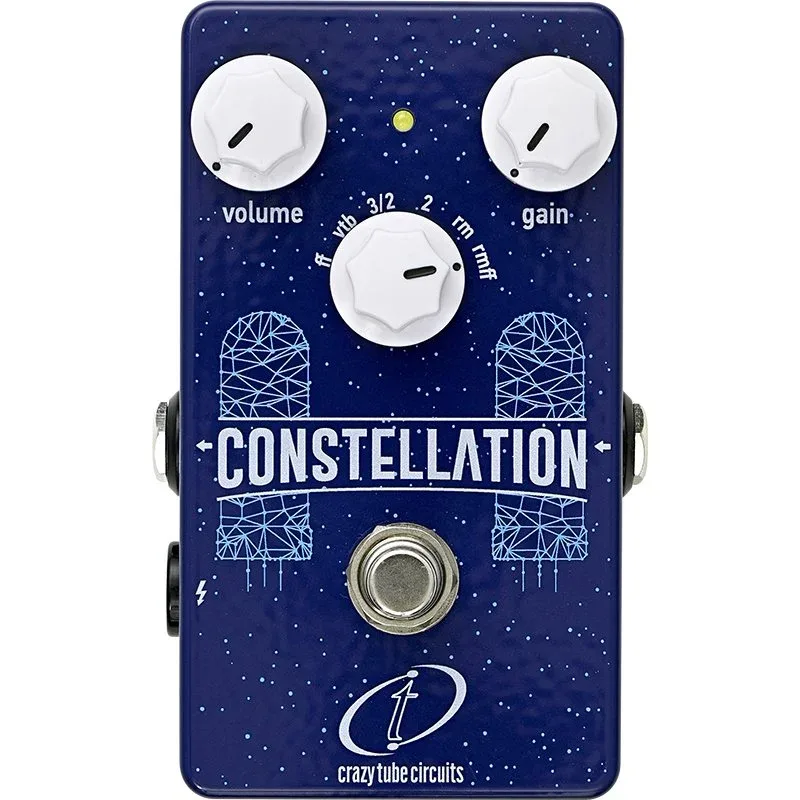
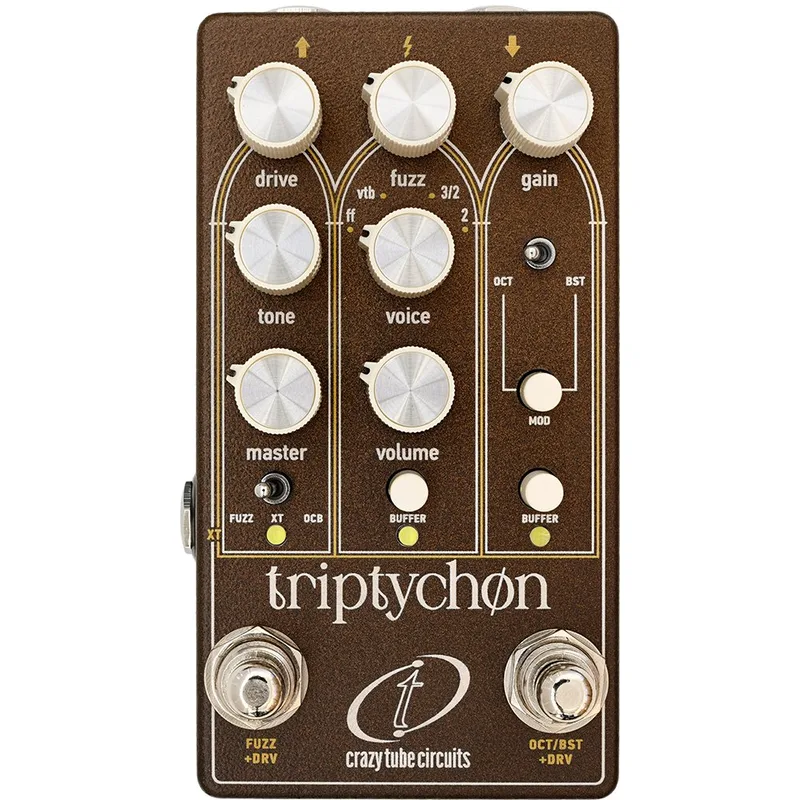
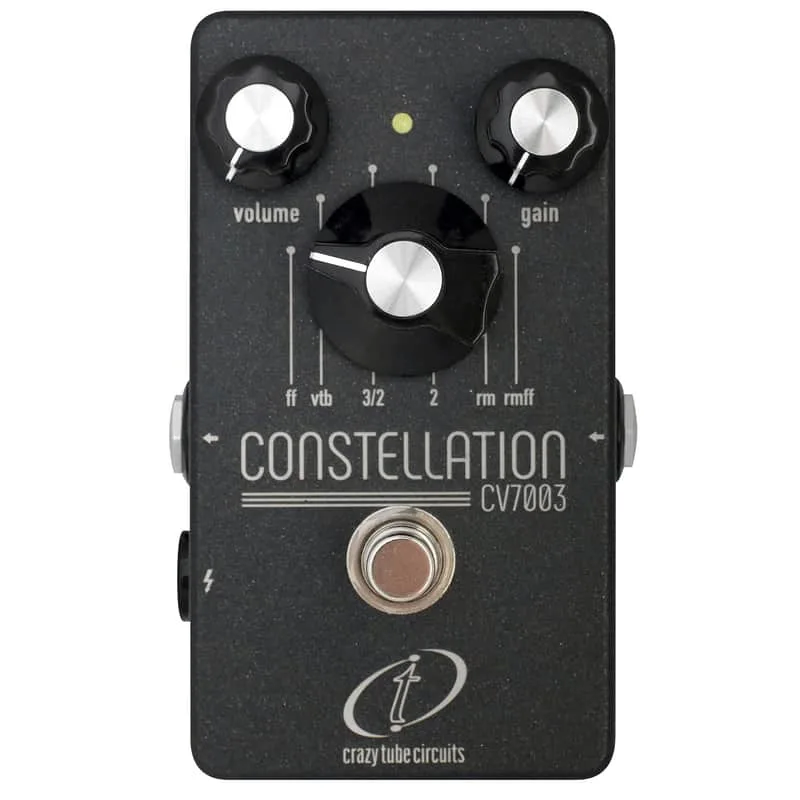
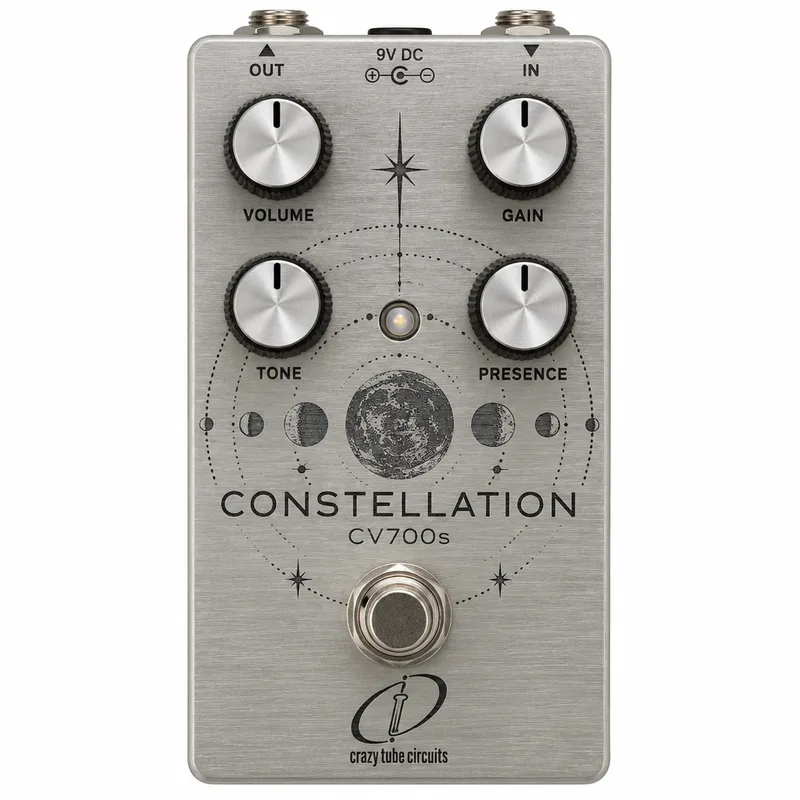
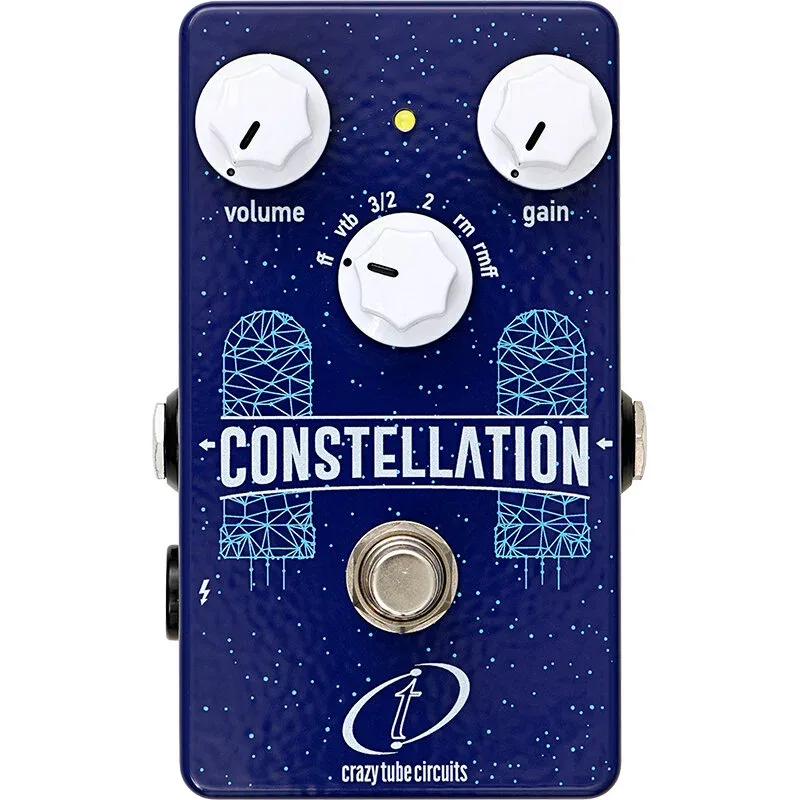
The Orama sits in the Crazy Tube Circuits gain lineup alongside the Constellation germanium fuzz family and the Triptychon multi-stage fuzz, and it covers ground that overlaps both fuzz and overdrive territory in a single box61.
Videos
FACE MI
AndyDemos
TheGuitarGeek
Questions
Can the AMP and FUZZ sides of the Orama be used at the same time?
Yes. Each section has its own footswitch and relay-based true bypass, so the two sides can run independently or stacked for layered tones. A passive effects loop sits between the sections, so other pedals can be inserted into the chain between the AMP and FUZZ circuits.
What is the difference between RAW and BURN on the Orama?
RAW and BURN are the two voicings of the FUZZ section, selected by a toggle. RAW is a tighter, lower-gain, vintage-style fuzz with an open, dynamic response and clear mids. BURN is the higher-gain setting, with deeper bass, more sustain and more saturation.
What does the F.A.T. control do on the Orama?
F.A.T. stands for Fatness Adjustment Tweak. On the AMP side it adjusts how bass and lower mids are fed into the gain stages, which changes the drive voicing and overall feel. Crazy Tube Circuits notes it operates in the mirrored direction of the original amp's circuit.
Is the Crazy Tube Circuits Orama true bypass?
Yes. Both sections use click-less true bypass switching via high-quality relays, one relay per section, so each side drops out of the signal path completely when switched off.
What can go in the Orama's effects loop?
The Orama has a passive effects loop between the AMP and FUZZ sections. Any pedal can be inserted there, so it sits after the amp-style drive and before the fuzz in the signal path, giving extra routing options when the sections are stacked.
Where is the Orama made?
The Orama is designed and hand-built in Athens, Greece, by Crazy Tube Circuits, a Greek effects maker whose range also includes the Constellation fuzz family and the Triptychon multi-stage fuzz.
Sources (6)
- Orama - Crazy Tube Circuits, Crazy Tube Circuits
- Guitar Pedal X, Guitar Pedal X, 2025-12-09
- Orama by Crazy Tube Circuits, RockBoard PedalPedia, 2026
- Crazy Tube Circuits Orama: Analog Dual Drive, gearnews.com, 2025-12-09
- Orama (B-Stock), Crazy Tube Circuits
- Orama — pedals, Crazy Tube Circuits