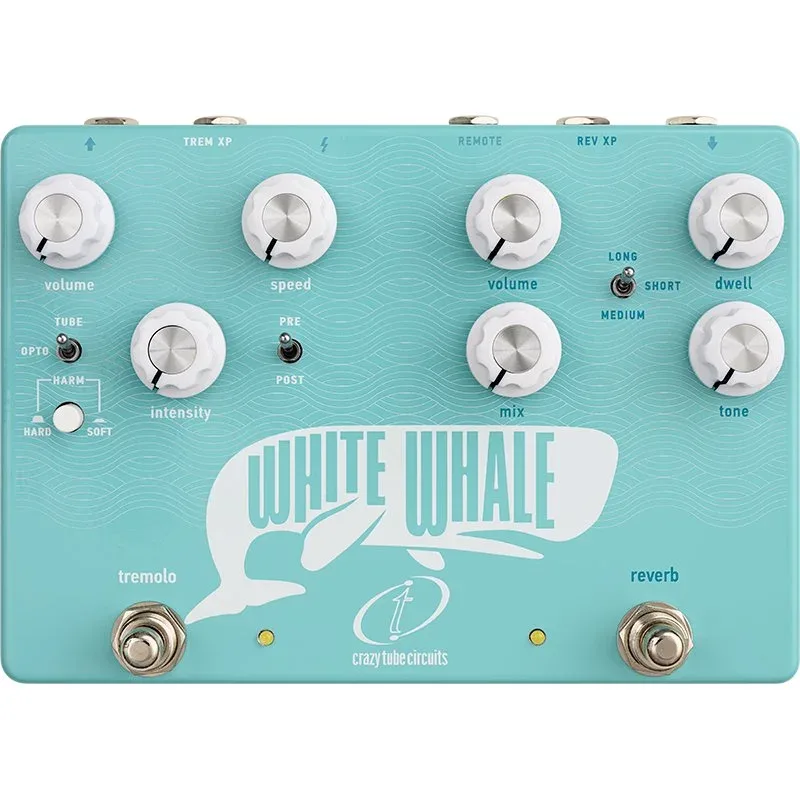


The Crazy Tube Circuits White Whale is a spring reverb and tremolo pedal with a real three-spring tank mounted inside the enclosure, driven by an analog power amp in the manner of the tube-driven spring reverbs built into 60s American amps and outboard reverb units12. The original White Whale is discontinued and sold as old stock, and the line now runs through the White Whale V2 and the compact White Whale Junior13.
The concept is the classic amp pairing of drip and wobble in one box: a genuine spring tank for reverb, plus an all-analog tremolo with modes drawn from vintage amplifier circuits. Delicious Audio called the V2 "the most tweakable real spring reverb out there"4.
A real spring tank and three tremolos in one pedal
The White Whale is not a digital emulation. It has actual springs under the hood, which is why the enclosure is as large as it is: the pedal is effectively the tank, with the three-spring assembly mounted to the baseplate46. The circuit follows the lineage of vintage designs, where a tube power amp drove the spring assembly through an output transformer2.
The tremolo side is likewise all analog. The original White Whale offered two selectable tremolo modes, an opto style and a bias shifting style4. The V2 keeps the opto and tube bias modes and adds a third, harmonic tremolo2.
The reverb controls and three spring settings
The V2's reverb section is built around the same three-spring tank assembly as the original, but with an upgraded power amp driving the springs for increased headroom and a wider frequency response2. A toggle switch selects the size and decay of the reverb between three tank types2:
| Toggle position | Tank character |
|---|---|
| 1 | Milder qualities of a short to medium 2-spring tank2 |
| 2 | Liveliness of a medium to long 2-spring tank, as in most blackface amp designs2 |
| 3 | Dense reverb qualities of a long 3-spring tank2 |
Guitar Pedal X lists the three playback modes as 2-Springs Short (to Medium), 2-Springs Medium (to Long), and 3-Springs Long7. The reverb controls are:
- Dwell: how hard the springs are driven4
- Tone: sits after the recovery stage at the tank output and affects only the wet signal2
- Mix: blends the wet signal on top of the dry guitar signal; on the V2 it can also be controlled by an expression pedal25
The tremolo section: harmonic, opto and bias
The V2's tremolo offers three modes, all types used at various times in Fender amps: bias, opto and harmonic5. The harmonic mode is new to the V2, and Crazy Tube Circuits says it includes the two most significant variations of the effect as found in the original amps, differing in range and sweep of the pulsating frequencies2. The maker describes harmonic tremolo as a hypnotic, frequency-based modulation that originated on certain brown and blonde era amp models2.
The depth control sets the intensity of modulation, and the speed control's range is extended beyond the span of vintage amps' speed controls2. Tremolo speed can be controlled by an expression pedal or an external tap tempo footswitch, neither included25.
The two onboard footswitches engage or bypass each effect section independently, with a power-up bypass/engage preset function, and the V2 lets you set whether the tremolo runs before or after the reverb2. Crazy Tube Circuits' guidance on ordering: optical and tube bias tremolo usually sound better placed after the reverb, while harmonic tremolo usually sounds better in front of it2.
Power and connections
The V2 runs on a 9V DC adapter, not supplied, drawing 180 mA5. Its connections are a standard input, a standard output, TRS jacks for tremolo and reverb expression, and a TRS remote jack5. Guitar Pedal X noted the one real limitation: it is not a stereo solution7.
History and versions: V1, V2 and the Junior
The original White Whale is now discontinued/old-stock, with an original price of €309.001. The White Whale V2 adds a toggle switch selecting the size and decay between three reverb tank types, a harmonic tremolo mode that originated on certain models of the brown and blonde era amps and does frequency-based modulation, and an upgraded power amp driving the springs for increased headroom and wider frequency response2. The V2 lists at €349.00 and ships in 3-4 weeks2. It keeps the same pedalboard-friendly enclosure, 17 x 12,5 x 7,5 cm, in a surf-friendly light green finish2.
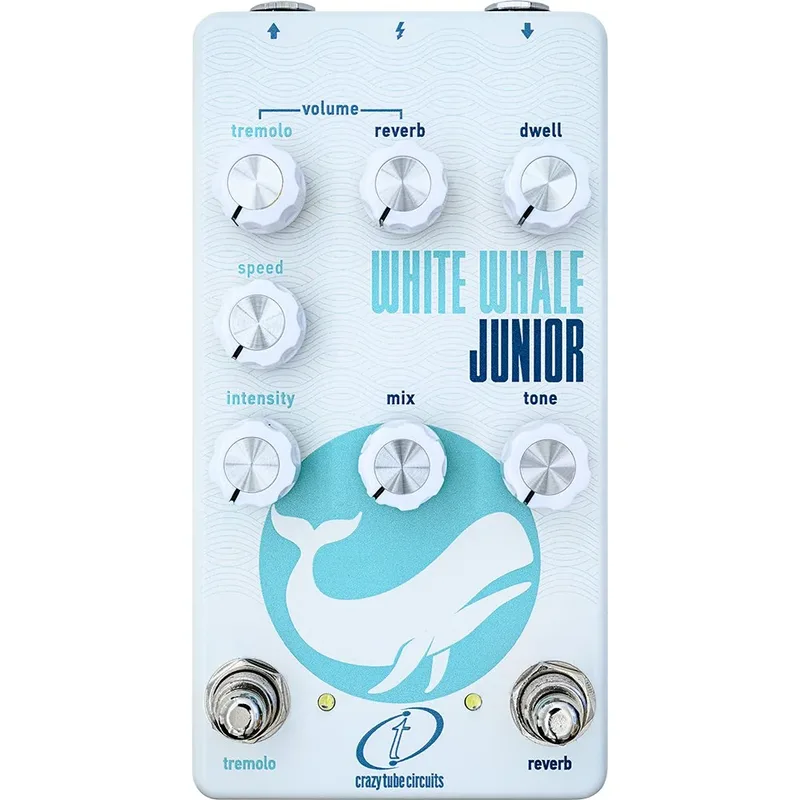
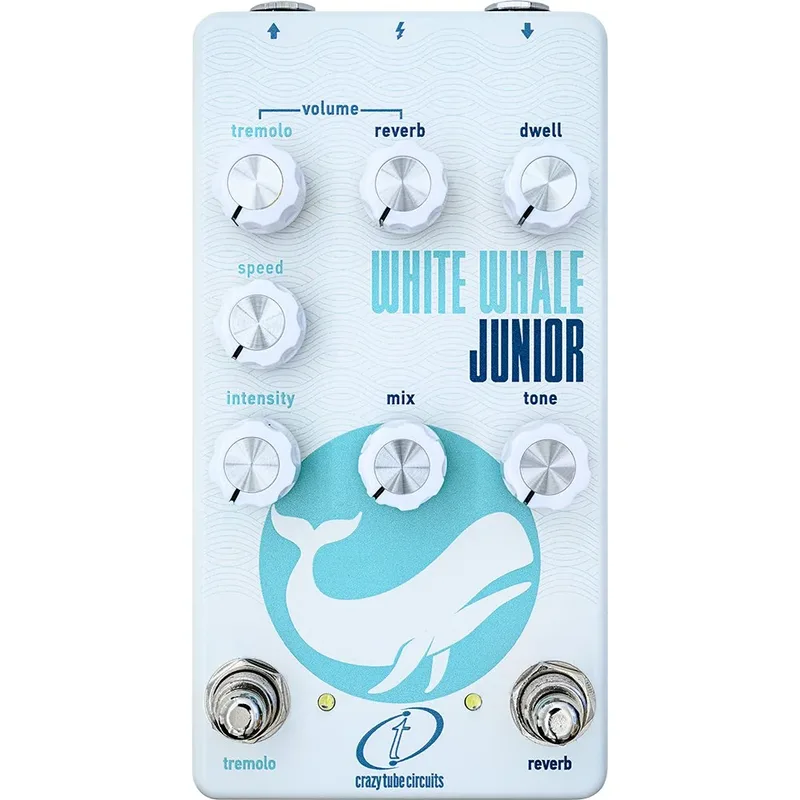
In June 2026 the company followed with the White Whale Junior, a compact version that uses the exact same three-spring assembly as its larger siblings, driven by a dedicated analog power amp3. The Junior trims the feature set: the effect order is fixed at reverb first, the tremolo has a single mode instead of three, a hybrid of the optical and bias styles, and the reverb length is fixed6. It measures about 15 cm long by 8 cm wide and 5 cm deep, runs on 9V DC center negative at 110 mA, and uses true relay bypass689.
The original White Whale is discontinued. The maker's old-stock listing showed it at €309.00, on sale at €219.00, and the B-stock listing at €199.00 is sold out110.
The White Whale Remote
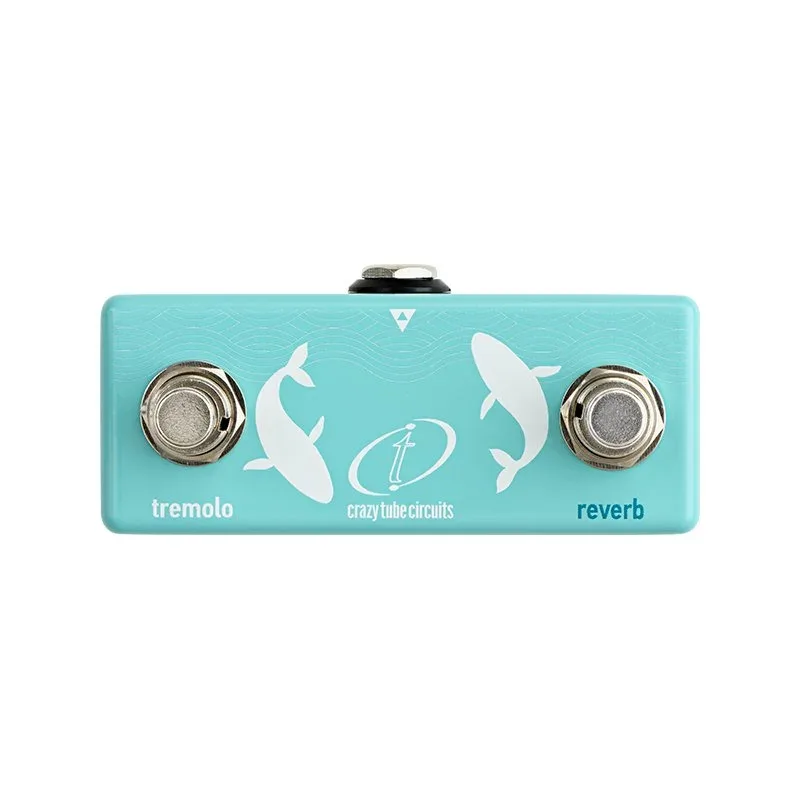
The White Whale Remote is an external unit that controls the bypass state of each effect section, tremolo and reverb, from elsewhere on a pedalboard11. It operates on both the V1 and V2: on the V2 it connects to the Remote input jack, while on the V1 it connects to the reverb expression input jack with an internal assign slider switch set to FX SW11. A TRS cable is required and not included, and the Remote also functions as a studio grade buffer and booster11.
What reviewers said
A reviewer concluded that while you could buy separate tremolo and spring reverb pedals, getting both effects in one small chassis with easily switchable ordering makes absolute sense, calling it the perfect remedy for an amp without onboard reverb and tremolo5. The same review noted that a Mix knob governs how much reverb is added to the dry signal, and that an expression pedal plugged into the Trem XP input will control the speed of the tremolo5. The V2 is made in Greece12.
One reviewer observed that the reverb playback modes on the V2 are 2-Springs Short (to Medium), 2-Springs Medium (to Long), and 3-Springs Long, and that the only downside, if there is one, is that this is not a stereo solution7.
Videos
AndyDemos
60 Cycle Hum
The Studio Rats
Questions
Does the White Whale have a real spring tank?
Yes. The White Whale houses a real three-spring reverb tank assembly inside its enclosure, driven by an analog power amp in the style of the tube-driven spring reverbs found in 60s American amps. It is not a digital emulation of springs.
Can you change the order of the reverb and tremolo?
On the White Whale V2, yes. The tremolo can be placed before or after the reverb, and Crazy Tube Circuits notes that optical and tube bias tremolos usually sound better after the reverb while harmonic tremolo usually sounds better in front of it. On the Junior, the order is fixed at reverb first.
What does the White Whale Remote do?
The Remote is an external switching unit that controls the bypass state of each effect section, tremolo and reverb, from elsewhere on your board. It works with both the V1 and V2, connecting via a TRS cable that is not included, and it also works as a studio grade buffer and booster.
Is the White Whale true bypass?
Yes. Each effect has its own true bypass function, switchable from the onboard footswitches or the Remote switching unit, so you can run the reverb and tremolo independently or together.
Sources (12)
- White Whale (discontinued/old-stock), crazytubecircuits.com
- White Whale v2, Crazy Tube Circuits
- White Whale Junior, Crazy Tube Circuits
- Crazy Tube Circuit White Whale V2 Spring Reverb, Delicious Audio, 2024-06-27
- Crazy Tube Circuits White Whale V2 review, Guitar World, 2024-08-05
- Crazy Tube Circuits White Whale Junior review, Guitar.com
- Guitar Pedal X, Guitar Pedal X, 2024-04-16
- Crazy Tube Circuits White Whale Junior review, MusicRadar, 2026-08-21
- Guitar Pedal X, Guitar Pedal X, 2026-06-30
- White Whale (B-Stock), Crazy Tube Circuits
- White Whale Remote, Crazy Tube Circuits
- Best Reverb Pedals With Tremolo In 2023, Delicious Audio (delicious-audio.com), 2023-05-11