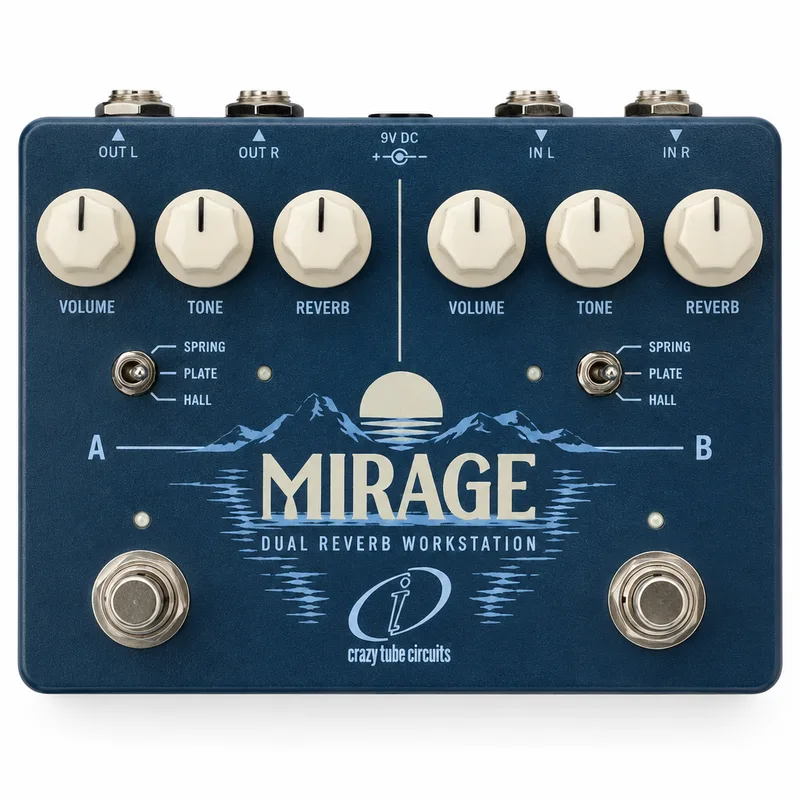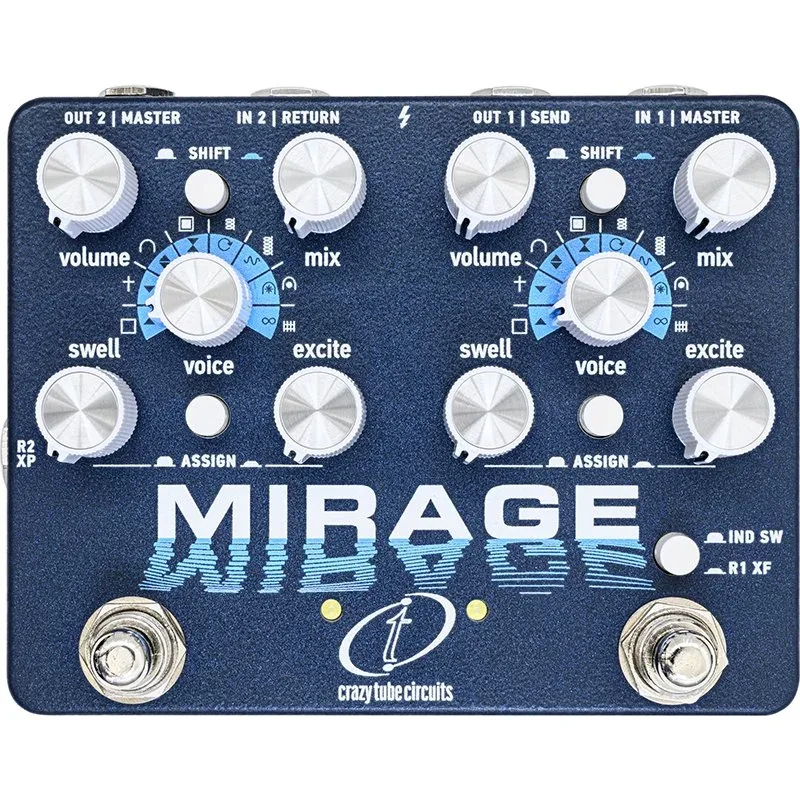


The Crazy Tube Circuits Mirage is a dual-engine ambient reverb workstation: two fully independent reverb engines, R1 and R2, in one compact pedal, each with its own set of controls and each able to load one of 16 reverb algorithms12. Crazy Tube Circuits, a Greek effects maker, describes it as a creative reverb platform built for guitarists, synth players and sound designers, offering studio-grade depth in one compact unit1. It was announced in July 20253.
What makes it unusual is that the two engines can work together or completely apart. You can run them in series for immersive, layered reverbs, split them left and right for stereo processing, or use them as independent reverbs in a dual mono setup1. With both engines in play, that gives 256 algorithm combinations2.
Two independent reverb engines in one pedal
Guitar World's reviewer, Trevor Curwen, described the Mirage as two fully independent reverb engines that can each load one of 16 distinct algorithms, collected in two banks of eight2. MusicRadar's Jonathan Horsley likewise noted two reverb engines, each drawing on 16 newly designed algorithms5. Each engine has its own knobs and switches, so you can dial in two completely different spaces and combine or switch between them.
The pedal sits in a Dark Abyss Blue die-cast enclosure, compact and rugged and designed for road use, weighing 457 grams4. There is even an inscription on the circuit board: "Music is a mirage that throws a party, nothing is real but everything grooves."2
The algorithms: from plate and spring to Inchindown
The 16 algorithms are organized into two banks. The outer arc of the Voice switch holds the more traditional and familiar reverbs: Plate, Cathedral, Hall, Room, Gated, two different springs (Spring and Springier) and Inchindown2. The inner bank pushes into ambient territory with shimmer, modulation and infinite sustain1.
Some highlights from the reviewers:
| Algorithm | What it does |
|---|---|
| Plate | Reverb with a solid density that sits well with guitar2 |
| Room | A simulation of a mic'd up room5 |
| Gated | Quick cut-off for "rhythmic punch"5 |
| Spring | A very usable recreation of classic amp reverb2 |
| Springier | An outboard unit with longer springs, revisiting early '60s surf guitar2 |
| Inchindown | Inspired by Scottish oil tanks said to have the longest man-made reverb; atmospheric, lingering reverb with a metallic edge at maximum decay2 |
| Frozen Hall | Behaves "like a classic hall until you crank decay to max and it freezes into endless sustain"5 |
| Repeater | "Echoes trapped in reverb" that yield "rhythmic, cascading reflections that evolve into ambient textures"5 |
| Infinite | Can hold your reverb loop indefinitely5 |
On the spring side, Guitar World noted that Swell mimics a Dwell control and Excite dials in the splashiness2. The shimmer side includes four shimmer delays, all with adjustable decay: three pitched at an octave (up, down, or an adjustable crossfade between up and down) and a fourth with a stable pitch-shift set with the Excite knob2.
The controls: Swell, Excite, Mix and Volume
Each engine carries its own set of controls: Volume, Mix, Swell, Excite and Voice, plus Shift and Assign switches24. Mix and Volume have a fixed use, while the other two knobs vary their function per algorithm2.
| Control | What it does |
|---|---|
| Mix | Fixed use: wet/dry balance2 |
| Volume | Fixed use: output level2 |
| Swell | Controls the size or length of the reverb effect in most cases2 |
| Excite | Context-sensitive: brightness on conventional reverbs, pitch-shift and modulation adjustment on others2 |
| Voice | Selects one of the 16 algorithms4 |
| Shift switch | Switches between the outer and inner algorithm banks2 |
| Assign switch | Assigns the footswitches to Swell or Excite2 |
Internal switches cover Kill Dry for R1 and R2, bypass mode for each engine, and routing assignment2. Real-time control comes via footswitches and an expression input1, and Guitar World highlighted ramping up the decay via a press-and-hold of the right footswitch for R12.
Routing: series, stereo split and dual mono
R1 and R2 each have their own input and outputs, which is what makes the Mirage's routing flexible2. The three main configurations:
- Series: run the engines one into the other for immersive, layered reverbs1
- Stereo split: split them left and right for stereo processing, with a different reverb type per channel12
- Dual mono: use them as two independent mono reverbs1
Connections are standard inputs 1 (master) and 2 (return), standard outputs 1 (send) and 2 (master), and an XP expression pedal input2.
Power and connections
The Mirage runs on a 9V DC adapter (not supplied), drawing 210 mA, with a 2.1 mm x 5.5 mm center negative connector24. Guitar Pedal X's launch coverage recommended an isolated 9V DC supply4.
At 210 mA the Mirage draws more current than a typical analog pedal, and it has no battery option. An isolated 9V DC power supply with a 2.1 mm x 5.5 mm center negative plug is what the maker's coverage calls for42.
History and versions, including the Mirage Jr
Crazy Tube Circuits announced the Mirage on July 1, 2025, with a €325 street price431. A B-Stock unit has since appeared on the maker's store at a €276 sale price6. The company also stated at launch that a more compact, single-engine version was coming soon3.
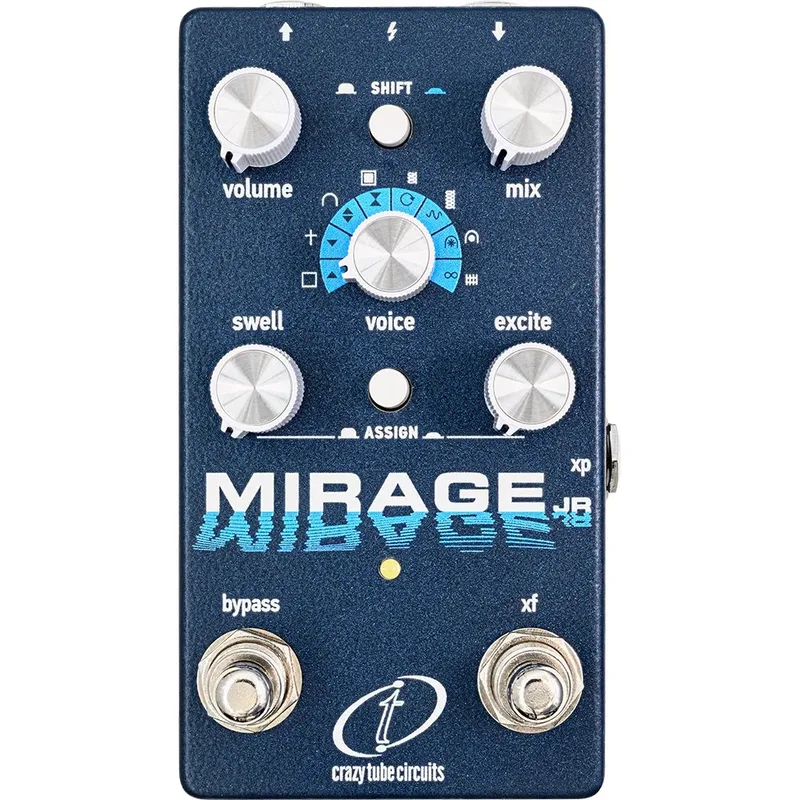
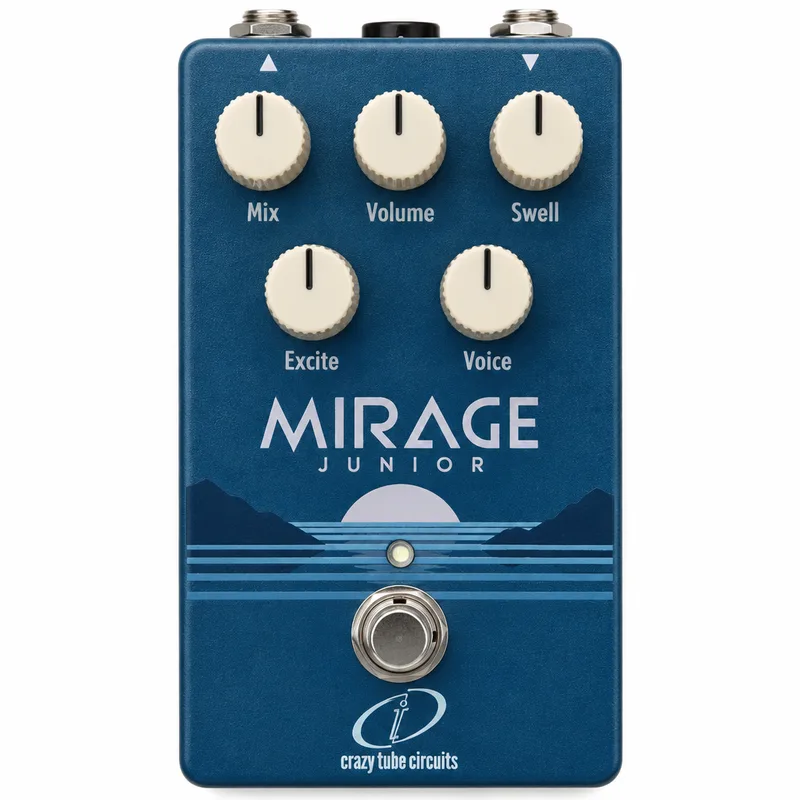
That version arrived as the Mirage JR, released in late September 2025, a little over two months after the original3. It extracts the first channel of the Mirage Dual Reverb Workstation, keeping the 16 algorithms and control topology but omitting the routing options and stereo playback7. Gearnews described it as half of the big Mirage: everything the larger version offers except stereo and the second engine3. Premier Guitar reported that Mirage JR delivers the same studio-grade processing power in a streamlined, single-engine mono format8.
| Mirage | Mirage JR | |
|---|---|---|
| Engines | Two (R1 and R2)2 | One3 |
| Algorithms | 16 per engine2 | 16, in two banks2910 |
| Format | Stereo-capable1 | Mono3 |
| Power | 9V DC, 210 mA2 | 9V DC center negative, 115 mA11 |
| Bypass | True or buffered with trails2 | True or buffered with trails11 |
Delicious Audio also reported that a simpler single-engine version was in development for players who prefer a more straightforward option, which matches the JR that followed9.
What reviewers said
Guitar World gave the Mirage four and a half stars, concluding that its routing flexibility, creative sonic potential and performance options could make it a solid reality on your pedalboard2.
Guitar World's Trevor Curwen gave the Mirage four and a half stars, finding that its routing flexibility, creative sonic potential and performance options could make it a solid reality on your pedalboard, and noting that it works without menus2.
MusicRadar's Jonathan Horsley called it "one serious reverb pedal with no menu-diving required"5. The Mirage Jr fared just as well in the press: MusicRadar rated its sounds five stars11, and Premier Guitar credited it with lush, detailed soundscapes8.
Videos
The Studio Rats
TheGuitarGeek
Mike Hermans
Questions
Is the Crazy Tube Circuits Mirage analog or digital?
It is a digital reverb with a full analog dry signal path, meaning your uneffected guitar signal stays analog from input to output while the reverb processing happens digitally. Each of its two engines runs one of 16 algorithms, from plate and spring emulations to shimmer and infinite sustain.
Can the Mirage run in stereo?
Yes. The two engines, R1 and R2, each have their own input and outputs, and you can split them left and right for stereo processing, with a different reverb type on each channel. You can also run the engines in series for layered reverbs, or as two independent mono reverbs.
Is the Mirage true bypass or buffered?
Both, selectable. You can set each engine for true bypass or buffered bypass with trails, so the reverb tail continues after you disengage. Internal switches handle the bypass mode for R1 and R2 along with routing assignment and a kill dry option.
How many reverb algorithms does the Mirage have?
Sixteen per engine, organized into two banks of eight. The outer bank holds familiar reverbs like Plate, Hall, Room, Gated, Spring, Springier and Inchindown, while the inner bank pushes into shimmer, modulation and infinite sustain territory. With both engines combined there are 256 algorithm combinations.
What is the difference between the Mirage and the Mirage Jr?
The Mirage Jr is a compact, single-engine, mono version of the Mirage. It keeps the same 16 algorithms and the same core controls, Mix, Volume, Swell, Excite and Voice, but drops the second engine, the stereo routing options and stereo playback. It draws 115 mA instead of the Mirage's 210 mA.
Sources (11)
- Mirage - Crazy Tube Circuits, Crazy Tube Circuits
- Crazy Tube Circuits Mirage review, Guitar World, 2025-11-05
- Crazy Tube Circuits Mirage Junior: Compact Ambient Reverb with Single Engine, gearnews.com, 2025-09-29
- Guitar Pedal X, Guitar Pedal X, 2025-07-01
- “A creative reverb platform built for guitarists, synth players, and sound designers who want studio-grade depth”: With dual reverb engines, 16 algorithms, Crazy Tube Circuits' Mirage is one serious reverb pedal with no menu-diving required, MusicRadar, 2025-07-01
- Mirage (B-Stock), Crazy Tube Circuits
- Guitar Pedal X, Guitar Pedal X, 2025-09-24
- Crazy Tube Circuits Announces Mirage JR, Premier Guitar, 2025-09-29
- Crazy Tube Circuits Mirage Dual Reverb, Delicious Audio, 2025-07-11
- Mirage JR, Crazy Tube Circuits
- "When it comes to sound, I'm convinced there isn't a bad tone in this pedal": Crazy Tube Circuits Mirage JR reverb pedal review, MusicRadar, 2025-11-21