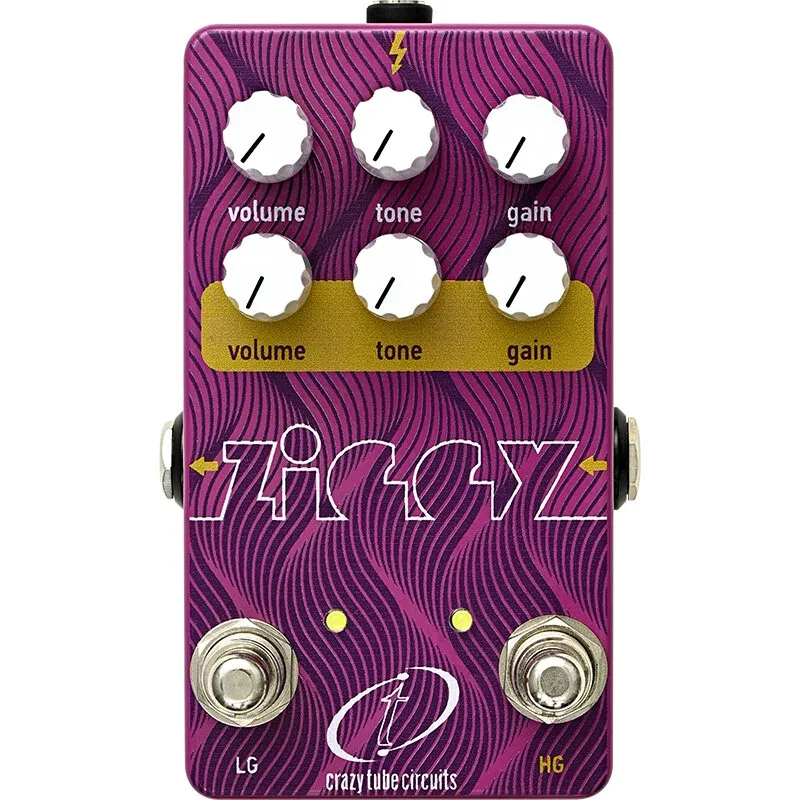


The Crazy Tube Circuits Ziggy is a British-flavored dual overdrive/distortion pedal: two separate gain channels in one box, one low gain and one high gain, each with its own controls and its own footswitch, selected by a silent relay true-bypass switching circuit1. Where most overdrives lean on an opamp for their gain, the Ziggy is built from cascaded discrete MOSFET gain stages, which the maker says are designed to respond like a tube amp with ultra touch sensitivity12.
The amp targets are classic British territory. MusicRadar's reviewer, Trevor Curwen, describes the pedal as designed to give the sound of two classic Brit amps, the AC30 Top Boost and the JTM453. Crazy Tube Circuits says the low gain channel is voiced after a late 60s Super Bass, while the high gain channel sounds and responds like a late 70s Master Volume British amp1.
The controls
The v2 gives each channel its own control set, and the two channels are voiced differently, low and high gain, for what the maker calls ultimate versatility1. Delicious Audio's buying guide lists the v2's controls as Input Gain, Output Master, a three-band EQ (Bass, Mid, Treble), and a Presence switch that can either attenuate negative feedback or boost high-end frequencies7.
| Control | What it does |
|---|---|
| Gain (both channels) | Sets drive level; also acts as a voicing control, adding more bass as you turn clockwise, from jangly and sparkling clean to thick crunch1 |
| Tone / EQ | Behaves as a presence control, adding bite to your tone1; v2 adds Bass, Mid and Treble knobs7 |
| Presence switch (v2) | Attenuates negative feedback or boosts high-end frequencies7 |
| Two footswitches | One per channel, selecting between the two overdrive/distortion channels via relay true bypass16 |
Two details of the gain knob are worth knowing as a player. First, it has an "off" position at fully counterclockwise, and turning it just a little goes immediately from no sound to the first audible sound. An independent circuit analysis found this was deliberate, mimicking the gain knob behavior of most tube amps2. Second, the voicing trick is real circuit behavior, not marketing: the gain pot carries a 22nF treble bleed capacitor, which, as the same analysis puts it, "actually does all the 'voicing' thing"2.
"It is set up as a treble bleed cap but it actually does all the 'voicing' thing."
History and versions
The original Ziggy was a single-channel overdrive with volume, tone and gain knobs. In a 2013 demo video, Pete Thorn walked through it: "Here you've got a volume, a tone control that acts like uh very much like a presence control"8. An updated white and gold version added a two-position gain switch, whose higher gain setting has extra bite and sustain, making it suited to lead sounds2.
The v2, announced in January 2018 and available that April at €199, rebuilt the pedal as the two-channel dual overdrive/distortion sold today5. Delicious Audio described it at launch as a two-channel Plexi-style distortion and one of the company's most popular pedals6. The current webstore price is €189.001.
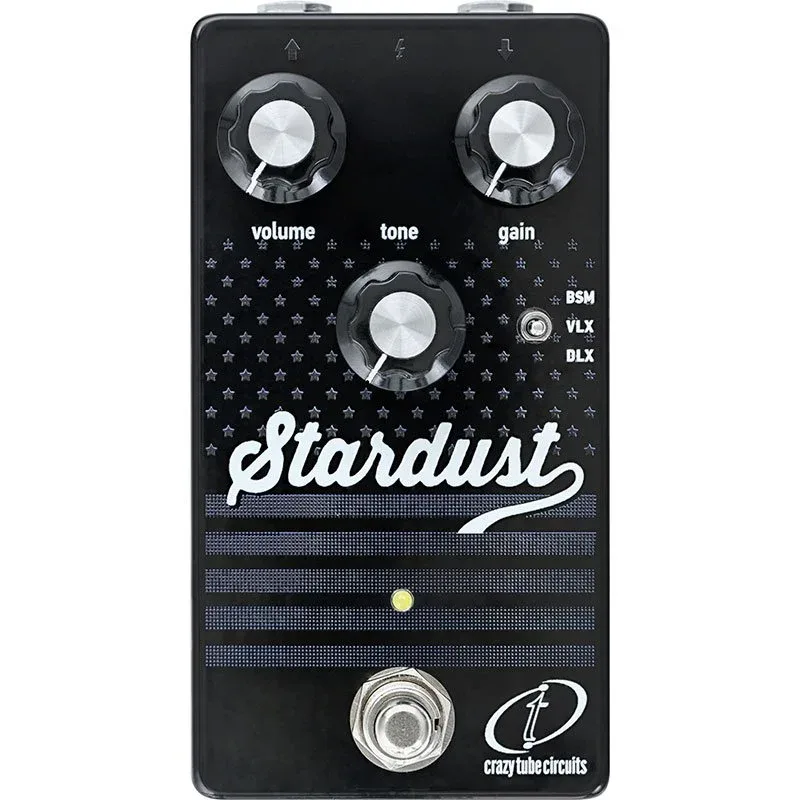
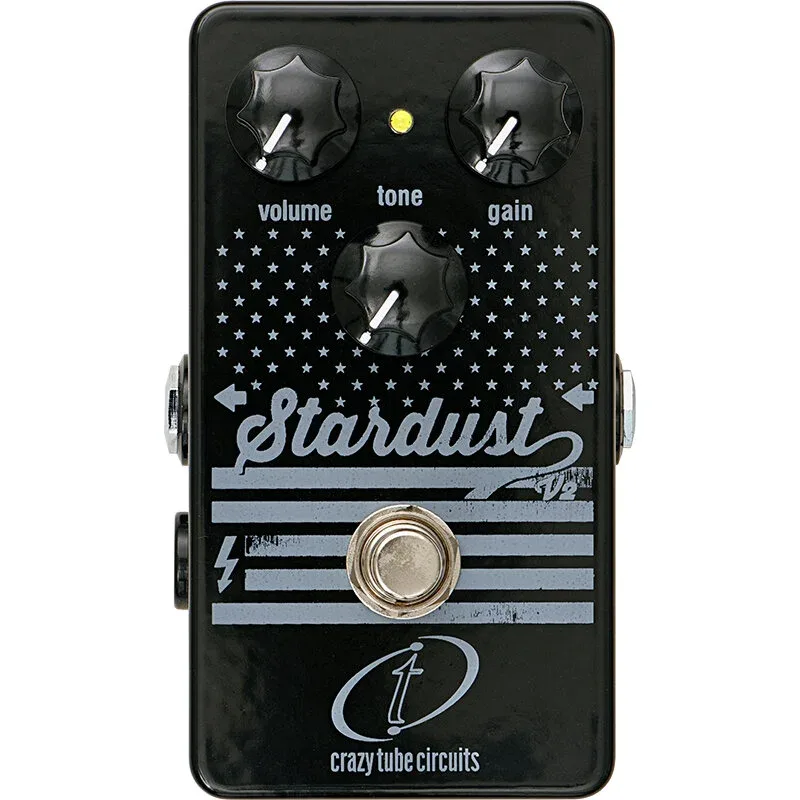
The higher gain setting of the original's gain switch is reminiscent of the now discontinued wine red Stardust, an earlier Crazy Tube Circuits pedal2.
Inside the circuit: three BS170 MOSFETs
The Ziggy's circuit is what sets it apart from most overdrive pedals. An independent teardown of the pedal, reverse-engineered by its own designer Giorgos Ziotas with a schematic drawn by Nocentelli and the layout verified by Hozy31, found three BS170 MOSFETs arranged as cascaded discrete gain stages2.
The analysis notes that, unlike most overdrives, the pedal does not feature a "mojo" opamp but cascaded discrete MOSFET gain stages2. Supporting details from that teardown:
- 9.1V zener diodes (BZX55C) from gate to source protect the MOSFETs from static2.
- Static protection diodes appear on only 2 of the 3 BS170s: the first MOSFET needs protection from almost everything, and the second because of a risk of a spike during switching2.
- The two-position gain switch simply adds 2 resistors in parallel going to ground, and should be an On-On switch2.
The same analysis compared the topology to a familiar benchmark: the Z.Vex Box of Rock. The finding was that the Ziggy is very similar in topology, with cascaded gain stages, but with a different gain and tone structure yielding different sonic qualities, for example touch sensitivity2.
What reviewers said
MusicRadar's Trevor Curwen reviewed the Ziggy and found the gain knob central to its character: starting with mild overdrive and a bright tonality, it gradually loses its trebly edge and gets crunchier, up to midway reminiscent of a Vox with dirt, then cranked Marshall territory3. His overall verdict:
"An overdrive with distinct character - try it if you fancy some 60s Brit amp tone."
"Cool recreation of two old favourites."
The review was not entirely uncritical: alongside that praise, MusicRadar listed four-screw battery access among the pedal's drawbacks3.
Pete Thorn's 2013 demo of the original Ziggy covers the control set and the range of drive tones, from the low-gain jangle through the higher-gain crunch8.
Videos
Rabea Massaad
R.J. Ronquillo
Questions
Is the Crazy Tube Circuits Ziggy true bypass?
Yes. The Ziggy v2 uses a silent relay true-bypass switching circuit, which selects between its two separate overdrive/distortion channels, one low gain and one high gain, each with its own footswitch. When both channels are off, the signal path is true bypass.
What amps is the Crazy Tube Circuits Ziggy based on?
MusicRadar's reviewer describes the Ziggy as designed to give the sound of two classic British amps: the Vox AC30 Top Boost and the Marshall JTM45. Crazy Tube Circuits itself says the low gain channel is voiced after a late 60s Super Bass, and the high gain channel sounds and responds like a late 70s Master Volume British amp.
Does the Crazy Tube Circuits Ziggy take a battery?
It can take one, but battery access is awkward. MusicRadar's review lists four-screw battery access among the pedal's drawbacks, meaning you have to unscrew the bottom plate to swap a battery. Like most modern pedals, it is happiest powered from a 9V DC supply.
Is the Ziggy similar to the Z.Vex Box of Rock?
In topology, yes. An independent circuit analysis found the Ziggy very similar in layout to the Z.Vex Box of Rock, with cascaded gain stages, but with a different gain and tone structure that yields different sonic qualities, including touch sensitivity. The Ziggy uses three BS170 MOSFETs in place of an opamp-based drive.
Sources (8)
- Ziggy v2, Crazy Tube Circuits
- Guitar FX Layouts: Crazy Tube Circuits Ziggy, Guitar FX Layouts (tagboardeffects.blogspot.com), 2016-05-02
- Crazy Tube Circuits Ziggy review, MusicRadar, 2013-06-05
- Ziggy v2, Crazy Tube Circuits
- Crazy Tube Circuits introduce Constellation Germanium Fuzz & Ziggy v2, Guitar.com, 2018-01-19
- Crazy Tube Circuits Ziggy V2 Dual Overdrive/Distortion, Delicious Audio, 2018-03-08
- 2024 Best Plexi Pedals & Marshall-Style Distortions: A Buyer's Guide, Delicious Audio, 2024-09-16
- Crazy Tube Circuits Ziggy Overdrive, demo by Pete Thorn/Vintage King, YouTube (Pete Thorn channel), 2013-06-21