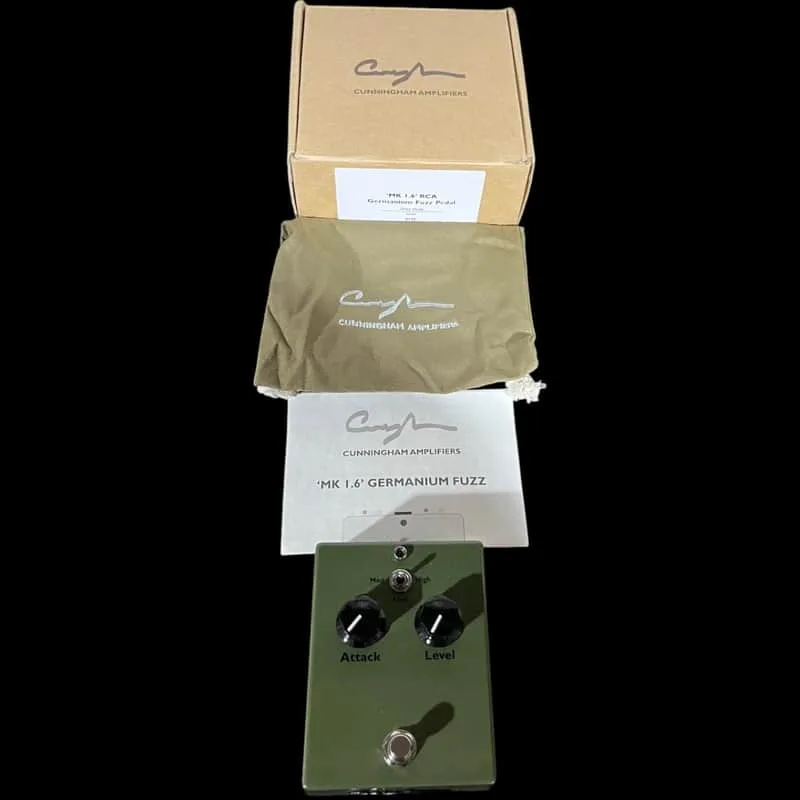


The Cunningham Amps Dual Range Fuzz is a high-end, hand-wired fuzz pedal made in New Zealand, built as a Tone Bender-inspired circuit. It pairs the fuzz with a boost controlled by its own separate footswitch, and it is available in Germanium, Silicon or Hybrid versions, each named for the clipping transistors inside1.
A Tone Bender-style fuzz with a separate boost
The circuit is based on the MK 1.6 of the Tone Bender, the vintage fuzz design, and Delicious Audio describes it as "a high-end, hand-wired Tone Bender-inspired circuit"1. The sound, again by Delicious Audio's description, "ranges from soft to sonic destruction", from boosted cleans to full fuzzed-out mayhem1. The clipping transistor diode is customizable, with each option hand selected and tested1.
Construction follows the same approach: the circuit is built on a hand etched board with what the maker's write-up calls the highest quality components and an obsessive attention to detail1. Delicious Audio added the pedal to its article on the best Tone Bender-style fuzz pedals1.
On That Pedal Show's fuzz roundup episode, which explored ten fuzz pedals including the Cunningham, Daniel Steinhardt later told Guitar World that the RCA Germanium version was "my favorite fuzz pedal in recent memory", saying it sounds great with humbuckers and single coils and that the build quality is second to none2. There is a separate page for the Dual Range Fuzz RCA Germanium.
The controls and footswitches
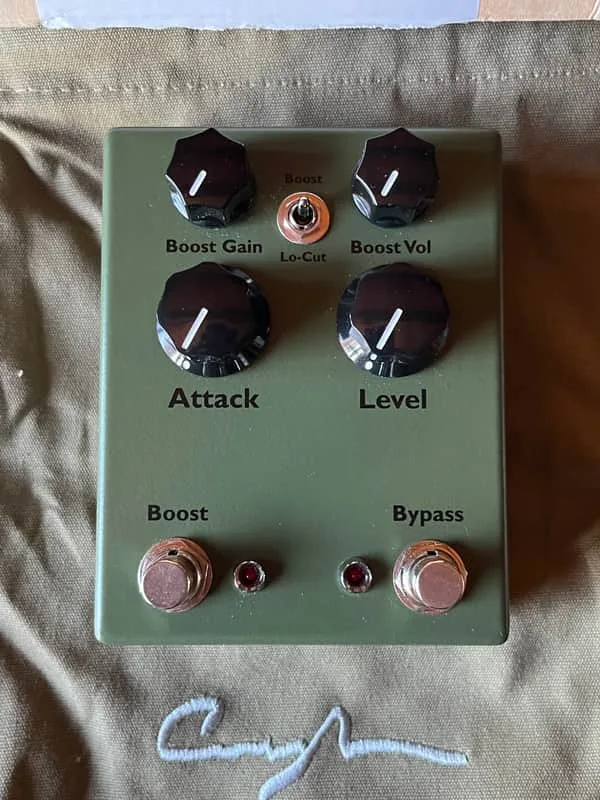
The pedal keeps things simple: "Attack" dials up the fuzz and "Level" sets the overall output of the effect, while the boost is controlled by a separate footswitch and two knobs, for gain and volume, alongside the main fuzz footswitch1.
| Control | What it does |
|---|---|
| Attack | Dials up the fuzz1 |
| Level | Sets the overall output of the effect1 |
| Boost gain | Sets the boost's gain1 |
| Boost volume | Sets the boost's volume1 |
The boost is controlled by a separate footswitch, alongside the main fuzz footswitch, so the two sections can be switched independently1.
Power and the germanium question
The Dual Range Fuzz is both battery powered and includes a DC power socket, with a standard center negative 2.1mm plug, and it has an on/off switch for use on battery only1.
The Germanium version has a positive ground and must be used with the battery or an isolated power supply. Do not daisy chain it with negative ground pedals1.
The three versions differ in their clipping transistors:
| Version | Transistors |
|---|---|
| Germanium | Premium select NOS devices1 |
| Hybrid | One germanium and one silicon, for the best of both worlds1 |
| Higher Gain Silicon | Premium NOS BC109s1 |
Videos
Edge of Breakup 🎥 Guitars, Pickups, Amps & Pedals
Once Upon A Tone
Dhany
Questions
Which Tone Bender is the Cunningham Dual Range Fuzz based on?
According to Delicious Audio, the circuit is based on the MK 1.6 of the Tone Bender, the vintage fuzz design the pedal takes its inspiration from. It is built as a high-end, hand-wired circuit on a hand etched board with hand selected and tested clipping transistors, and it is made in New Zealand.
Can I daisy chain the Dual Range Fuzz with other pedals?
Not the Germanium version. It has a positive ground, so it must be used with its battery or an isolated power supply, and Delicious Audio warns not to daisy chain it with negative ground pedals. The pedal also includes a DC power socket with a standard centre negative 2.1mm plug for the versions that use one.
Does the Cunningham Dual Range Fuzz run on a battery?
Yes. The Dual Range Fuzz is battery powered and also includes a DC power socket, so it can run either way. When running on battery only, it has an on/off switch to conserve the battery.
Where is the Cunningham Dual Range Fuzz made?
It is handmade in New Zealand. Cunningham is an amp company based there, and according to Guitar World the company sent pedals to Daniel Steinhardt of That Pedal Show to try, leading to his comments on the RCA Germanium version.
What is the difference between the germanium and silicon versions?
The pedal is available in Germanium, Silicon or Hybrid models. The Germanium version uses premium select NOS devices and has a positive ground. The Higher Gain Silicon version uses premium NOS BC109s. The Hybrid uses one germanium and one silicon transistor, described as the best of both worlds.
Sources (2)
- Cunningham Amps Dual Range Fuzz, Delicious Audio, 2022-12-05
- Daniel Steinhardt reveals his top 5 pedals (from the past 5 years), Guitar World, 2025-05-29