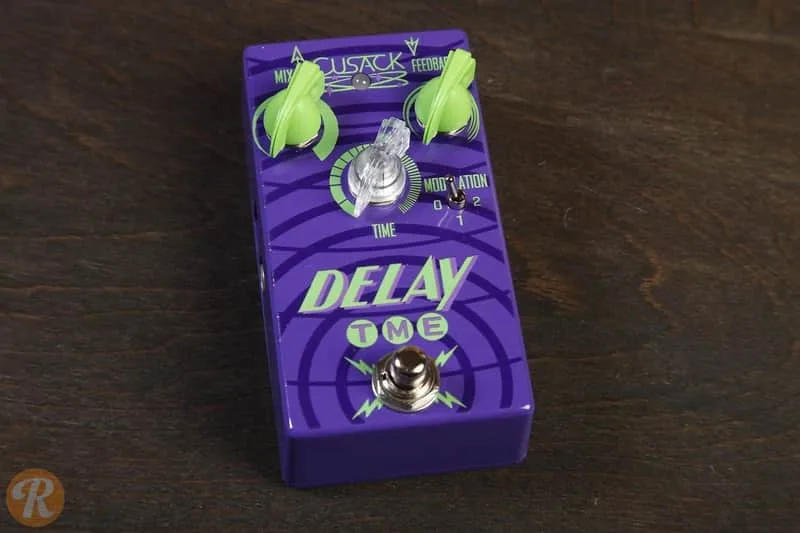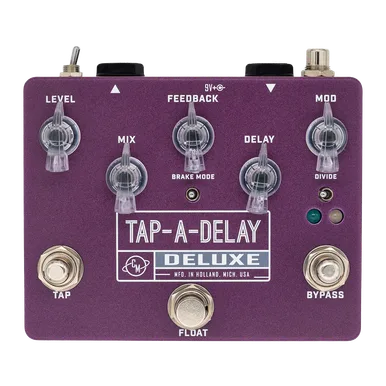


The Cusack Music Delay TME is a compact delay pedal with tap tempo, built as a scaled-back version of the company's Tap-A-Delay. "TME" stands for Time Modulation Emulator, and the pedal pairs its delay with a modulation section that Cusack describes as tape-like, especially at longer delay times, courtesy of the PT-2399 chip at the heart of the circuit12. The original Delay TME and the Delay TME with Tap Tempo are both discontinued; the design lives on in the Delay TME 2.0, which adds brake mode and tap divide32.
What the Delay TME does
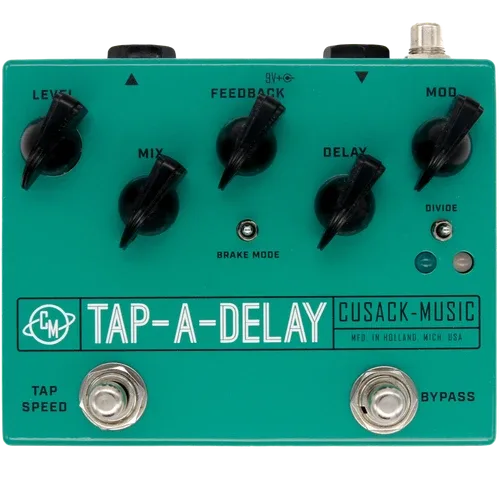
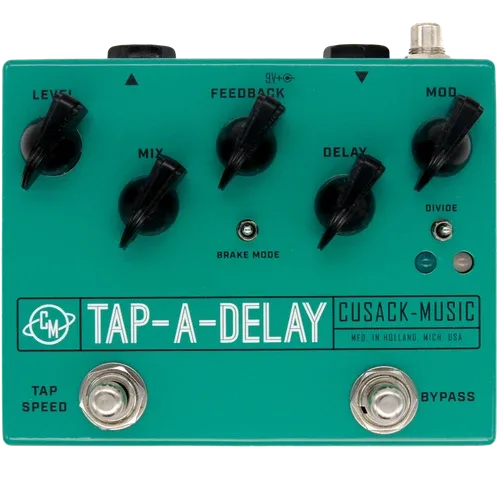
The pedal is a digital delay that mixes your original analog signal with the delayed signal, an approach Cusack also uses on the Tap-A-Delay, a 750mS digital delay the TME is based on65. The original Delay TME's delay range runs from 50 to 750 mS5, while the 2.0 covers 120 to 750 mS, which Cusack calls "a very useable range of delay time"2.
The 2.0 is built on the PT-2399 chip, which Cusack describes as follows2:
"the venerable PT-2399 chip, which is known for it's tape-like response (especially at longer delay times)"
The modulation section is what gives the pedal its name. A three-position toggle selects between modulation off and two modulation settings, which the manual labels No Modulation, Soft Modulation and Deep Modulation4. The 2.0 ships in a tropical turquoise two-stage metallic powdercoat with a non-scratch textured black backplate2.
The controls
The control set is deliberately simple. The 2.0's manual describes four knobs: Mix, Feedback, Time and Level2, and the earlier Tap Tempo model matches that layout7.
| Control | What it does |
|---|---|
| TIME | Controls the timing of your repeats; turning it overrides the current tempo, and tapping a tempo overrides the knob41 |
| FEEDBACK | Adjusts the amount of repeats; fully clockwise it will self oscillate4 |
| MIX | Balances dry and delayed signal7 |
| LVL / Level | Adjusts overall output gain4 |
| MOD switch | Selects the modulation type on the delayed signal: No Modulation, Soft Modulation, Deep Modulation4 |
An earlier manual describes the feedback behavior in more detail: around 3 o'clock gives infinite repeats, and past that the delay oscillates1. The 2.0's clear Time knob is LED illuminated and flashes the delay time selected2.
There are two footswitches, TAP and BYPASS. Pressing both at the same time switches between Brake Up and Brake Down4.
Tap divisions and brake modes
Tap in a tempo, then hold the Bypass switch and move the mod switch to change your tap divisions4. The divisions available are 1/4 note, 1/8 note and dotted 1/8 note4. On the 2.0, the three-way toggle serves triple duty: on its own it selects modulation, held with the Tap footswitch it selects brake release behavior, and held with the Bypass footswitch it sets the tap divide2.
Brake mode ramps the delay time while you hold the Tap switch, and the mod selector chooses how the brake disengages4:
- Mod 1 (Stay): the rate stays where the ramp ended
- Mod 2 (Snapback): the rate quickly snaps back to the original tempo
- Mod 3 (Driftback): the rate slowly drifts back to the original tempo42
Brake direction, up or down, is changed by tapping both footswitches at once42.
Power
The pedal runs on a standard 9V DC center-negative power supply, and the original also accepts a 9V battery, with neither included43. Current draw is listed as about 22mA in the 2024 manual4 and about 32mA in the 2021 manual1, so plan your power supply for the higher figure. Either way, the draw is low enough that the pedal shares comfortably with other effects on a typical isolated supply.
Versions: Delay TME, Tap Tempo model and 2.0
The line went through three stages:
| Version | Status | Key points |
|---|---|---|
| Delay TME | Discontinued3 | Based on the Tap-A-Delay, scaled back to be more user friendly; recessed RCA tap input on the left of the pedal5 |
| Delay TME with Tap Tempo | Discontinued7 | Adds tap tempo; toggle switch selects three modulation levels7 |
| Delay TME 2.0 | Current | Compact tap tempo delay with brake mode, tap divide and an EXPression/Tap jack; $195.002 |
The original's RCA TAP IN jack is a recessed RCA jack on the left of the pedal used to tap in a tempo: connect a momentary, normally open switch and tap it twice to change the tempo5. The 2.0 replaces this with an EXPression/Tap jack that controls the delay time or the tap tempo remotely, so an expression pedal works for time control2.
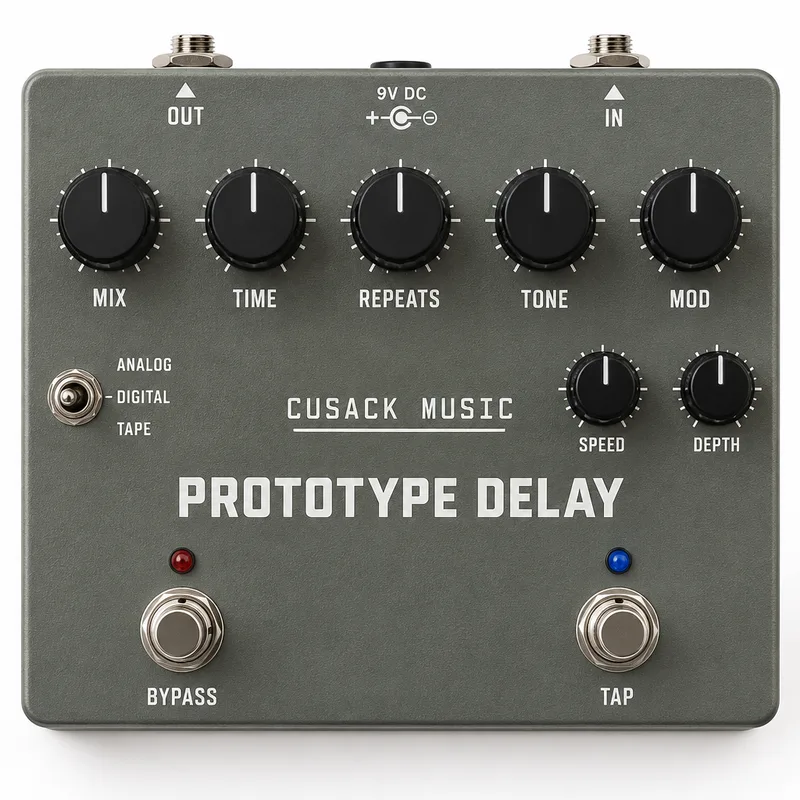
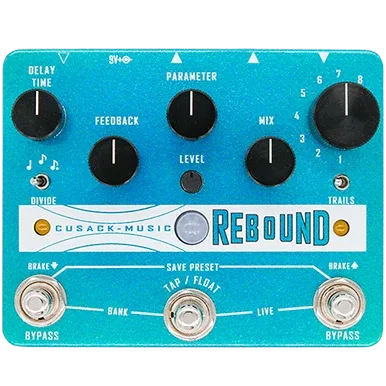
Cusack describes the Tap Tempo model as "our one of a kind delay effect in a scaled down version that is packed with versatile settings in a user friendly configuration"7. The company's later delay work continued with the Prototype Delay and the Rebound.
Videos
shnobel
Best Guitar Effects
BeardTone
Questions
Is the Cusack Delay TME discontinued?
Yes. Cusack Music lists the original Delay TME and the Delay TME with Tap Tempo as discontinued. The design continues in the Delay TME 2.0, a compact tap tempo delay that keeps the modulation, brake mode and tap divide features and sells for $195.00.
Can I use an expression pedal with the Delay TME?
Yes. The Delay TME 2.0 has an EXPression/Tap jack that lets you control the delay time or the tap tempo remotely. Earlier versions used an EXP/TAP jack on the pedal for expression or external tap, and the original Delay TME had a recessed RCA jack for tapping in a tempo with a momentary switch.
Will the Delay TME self-oscillate?
Yes. The manual says the Feedback knob adjusts the amount of repeats and that turned fully clockwise it will self oscillate. An earlier manual describes the same behavior in stages: around 3 o'clock gives infinite repeats, and past that the delay oscillates.
Where is the Cusack Delay TME made?
The manual states the Delay TME is manufactured in Holland, Michigan, USA. Cusack Music is a small builder, and the Delay TME line is part of its range of delay, fuzz and switching pedals.
What is brake mode on the Cusack Delay TME 2.0?
Brake mode ramps the delay time while you hold the Tap footswitch, like slowing a tape machine. On the 2.0, holding the Tap footswitch and moving the three-way toggle selects how the brake releases: Stay, Snapback or Driftback. Tapping both footswitches at once changes the brake direction.
What are the tap divide options on the TME 2.0?
The tap divide options are 1/4 note, 1/8 note and dotted 1/8 note. You tap in the tempo, then hold the Bypass footswitch and move the three-way toggle to change the division. The same toggle selects modulation settings when neither footswitch is held.
Sources (7)
- on:, Cusack Music, 2021-10
- Delay TME Compact Tap Tempo Delay, Cusack Music
- Delay TME Time Modulation Emulator (Original), Cusack Music
- delaytmeFinalPrint, Cusack Music, 2024
- on:, Cusack Music, 2014-11-20
- Tap-a-Delay Tap Tempo Analog Voiced Delay, Cusack Music
- Delay TME with Tap Tempo (Discontinued), Cusack Music