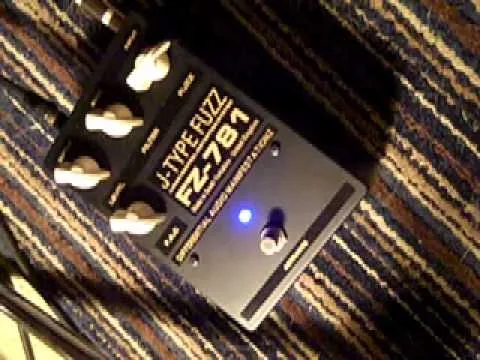

The DAM FZ-781 J Type Fuzz is a fuzz pedal from DAM, the maker behind a family of limited-run fuzzes documented largely by the DIY community. It is described by the independent layout blog Guitar FX Layouts as "a nice variant of Tonebender MkII", placing it in the lineage of the classic three-transistor British fuzz circuit1. Its distinguishing feature is a four-position rotary switch that swaps the output capacitor, giving the player several output voicings in one box1.
The FZ-781 is a positive ground effect, like the DAM FZ-673 layout posted the day before it on Guitar FX Layouts1. Positive-ground pedals do not mix with standard negative-tip daisy-chain supplies, so plan for an isolated or dedicated power arrangement.
Status and origins
Guitar FX Layouts, which published a stripboard layout for the pedal on 29 July 2014, could not find an official description of the pedal: "I can't find an official description for this pedal which I'm assuming was one of DAM's limited runs"1. The same post linked a video demo, with the author noting "But it sounds pretty good in this vid"1. DAM's limited-run fuzzes have drawn similar community documentation over the years, including the DAM Meathead Deluxe and the DAM Buzzotron1.
What is on record about the pedal comes together like this:
| Item | Detail |
|---|---|
| Circuit family | Tone Bender MkII variant1 |
| Signature control | 4-position rotary switch swapping the output cap1 |
| Power polarity | Positive ground1 |
| Layout published | 29 July 2014, Guitar FX Layouts1 |
| Schematic source | beedotman on the freestompboxes.org forum1 |
| Official maker description | None found; assumed a DAM limited run1 |
The output cap rotary switch
The FZ-781's signature control is simple in concept: "This uses a 4 position rotary switch to swap the output cap"1. Swapping the output capacitor changes how the fuzz's output is shaped, effectively giving four voicings from the same circuit.
There is a catch for anyone building or modifying one. As the layout author put it, "none of the values used in the switch are confirmed, so as usual with anything like this it's a much better idea to use" values chosen to suit the builder's own taste and gear1. In other words, the four positions are a starting point, not a fixed specification.
Circuit and transistors
The circuit sits in the fuzz family close to the Tone Bender MkII, a design where transistor choice strongly shapes the tone. The builder of the tagboard version reported success with germanium-style parts on hand: "Will have to try different trannies as I have just droped 3 2N404A that I had on hand"1. He also confirmed the layout itself works: "You can tag it. Works fine"1.
For anyone approaching the tagboard build, the post's practical points are:
- The layout is a stripboard (tagboard) build, confirmed working by its builder1.
- The schematic it was based on came from beedotman on freestompboxes.org1.
- The builder used three 2N404A transistors he had on hand and planned to try others1.
- The rotary switch's capacitor values are unconfirmed, so choose values to taste1.
Videos
jermsfuzz
Questions
Is the DAM FZ-781 a Tone Bender circuit?
The independent layout blog Guitar FX Layouts describes the FZ-781 as a nice variant of the Tonebender MkII. That places it in the classic three-transistor British fuzz family, though it is a variation rather than a straight copy, with its own output capacitor switching arrangement added on top of the core circuit.
Is the FZ-781 positive ground?
Yes. Guitar FX Layouts identifies it as a positive ground effect, like the DAM FZ-673 layout posted the day before. That matters for power: positive-ground pedals cannot share a standard daisy chain with modern negative-tip pedals, so builders and players need an isolated supply or a dedicated power arrangement.
What transistors did a builder use in the FZ-781?
The builder behind the Guitar FX Layouts tagboard version said he dropped in three 2N404A transistors that he had on hand, and planned to try different transistors afterward. Transistor choice is a known variable in this style of fuzz, so substitutions are expected.
Is the DAM FZ-781 J Type Fuzz an official DAM release?
Guitar FX Layouts could not find an official description of the pedal and assumed it was one of DAM's limited runs. No official maker description of the pedal is known, so what is documented about it comes from the independent DIY community rather than the company.
What does the rotary switch do on the FZ-781?
It is a four-position rotary switch that swaps the output capacitor, changing the character of the fuzz's output. The values used in the switch are unconfirmed, so the layout author suggests choosing capacitor values to suit your own taste and gear rather than treating any published set as fixed.
Sources (1)
- Guitar FX Layouts: DAM FZ-781 J Type Fuzz, Guitar FX Layouts (tagboardeffects.blogspot.com), 2014-07-29