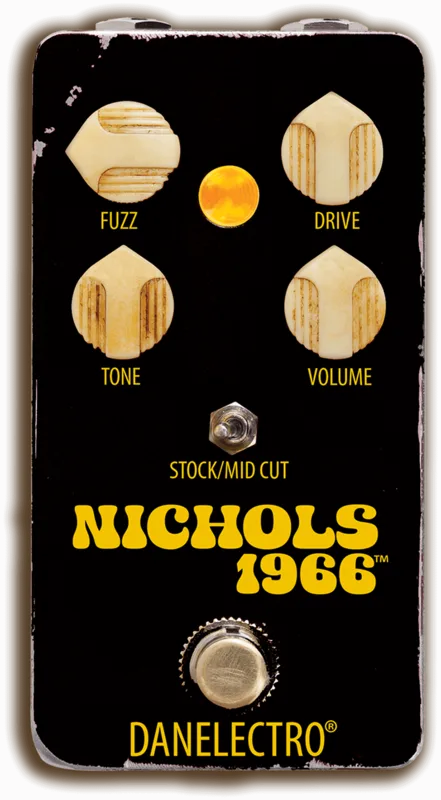


The Danelectro Nichols 1966 is a fuzz pedal that blurs the lines between fuzz and overdrive. Built around a unique three-transistor circuit, it delivers a dynamic range of tones, from subtle overdrive to saturated fuzz, and Danelectro describes its circuit architecture as completely unique, one that has never been seen again1. It was introduced by Danelectro as new for 2024 at NAMM2.
The pedal is a modern re-creation of the Liverpool Fuzz-Tone, the first effects pedal designed by Steve Ridinger, the founder of Foxx pedals and Danelectro's current owner3. GuitarPlayer calls the Nichols 1966 a reissue of Ridinger's own original-design dirt pedal from 19664.
A three-transistor pedal between fuzz and overdrive
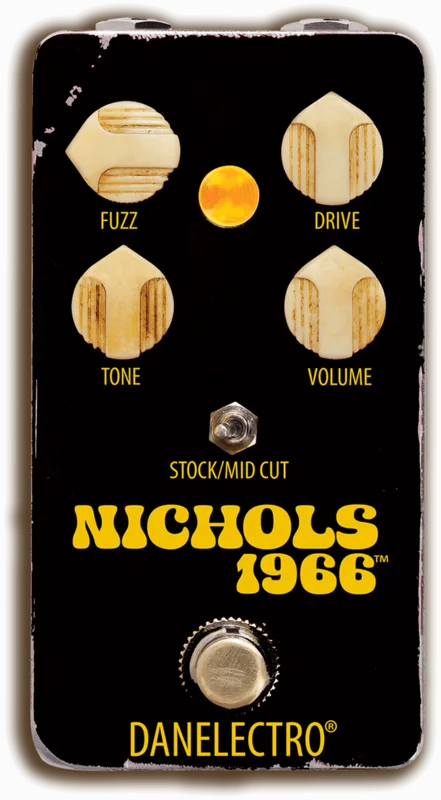
The Nichols 1966 houses a unique three-transistor circuit5, and its behavior depends heavily on where the knobs sit. gearnews describes it as straddling somewhere between a fuzz and a distortion, depending on where the controls are set3. The build document for the circuit puts it similarly: a versatile palette from subtle overdrive to saturated fuzz1.
Pedal of the Day's review characterizes the sound as a distinctive "glass-shattering" quality that falls somewhere between a fuzz and a distortion, and notes it is highly reactive to the guitar's volume knob6. That volume-knob responsiveness is worth knowing for players who roll their guitar back to clean up.
The four knobs interact with each other. Both Delicious Audio and Pedal of the Day highlight the interactive Fuzz and Drive knobs as the heart of the pedal, bolstered by more conventional Tone and Volume controls56.
| Control | What it does |
|---|---|
| Fuzz | Sets fuzz amount; interacts with the Drive knob56 |
| Drive | Sets drive amount; interacts with the Fuzz knob56 |
| Tone | Conventional tone control56 |
| Volume | Output level56 |
| Stock/Mid Cut toggle | Mid Cut gives a scooped midrange response; Stock keeps the original voicing15 |
Pedal of the Day's overall take on the control set:
"This stompbox is a true tone tweaker's delight, thanks to its interactive Fuzz and Drive knobs"
History: Steve Ridinger's Liverpool Fuzz Tone
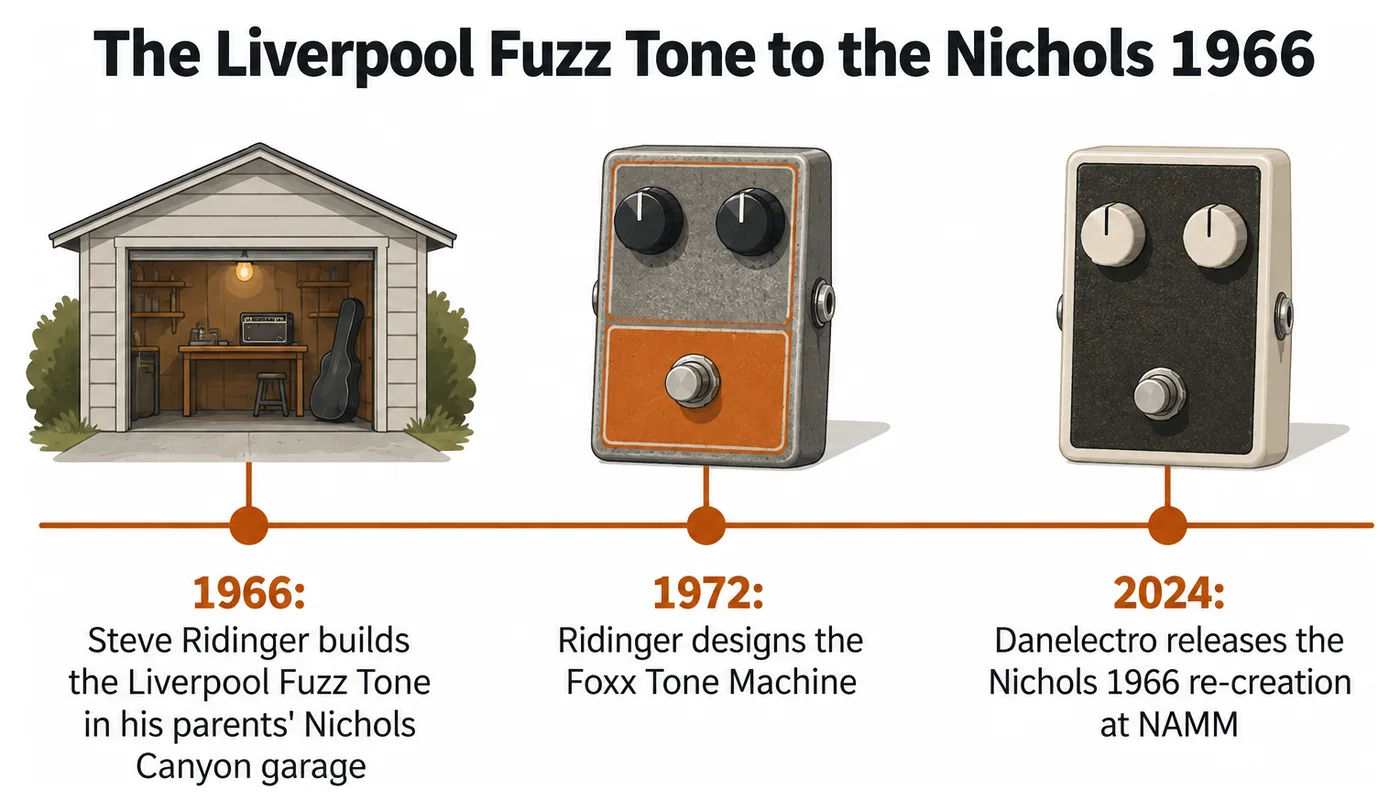
The circuit behind the Nichols 1966 goes back to 1966, when a teenage Steve Ridinger hand built the first Liverpool Fuzz-Tone units in the garage of his parents' Nichols Canyon home in Hollywood, California, and sold them to his high school classmates26. The pedal's name comes from that location: Nichols Canyon Place, where Danelectro says Ridinger created his first effects pedal2.
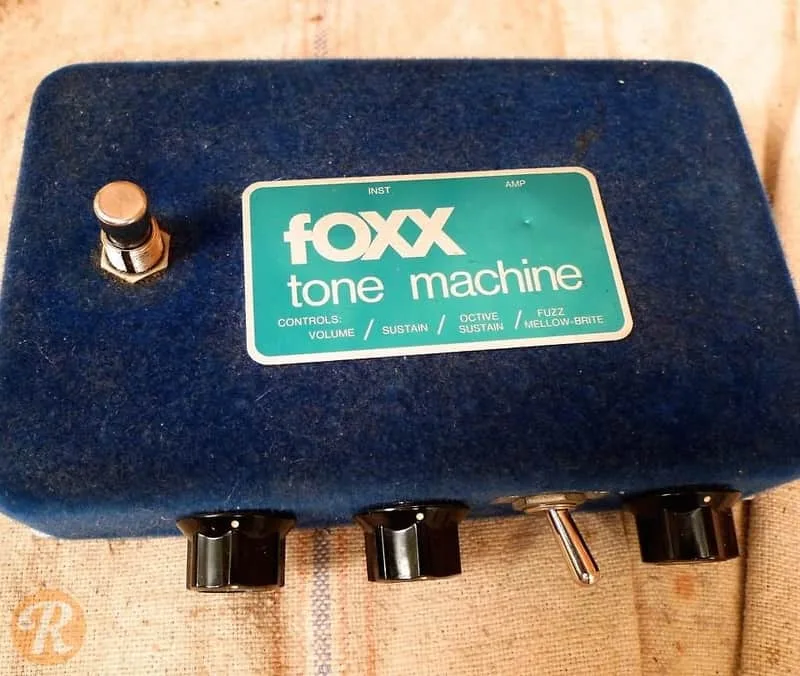
Ridinger went on to design the 1972 Foxx Tone Machine7, and Danelectro credits him with a circuit architecture for the 1966 pedal that it says has never been seen again2. Guitar Pedal X describes the original Liverpool Fuzz-Tone as rare8.
Danelectro notes that it is not affiliated with any current owners of the Liverpool or Fuzz Tone trademarks2, which explains why the modern pedal carries the Nichols Canyon name rather than the original one.
A timeline of the circuit:
Part of a Danelectro fuzz trilogy
Guitar Pedal X also documented a later variant of the Nichols 1966 with changed main typography, described as a much neater variant8.
What reviewers said
Reviews of the Nichols 1966 have been positive, with a few qualifications.
- Pedal of the Day called it a true tone tweaker's delight thanks to its interactive controls and tweakability6.
- GuitarPlayer's verdict: "The Nichols 1966 is a satisfying pedal that's loaded with cool distortion textures, is a blast to play, and kind of inspiring in how it's rooted in a place and time when grind pedals were limited"4.
- Guitar Pedal X, rounding up 2024's fuzz pedals, found it "part novelty obviously but actually delivers some wiry / buzzy / spitty flavours of fuzz", a little raw around the edges overall9.
"Part novelty obviously but actually delivers some wiry / buzzy / spitty flavours of fuzz"
Price
GuitarPlayer lists the Nichols 1966 at $1994, matching the $199 price Guitar Pedal X reported at the pedal's release in early 202449. An earlier preorder listing at Thomann, cited by gearnews in February 2024, showed $136.003, so street pricing has run below list at times.
Videos
Premier Guitar
Guitar World
Soul String
Questions
What does the Mid Cut switch on the Nichols 1966 do?
The Stock/Mid Cut toggle provides additional tonal shaping. In the Mid Cut position it gives a scooped midrange response, while the Stock position leaves the circuit's original voicing intact. Reviewers describe it as adding sonic flexibility on top of the four knobs.
Is the Danelectro Nichols 1966 a fuzz or a distortion?
It is both, depending on where the controls are set. The three-transistor circuit offers a range from subtle overdrive to saturated fuzz, and gearnews describes it as straddling fuzz and distortion. Pedal of the Day calls the result a distinctive glass-shattering sound that reacts strongly to the guitar's volume knob.
Is the Nichols 1966 part of a Danelectro fuzz trilogy?
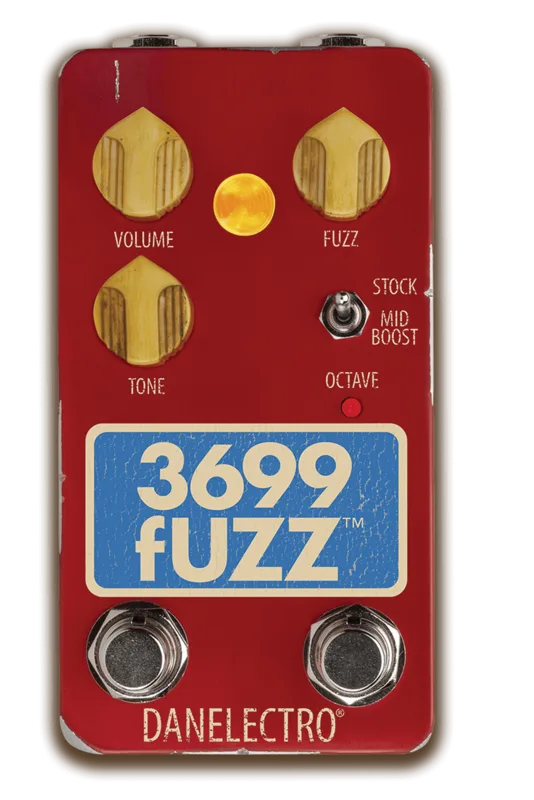
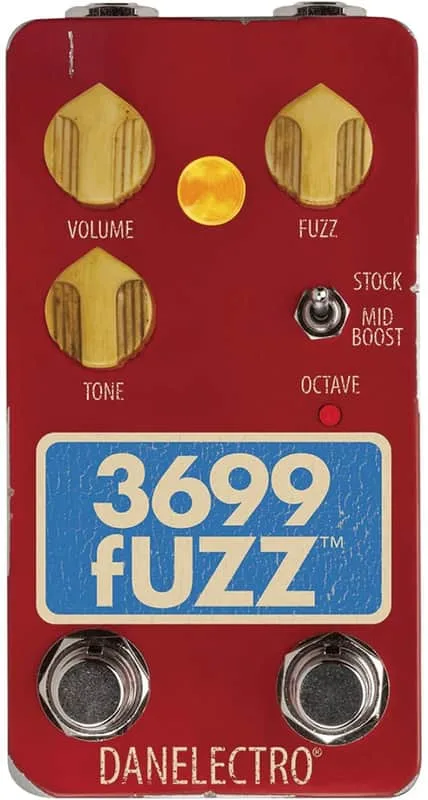
Yes. Guitar Pedal X describes it as the third pedal in Danelectro's vintage fuzz trifecta, joining the Eisenhower Fuzz and the 3699 Fuzz, each tracing a Steve Ridinger design: the 1966 Liverpool Fuzz-Tone, the 1972 Foxx Tone Machine lineage, and the Eisenhower. All three were listed at $199.
How much does the Danelectro Nichols 1966 cost?
GuitarPlayer lists the Nichols 1966 at $199, the same price Guitar Pedal X gave when the pedal launched in 2024. An early 2024 preorder listing at Thomann showed $136.00, so street pricing has varied from the list price.
Sources (9)
- Danelectro-Nichols-1966-Build-Document.pdf, GuitarPCB, 2025-10
- Nichols 1966™, Danelectro (danelectro.com)
- Danelectro Nichols 1966 Fuzz Drive, gearnews.com, 2024-02-08
- “The Nichols keeps the sounds of your guitars intact while running at distortion levels that you can control for lead and rhythm right from the guitar”: Danelectro Nichols 1966 review, GuitarPlayer, 2024-08-23
- Danelectro Nichols 1966 Fuzz, Delicious Audio, 2024-04-22
- Danelectro Nichols 1966 Distortion Fuzz, Pedal of the Day, 2024-04-21
- Guitar Pedal X, Guitar Pedal X, 2024-01-30
- Guitar Pedal X, Guitar Pedal X, 2024-11-12
- Guitar Pedal X, Guitar Pedal X, 2024-12-18