The Foxx Tone Machine is an analog fuzz pedal with a built-in octave-up mode, first released in 1971 and designed by Steve Ridinger12. A single switch takes it from a standard fuzz to an octave-up fuzz, and Guitar Player's Dave Hunter describes it as one of the most expressive and more extreme fuzz boxes of the 1970s, a circuit that offered more control than the average Fuzz Face or Maestro clone2.
What made it stand out was that octave. Where most fuzz pedals of the era, like the Fuzz Face or Tone Bender, stopped at saturated distortion, the Tone Machine added a note an octave above the fundamental, in the territory of the Octavia. Guitar Player's history of the pedal calls it the fuzz of choice for Peter Frampton, Billy Gibbons and Adrian Belew3.
Where the Tone Machine came from
Steve Ridinger created the Foxx pedal line in the 1970s and priced the Tone Machine at $495. Production began in Los Angeles: some of the very early Tone Machines were made in North Hollywood, with most made in Chatsworth from the summer of 1972 onward6. TONEHOME's reference page records the pedal as made by Ridinger Associates Inc of Chatsworth, California, in the early 1970s, produced from the early to mid 70s and re-issued in the 2000s1.
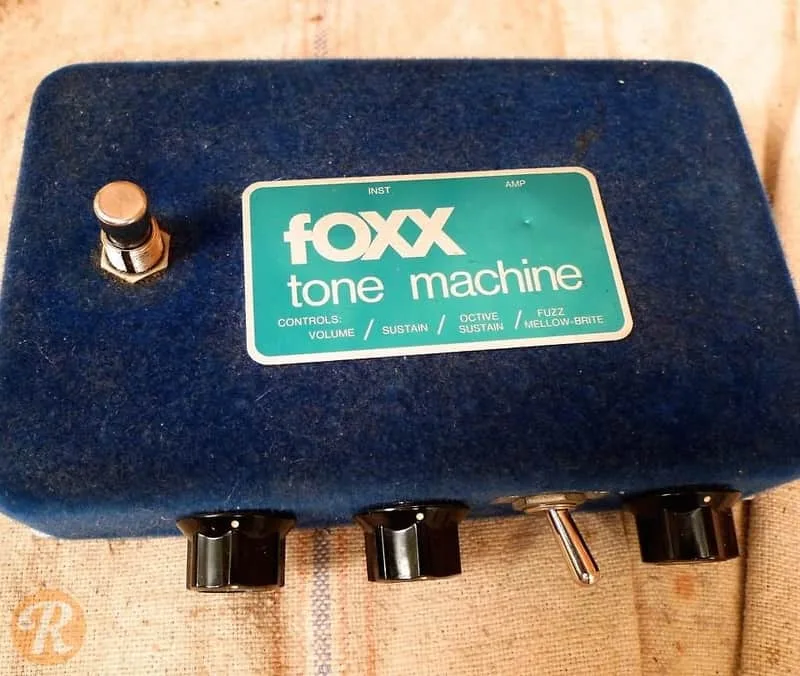
The pedal's look was as distinctive as its sound. It wore a unique velour treatment on the housing, a flocked finish that came in red, black and purple and was, reportedly, a pain to apply6. That finish, and the octave-up sound, are what most players recognize the pedal by today.
How the circuit works: four transistors and an octave-up phase splitter
The Tone Machine used four transistors and had a very effective octave-up sound2. The octave generation is the heart of the design: the stock Tone Machine uses a phase splitter with diode rectifiers to produce the octave-up effect7. In plain terms, the guitar signal is split into two opposite-phase copies, then a pair of diodes rectifies them so their peaks align; what comes out is a waveform dominated by a component at double the original frequency, which the ear hears as the note an octave up.
The transistor choice is undemanding by DIY standards. General Guitar Gadgets' replica kit specifies 2N3904 or other NPN bipolar transistors for all four positions, Q1 through Q48. The original also used orange drop caps and other large size film caps for the non-electrolytic capacitors8.
Compared with its contemporaries, the circuit is on the complex side. A Tone Bender MK-III or MK-IV used three germanium transistors and a tone knob9, and the Univox Super-Fuzz took a different route to its octave. The Tone Machine's four silicon transistors, fuzz and tone shaping, and switchable octave gave it more control than the average Fuzz Face or Maestro clone of the time2.
"The Tone Machine used four transistors and had a very effective octave-up sound"
Guitar Player's reviewer also judged the octave-up effect to be a major bonus that performed better than many other octave and octave-fuzz units on the market2.
The controls and the octave toggle
The control panel is simple: three knobs and a switch. TONEHOME's page lists them as Tone, Gain and Volume1, while Guitar Player's Art Thompson interview with Steve Ridinger describes volume, sustain and fuzz (tone) controls plus a toggle switch to turn the octave on and off6.
| Control | What it does |
|---|---|
| Volume | Sets the output level |
| Gain (sustain) | Sets the amount of fuzz saturation |
| Tone (fuzz) | Shapes the fuzz character |
| Octave toggle | Switches the octave-up effect on and off |
The octave switch is the pedal's signature control. On the original it was labeled "Octive" on the control panel, misspelled, though corrected in the brochures2. The 2005 reissue replaced the toggle with a metal toggle switch described as adding an octave above the fundamental tone, "a la 'Purple Haze'"10, and a later Danelectro version moved the function to a footswitch11.
Versions: velour colors, Stars & Stripes and the reissues
Original Tone Machines came in a big range of colors. TONEHOME notes that purple, blue and red are the most popular ones, with white and US/stars and stripes versions the rarest of all1. The Stars & Stripes unit from 1972, finished in red-white-and-blue flocking, is among the rarest, because the masking needed for the multi-color flocking was laborious and very few were made2.
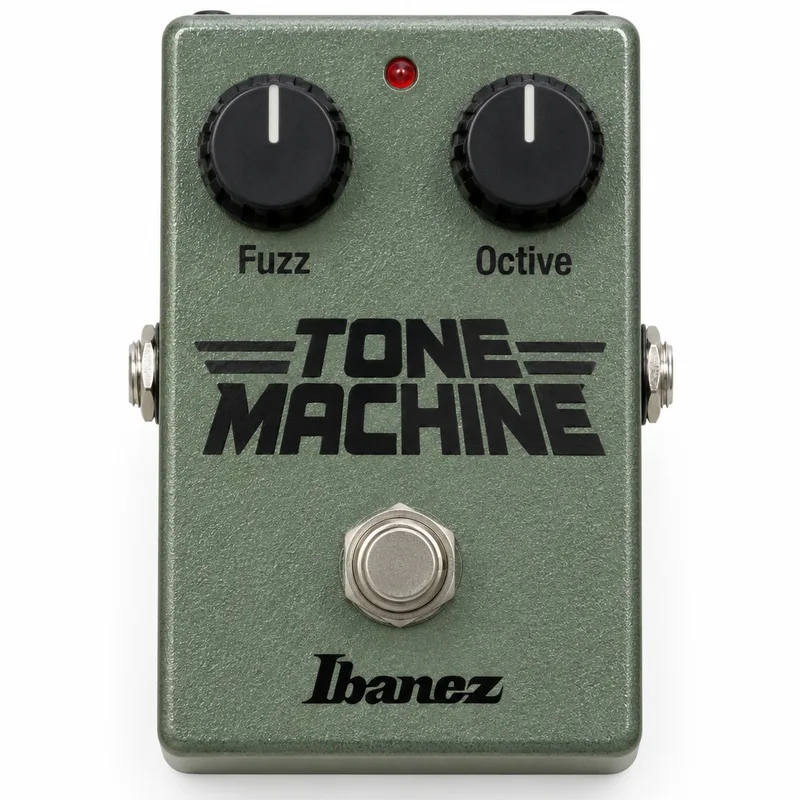
The pedal was also sold under other brand names: Turtle, Sears Roebuck & Co., Nashville, Paraclete and Emmons among them1. The best known of these OEM versions is the Ibanez No. 91 Tone Machine, made by fOXX in California in 1974 and 1975, which TONEHOME identifies immediately as a Steve Ridinger Associates made fOXX Tone Machine with mere OEM branding12. A prototype Ibanez Tone Machine surfaced for sale in 2019 at $20,320.55, which gearnews described as a super simple circuit but a pretty rare edition13.
The reissue history runs in two waves:
- A Foxx-branded reissue in the 2000s, which Guitar World's Trevor Curwen recalls as an official reissue from 2005, when the brand was revived in its original battery-only flocked form112. Guitar Player's Barry Cleveland reviewed that reissue at $249 retail and $199 street, calling it an authentic re-issue of the early-'70s original10.
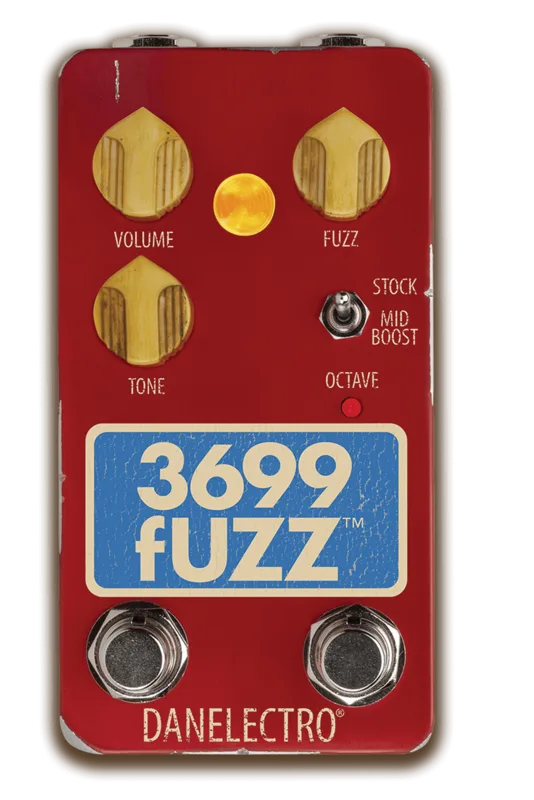
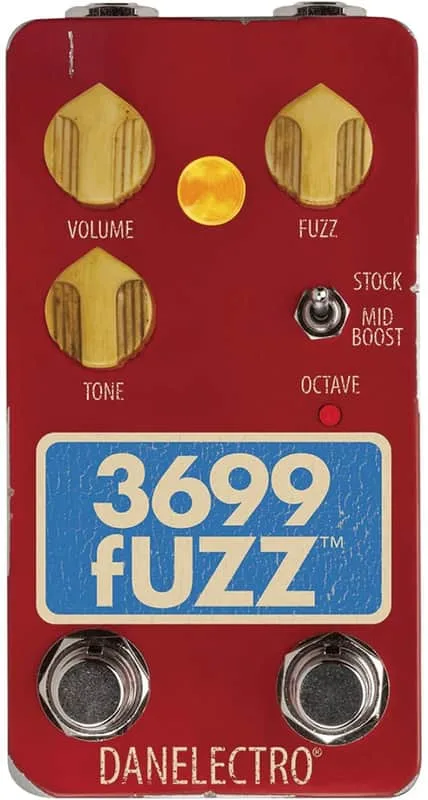
- Danelectro's 3699 fUZZ, in which Danelectro owner Steve Ridinger, the original designer, brought back his circuit with some important tweaks, including an added footswitch for the octave effect511.
The same circuit under other names
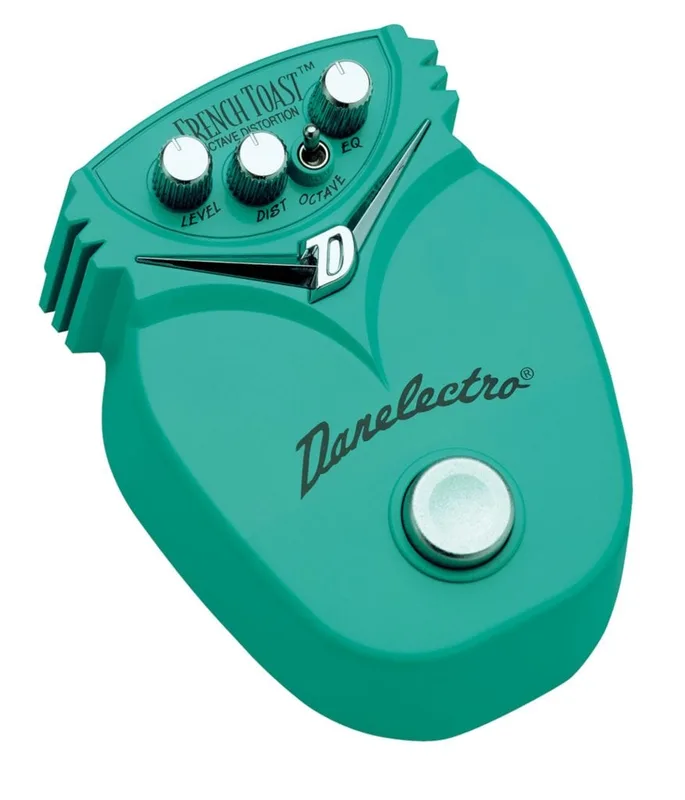
The Tone Machine circuit has had a long afterlife in other makers' pedals. Danelectro's French Toast was based on the original Tone Machine2, and the Danelectro 3699 Octave Fuzz is based on the 1972 Foxx Tone Machine14. Pedal of the Day describes the 3699 fUZZ Octaver as bringing back the original FOXX Tone Machine circuit with tweaks15.
Several current makers trace their octave fuzzes to the same design:
| Pedal | Maker | Relationship to the Tone Machine |
|---|---|---|
| 3699 fUZZ | Danelectro | Steve Ridinger's original circuit with tweaks5 |
| Fur Coat | Orange | Circuit loosely based on the classic Foxx Tone Machine16 |
| F-Octave | Diamond Pedals | Crafted in tribute to the Foxx Tone Machine17 |
| Helium Octave Fuzz | Pause&Effects | Handmade boutique octave-fuzz based on the Foxx Tone Machine circuit18 |
| Obscura Octave Blend | Aion FX | Octave section based on the fOXX Tone Machine, with a clean blend added19 |
| Wolfshirt | Madbean Pedals | DIY project based on the Foxx Tone Machine7 |
| Teisco Fuzz | Teisco | Kinda like the Octavia or the Foxx Tone Machine, but adjusted and modified20 |
The FOXX and TONE MACHINE trademarks are held by Mark Simonsen, who is not affiliated with Danelectro5.
Building one: schematics and kits
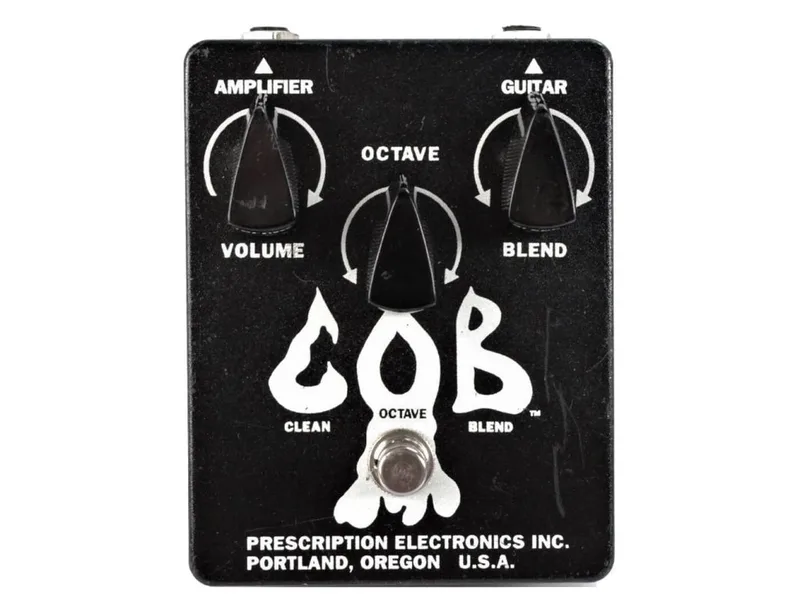
For players who want the circuit rather than the collectible, the Tone Machine is one of the more accessible vintage fuzzes to build. TONEHOME hosts a downloadable fOXX Tone Machine schematic1. General Guitar Gadgets sells a replica kit, referred to as FTM in its documents, using 2N3904 or other NPN bipolar transistors and a 9 volt battery, not included in the kit8. Madbean Pedals' Wolfshirt is a documented PCB project based on the Foxx Tone Machine7, and Aion FX's Obscura takes the octave section of the fOXX Tone Machine, with a few value tweaks, and adds a clean blend and a knob to change the character of the effect19. Aion FX also notes that Prescription Electronics' COB octave section is clearly based on the fOXX Tone Machine with a few value tweaks19.
Pedals on this page
News
Questions
Who used the Foxx Tone Machine?
Guitar Player's history of the pedal describes it as the fuzz of choice for Peter Frampton, Billy Gibbons and Adrian Belew. Its octave-up fuzz sound made it a favorite among players who wanted a more aggressive, harmonically rich fuzz than a typical Fuzz Face or Maestro-style unit offered.
What did the Foxx Tone Machine cost originally?
Steve Ridinger priced the Foxx Tone Machine at $49 when it launched in the early 1970s. By 1974 the retail price was $59.95. Danelectro's modern 3699 fUZZ, which uses the same circuit with tweaks, lists the originals as selling for $600 or more today.
How much is an original Foxx Tone Machine worth?
Original units sell for $600 or more on the used market, according to both Danelectro and Pedal of the Day. The rarest versions, such as the 1972 Stars and Stripes model with red, white and blue flocking, command more, and an Ibanez-branded prototype was listed in 2019 at $20,320.55.
Was the Danelectro French Toast a Foxx Tone Machine?
Yes, in circuit terms. Guitar Player's Dave Hunter notes that the Danelectro French Toast was based on the original Tone Machine. Danelectro's later 3699 fUZZ Octaver, designed by original creator Steve Ridinger, also brings back the Foxx circuit with some tweaks.
Does the Foxx Tone Machine reissue run on a battery?
The 2005 Foxx-branded reissue was battery-only, in its original flocked form. The Danelectro 3699 reissue of the circuit runs on 9V DC with a center negative plug, and DIY clone kits such as General Guitar Gadgets' version use a 9 volt battery, not included in the kit.
Is there a schematic for the Foxx Tone Machine?
Yes. TONEHOME hosts a downloadable schematic of the fOXX Tone Machine, and General Guitar Gadgets sells a complete replica kit with build documents. Madbean Pedals' Wolfshirt and Aion FX's Obscura are documented DIY projects based on the same circuit.
Sources (20)
- TONEHOME, TONEHOME - the World of Vintage Guitar Effect Pedals, 1974
- The Foxx Tone Machine Was the Fuzz of Choice for Peter Frampton, Billy Gibbons, and Adrian Belew, GuitarPlayer (www.guitarplayer.com), 2021-11-15
- Warm Audio Foxy Tone Box Fuzz, Delicious Audio, 2022-11-17
- Tone Machine by Foxx, RockBoard (rockboard.de PedalPedia), 2026
- 3699 fUZZ™, Danelectro Guitars, 1970
- Danelectro 3699 Fuzz review, GuitarPlayer (www.guitarplayer.com), 2020-08-13
- Wolfshirt.pdf, madbeanpedals.com, 2024-04-25
- Foxx™ Tone Machine™ Clone: Octave Fuzz Kit, PCB & Schematic, General Guitar Gadgets, 2014-05-18
- sunbenderMKIV.docx, Analog Man, 2021-08
- FUZ-1 | Guitar Player (October 2005) | Demeter Amplification, Guitar Player, 2005-10
- Danelectro 3699 Fuzz review, Guitar World, 2020-09-09
- TONEHOME, TONEHOME
- Ibanez 'Foxx' Tone Machine, gearnews.com, 2019-01-26
- Guitar Pedal X, Guitar Pedal X, 2024-11-12
- Danelectro 3699 fUZZ Octaver, Pedal of the Day, 2021-02-08
- Fur Coat Vintage Fuzz Pedal, Orange Music Electronic Co Ltd
- F-Octave, Diamond Pedals
- Helium - Octave Fuzz by Pause&Effects | RockBoard | PedalPedia, RockBoard PedalPedia, 2026
- Obscura Octave Blend / Prescription Electronics COB, Aion FX, 2023-09-08
- TEISCO'S BIG COMEBACK, JHS Pedals