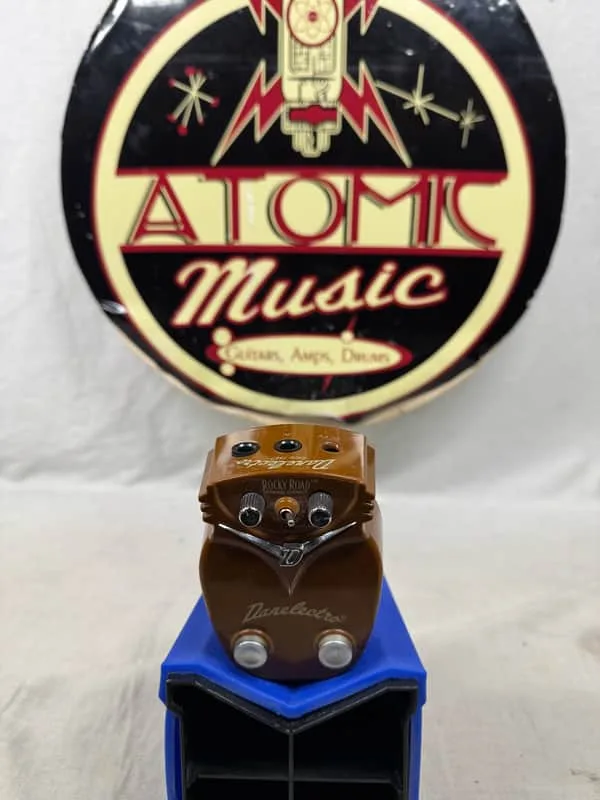


The Danelectro Rocky Road (DJ-20) is a compact, versatile rotary speaker simulation effect pedal, made by Danelectro. It aims to put the sound of a spinning speaker, the kind associated with classic Leslie cabinets, into a small stompbox that fits any pedalboard. RockBoard's product listing describes it as delivering "warm, vibrant rotary sounds reminiscent of classic Leslie speakers"1.
Rotary speaker effects sit in a family of their own on a board. If you are comparing it with more common modulation effects, it is listed alongside chorus pedals and vibrato pedals, and it is one of the speaker simulation pedals that try to suggest a moving speaker rather than a fixed one.
Controls and how it works
The Rocky Road keeps its operation simple. RockBoard's listing describes "simple operation via speed and ramp controls", which let you "seamlessly customise the effect, from smooth modulations" to "intense, swirling textures"1. Two knobs cover the range a rotary player needs:
| Control | What it does |
|---|---|
| Speed | Sets how fast the simulated speaker spins1 |
| Ramp | Shapes how the effect moves between states, from smooth modulations to intense, swirling textures1 |
The ramp control echoes the way a real Leslie takes a moment to accelerate or slow down when the player switches speeds. Because the circuit is analog1, the modulation happens in the analog domain rather than through digital modeling. For a rotary effect, that design choice shapes how the swirl is produced, and it keeps the pedal in line with the analog modulation pedals many players already run.
Power and pedalboard fit
The pedal runs on a standard 9V DC, center negative supply1, the same arrangement as nearly every pedal on a modern board, so it works with typical daisy-chain or isolated power setups. Its current draw is listed at 24mA1, which is a light load and leaves room on most power supply outputs.
RockBoard describes the enclosure as "robust, lightweight and ideal for any pedalboard"1. That combination of a small footprint and modest power needs makes it straightforward to place alongside other modulation effects.
The Rocky Road is a rotary speaker simulation, so it behaves differently from a straight chorus or vibrato pedal. RockBoard lists it under both chorus and vibrato1, which reflects how a spinning speaker blends pitch movement with a swirling, shifting quality.
Rocky Road versus a real Leslie
A Leslie speaker is a mechanical cabinet with rotating components, while the Rocky Road is a stompbox that suggests that motion electronically. The trade a player makes is familiar: a real Leslie brings moving air and a physical speaker, while the pedal brings a compact enclosure, standard 9V power1, and speed and ramp controls1 that can be changed instantly mid-song.
"warm, vibrant rotary sounds reminiscent of classic Leslie speakers"
Videos
randallcaster
Rafael Rechia
Jason Crawford
Questions
Is the Danelectro Rocky Road analog or digital?
The Rocky Road is an analog pedal. RockBoard's product listing for the DJ-20 gives the circuit type as analog, which matters for players who build their boards around analog signal paths or who prefer the character of analog modulation circuits. It is a compact rotary speaker simulation effect, so the analog circuit is doing the work of suggesting a spinning speaker rather than modeling one digitally.
What power supply does the Danelectro Rocky Road need?
The Rocky Road runs on a 9V DC supply with a center negative polarity, the standard arrangement used by most pedalboard power supplies. RockBoard lists the current draw at 24mA, which is modest enough for most supply outputs. As with any center negative pedal, use a supply intended for guitar effects rather than an adapter of unknown polarity.
Is the Danelectro Rocky Road a chorus or a vibrato?
RockBoard lists the Rocky Road under both chorus and vibrato, and that pairing makes sense for a rotary speaker effect. A spinning Leslie speaker produces a blend of pitch modulation and a shifting, swirling quality, so a rotary sim naturally sits between the two. The pedal's speed and ramp controls let you move from smooth modulations toward more intense, swirling textures.
How does the Danelectro Rocky Road compare to a real Leslie speaker?
Danelectro describes the Rocky Road as delivering warm, vibrant rotary sounds reminiscent of classic Leslie speakers. It is a simulation in a stompbox, not a mechanical rotating speaker, so it suggests the motion of a Leslie rather than reproducing one. What it offers instead is a compact, pedalboard-friendly enclosure that puts that character on a board.
How much current does the Danelectro Rocky Road draw?
RockBoard lists the current draw of the Rocky Road (DJ-20) at 24mA. That is a light load by pedal standards, so it fits comfortably on the output of most pedalboard power supplies alongside other effects.
Sources (1)
- Rocky Road (DJ-20) by Danelectro, RockBoard (rockboard.de), 2026