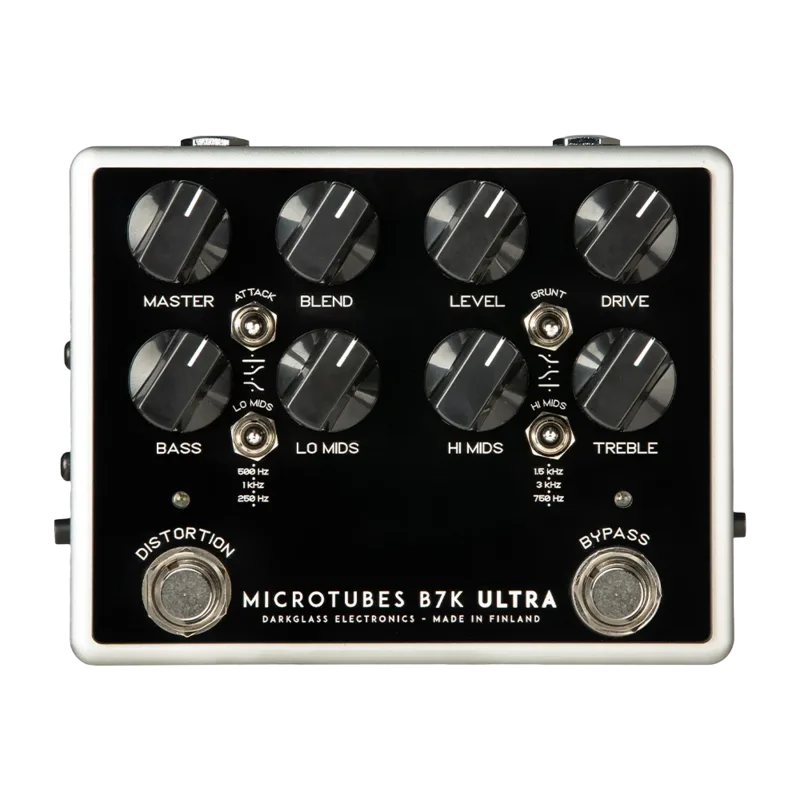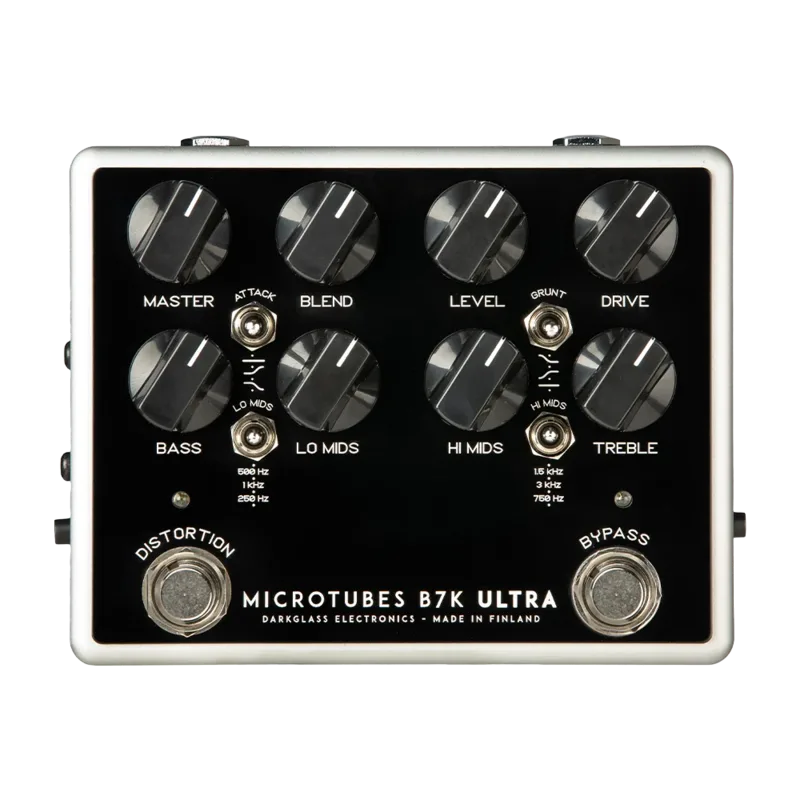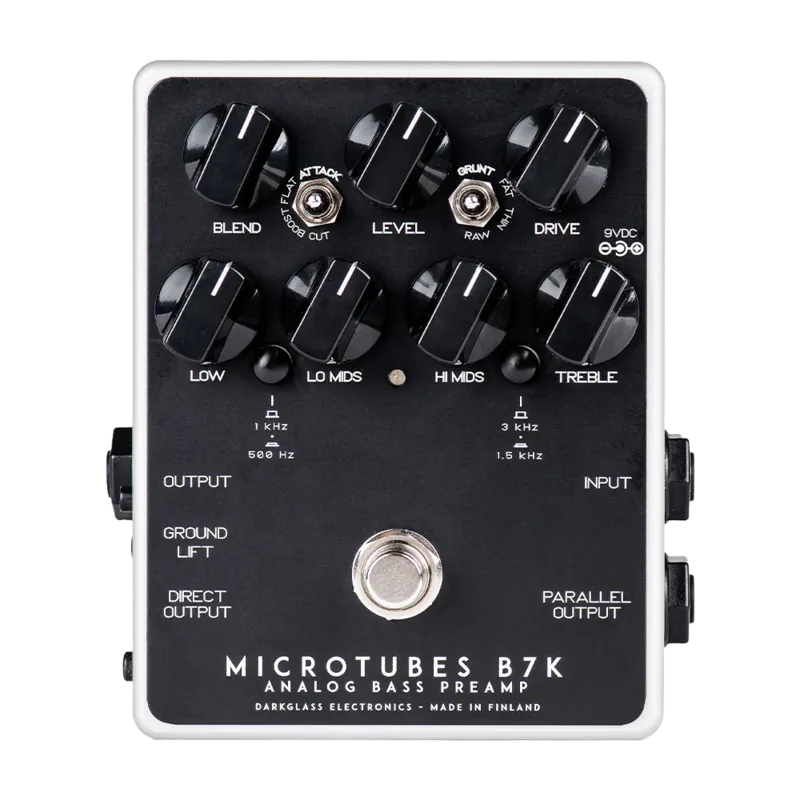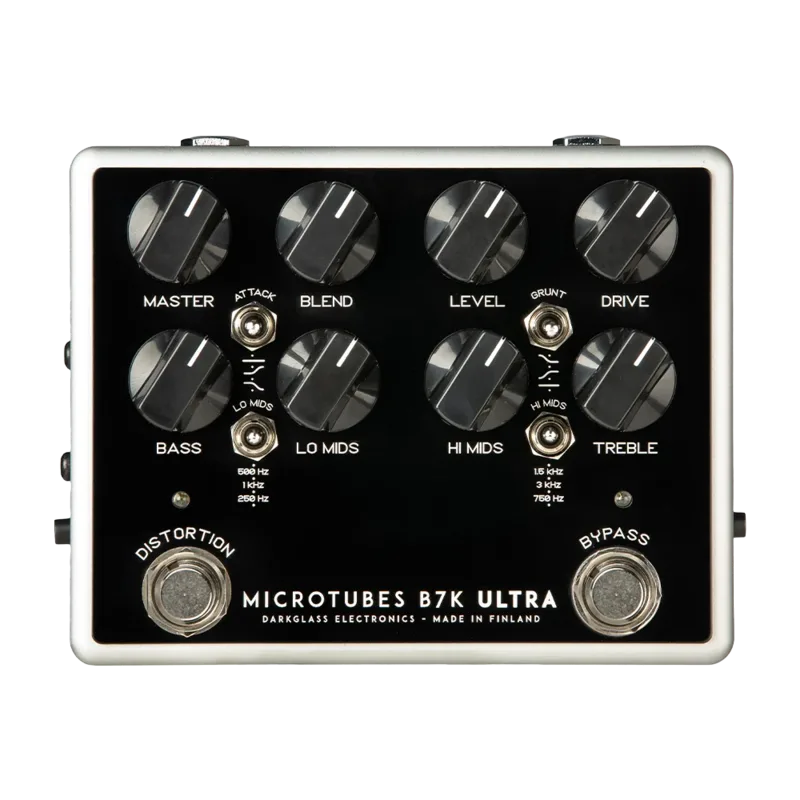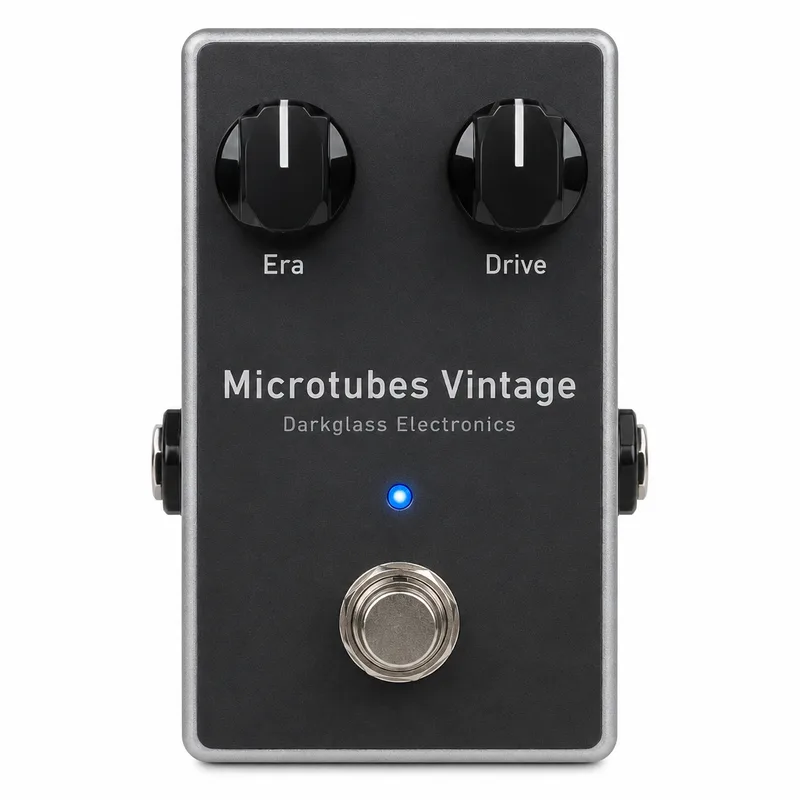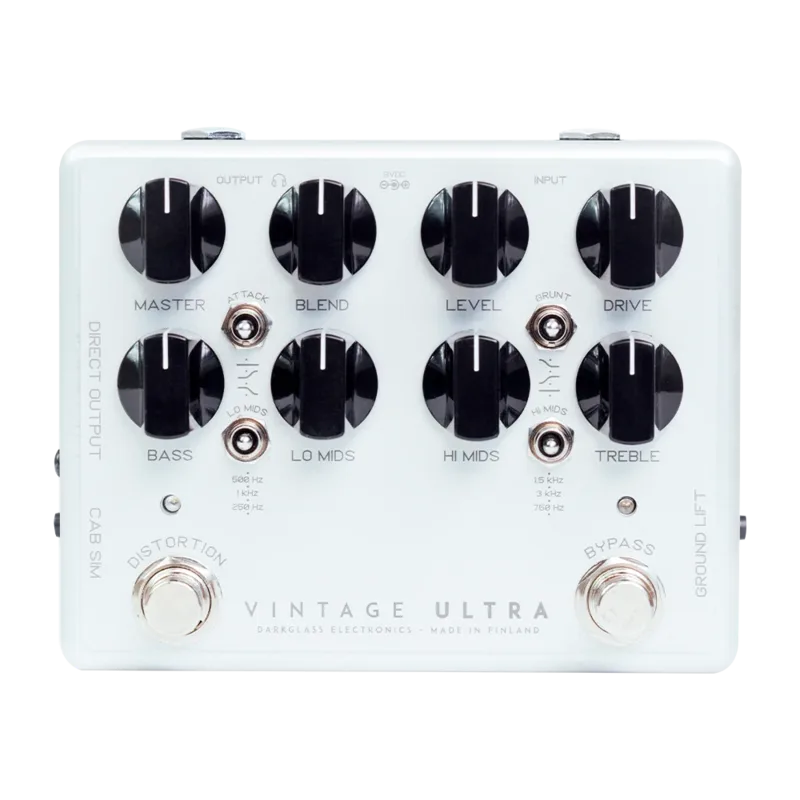
The Darkglass Vintage Ultra with Aux In is a bass preamp and overdrive pedal from Darkglass that carries the warm, tube-like voicing of the Vintage Microtubes and adds the feature set of the Microtubes B7K Ultra with Aux In: a balanced XLR Direct Output, a stereo headphone output and a 3.5mm Aux In for practicing along with backing tracks1. Darkglass describes its sound as "warm tube-like tones with a natural dynamic response that echoes the organic compression of old tube amps and reel-to-reel tape machines"1.
For a player, that means one box can sit at the end of a bass pedalboard as an overdrive and preamp, feed an amp through a quarter-inch output, feed a PA or interface through the XLR out with cabinet simulation, and drive headphones for silent practice with a phone or laptop plugged into the Aux In12.
What it does, and how it differs from the B7K Ultra
The Vintage Ultra with Aux In is a variant of the Microtubes B7K Ultra with Aux In, swapping that pedal's voicing for the warm, tube-like tones of the Vintage Microtubes1. Both pedals share the same connectivity: the Aux In, the headphone amplifier, the XLR out and the USB connection for loading impulse responses14. The difference is the character of the drive. Where the B7K line is Darkglass's modern take, MusicRadar's reviewers position the Vintage Ultra as "a good place to start" if you are "looking for gain but something more old-school"51.
The pedal works as both a clean preamp and an overdrive. The Drive section saturates the signal, and the Level knob sets the volume of that overdriven signal on its own, while the Master knob sets the overall volume of the unit, which lets you blend clean and driven levels against each other26. A four-band equalizer with six selectable mid frequencies shapes the tone further1.
The controls
| Control | What it does |
|---|---|
| Drive | Sets the amount of saturation in the overdriven signal2 |
| Level | Sets the volume of the overdriven signal2 |
| Master | Adjusts the overall volume of the unit; ideal for fine tuning the output on clean mode; also serves as a DI level control2 |
| Treble | +/-12dB at 5kHz2 |
| EQ | Four band equalizer with six selectable mid frequencies1 |
| Cab Sim switch | Toggles the cabinet simulation on/off on the Direct Output; completely bypasses all digital circuits for a zero latency signal2 |
The split between Level and Master is the core of how the pedal is meant to be used: Level controls the output of the distorted signal alone, while Master controls the overall output, including the clean path and the DI6. MusicRadar's review of the Vintage Ultra describes this arrangement directly: "Level pot controls the output of the distorted signal alone" while "a Master volume controls the overall output"6.
Power and connections
The Vintage Ultra runs only from a regulated 9V DC adapter with a center-negative plug, with a current draw of 120mA1. The manual gives the same voltage and polarity and lists current consumption at approximately 120mA3.
No battery option. The pedal takes power only from a 9V DC center-negative adapter, and at 120mA it draws more than a typical low-current overdrive, so check that your pedalboard supply can cover it13.
Connections on the back of the unit:
- Input: 1/4" mono jack for your instrument or the output of your pedalboard1
- Output: 1/4" jack to the input of your amplifier or another effects pedal12
- Direct Output: balanced XLR for connecting to a microphone preamp, PA system and similar destinations1
- Headphone output: 3.5mm stereo, driven by an internal stereo headphone amplifier capable of driving a minimum load of 16 ohms1
- Aux In: 3.5mm stereo input for backing tracks from a phone or laptop12
- USB: Micro USB B connector to connect to PC/Mac to load cabinet simulation impulse responses and control other settings1
The Aux In has two limits worth knowing. It can only be used together with the headphone output, and its level must be set from the audio source itself, since the pedal has no Aux level control12.
Cab simulation and the Direct Output
The Direct Output is a balanced version of the 1/4" output, useful for running into PAs or studio mixing consoles7. The Cab Sim switch toggles the cabinet simulation on and off on that output, and when switched off it completely bypasses all digital circuits, giving a zero latency signal2.
The Analog Cabinet selection covers more than forty models, including:
- Black and White 410, Cali 212, Cali 410 NEO, Cali Combo 212
- Dave 410, DG112N, DG212N, DG410N, DG412ES, DG810ES
- Fruity 115, Fruity 212, Fruity 410, Fruity 810
- Peggy 115, Peggy 210, Peggy 410, Peggy 810, Peggy 810 Vintage
- Stockman 212, Stockman 410, Stockman 810; Swirl 115, Swirl 410, Swirl 810
- Modern and Powerplant series cabinets, plus models such as Nolly 810, Panzer 412, London 412 and Snakeskin2
New impulse responses can be loaded over the Micro USB B connection from a PC or Mac, which also controls various other settings through Darkglass Suite1.
Silent practice and the bypass quirk
The headphone output and Aux In are stereo, fed by the internal stereo headphone amplifier1. One behavior to know before practicing with headphones: when the pedal is on bypass, the master volume does not affect the headphone volume. In that case the total volume is adjustable in Darkglass Suite2.
History and versions
The Vintage Ultra sits in Darkglass's line as an alternative for players who want gain with a more old-school character5. Darkglass describes it as a tribute to some of the most legendary sounds in rock history, providing warm tube-like tones with a natural dynamic response that echoes the organic compression of old tube amps and reel-to-reel tape machines1. Within the range it is a variant of the Microtubes B7K Ultra with Aux In, carrying the warm, tube-like tones of the Vintage Microtubes.
The Vintage Ultra V2 adds a dedicated headphone output and impulse-response cab emulation for its balanced direct out8. The with-Aux-In version examined here is the current form of that pedal, and the maker's product page lists it as sold out1. The related Microtubes B7K Ultra with Aux In is likewise listed as sold out4, and the B7K Ultra V2 'The Squid' Limited Edition is an upgraded version of the B7K Ultra with Aux In9.
Questions
Can I use the Darkglass Vintage Ultra as a DI box?
Yes. It has a balanced XLR Direct Output intended for connecting to a microphone preamp, PA system or studio mixing console. The Master knob also serves as the DI level control, and the Cab Sim switch toggles cabinet simulation on the Direct Output, so you can send a cab-simulated or dry balanced signal to the desk.
Does the Vintage Ultra with Aux In have cab sims?
Yes. A Cab Sim switch toggles the cabinet simulation on and off on the Direct Output, and switching it off completely bypasses all digital circuits for a zero latency signal. The Analog Cabinet selection includes more than forty models, from the Black and White 410 and Cali 212 to the Fruity, Peggy, Stockman and Swirl cabinets, plus others.
Why does the master volume not change headphone volume in bypass?
When the pedal is on bypass, the master volume does not affect the headphone volume. In that case the total headphone volume is adjustable in Darkglass Suite, the software you connect to over the pedal's Micro USB B port. With the pedal engaged, the Master knob works normally.
Can I run the Darkglass Vintage Ultra on a battery?
No. The Vintage Ultra runs only from a regulated 9V DC adapter with a center-negative plug, drawing about 120mA. There is no battery compartment, so it needs a power supply or an isolated pedalboard output that can deliver its current draw.
Sources (9)
- Vintage Ultra with Aux In, Darkglass
- Vintage Ultra with Aux In, Darkglass
- Vintage Ultra Manual, Darkglass
- Microtubes B7K Ultra with Aux In, Darkglass
- Darkglass Electronics Microtubes X Ultra review, MusicRadar, 2020-05-21
- Darkglass Vintage Ultra review, MusicRadar, 2016-08-10
- Darkglass Electronics Unveils the Vintage Ultra, Premier Guitar, 2016-06-08
- Darkglass unveils updated Vintage bass preamp pedals, MusicRadar, 2018-04-30
- B7K Ultra V2 'The Squid' Limited Edition by Darkglass Electronics, RockBoard PedalPedia, 2026