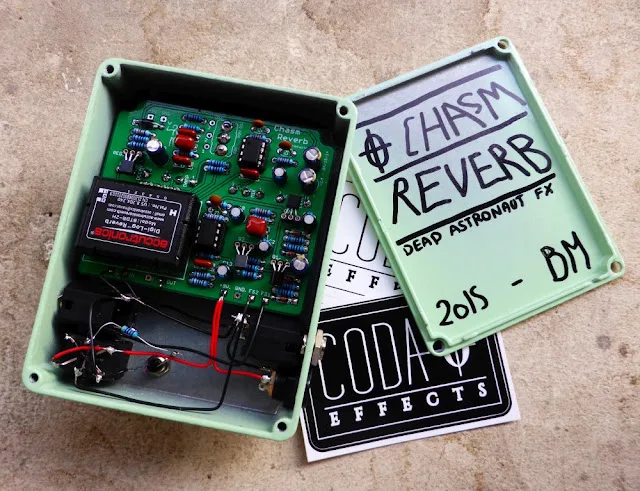
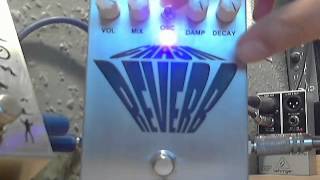


The Chasm Reverb is a reverb pedal from Dead Astronaut FX, offered both as a finished pedal and as a DIY PCB for builders who want to make their own. Coda Effects, which built and analyzed the circuit, describes it as "a beautiful, deep sounding reverb that can auto-oscillate to create great sounding \"waves\" of sounds, ideal for post rock or prog rock"1.
What it does to your sound
The Chasm is built around a Belton Brick, an integrated circuit that lets builders make digital reverbs without having to use a spring reverb tank2. At the front of the circuit there is a MOSFET input buffer that increases the signal a little before it reaches the reverb3.
Its distinguishing feature is the feedback loop: a part of the reverb signal can be routed back into the circuit, allowing the reverb to auto-oscillate3. In oscillation mode, Coda Effects says you can "make the reverb smoother, and create \"waves\" of sounds, that lush for a quasi illimited amount of time"3. That makes it a candidate for ambient washes and the long, swelling textures common in post-rock, rather than a straight room-or-plate reverb.
The controls
| Control | What it does |
|---|---|
| Decay | Sets the amount of reverberated signal fed back to the entry of the reverb circuit2 |
| Damp | Sets the overall brightness of the reverb3 |
| Volume | Master volume, wired as a variable resistor and acting as a classic volume knob2 |
| Oscillation switch | Puts the reverb in auto-oscillation mode3 |
The oscillation switch works by selecting between two resistors in the feedback loop: a 47k resistor, where a lot of signal goes back and the circuit oscillates, and a 100k one, where less goes back and you get a long-decay style reverb instead2. The Decay knob then sets how much signal goes back to the beginning of the circuit within that mode2. Coda Effects notes that this feedback arrangement "allows to approximately set the decay of the reverb, which is not possible with a standard BTDR2 brick" on its own3.
Switching and trails
The Chasm uses JFET transistors not as amplifiers but as on/off switches, in the way a computer switches signals3. Coda Effects says this switching scheme "diminishes \"popping\" issues, and allows reverb trails, which is super nice with this reverb and its auto oscillatin[g]"2. Trails mean the reverb keeps decaying after you turn the effect off, rather than cutting off instantly, which matters when you are riding long oscillating washes1.
Building one yourself
Dead Astronaut can make the reverb for you, or you can order a PCB to make it yourself1. The maker describes the Chasm as "a beautiful, deep sounding reverb that can auto-oscillate to create great sounding 'waves' of sounds, ideal for post rock or prog rock," and it includes a bypass system that lets the reverb end naturally when the effect is turned off, called "trails"1. The PCB route suits a DIY build, and the maker sells the PCB on its own for players who want to assemble it themselves1.
The Chasm is built around the Belton Brick reverb IC. If you are sourcing parts for a DIY build, the brick is the component the PCB layout is sized around1.
Videos
DEADASTRONAUTFX
Benoit M
Adam
Questions
What is a Belton Brick?
A Belton Brick is an integrated circuit that lets builders make digital reverbs without wiring up a spring reverb tank. Coda Effects describes it as an IC allowing builders to make digital reverbs, and notes that most DIY reverb designs, including the Chasm, are built around one. The Chasm's PCB layout leaves generous space for the brick.
Does the Dead Astronaut Chasm Reverb have trails?
Yes. The pedal uses a JFET switching scheme that Coda Effects says diminishes popping issues and allows reverb trails, meaning the reverb continues to decay naturally after you turn the effect off rather than cutting off abruptly.
Can you build the Chasm Reverb yourself?
Yes. Dead Astronaut can build the reverb for you, or you can order a PCB and make it yourself. The Coda Effects builder ordered the PCB for 11 pounds in April 2015 and documented a full DIY build in a Surf Green style enclosure, finishing it in February 2016.
How does the Chasm Reverb auto-oscillate?
Part of the reverb signal is routed through a feedback loop back to the start of the circuit. A switch selects between a 47k resistor, which sends a lot of signal back and produces oscillation, and a 100k resistor, which sends less back and gives a long-decay reverb instead. The Decay knob sets how much reverberated signal is fed back.
Does the Chasm Reverb have a decay control?
Yes, in the form of the Decay knob, which sets the amount of reverb signal fed back into the entry of the reverb circuit. Coda Effects notes this allows the decay to be set approximately, which is not possible with a standard BTDR2 brick on its own.
Sources (3)
- Coda Effects, Coda Effects (www.coda-effects.com), 2015-04
- Coda Effects, Coda Effects, 2026
- Coda Effects, Coda Effects (www.coda-effects.com), 2016-02