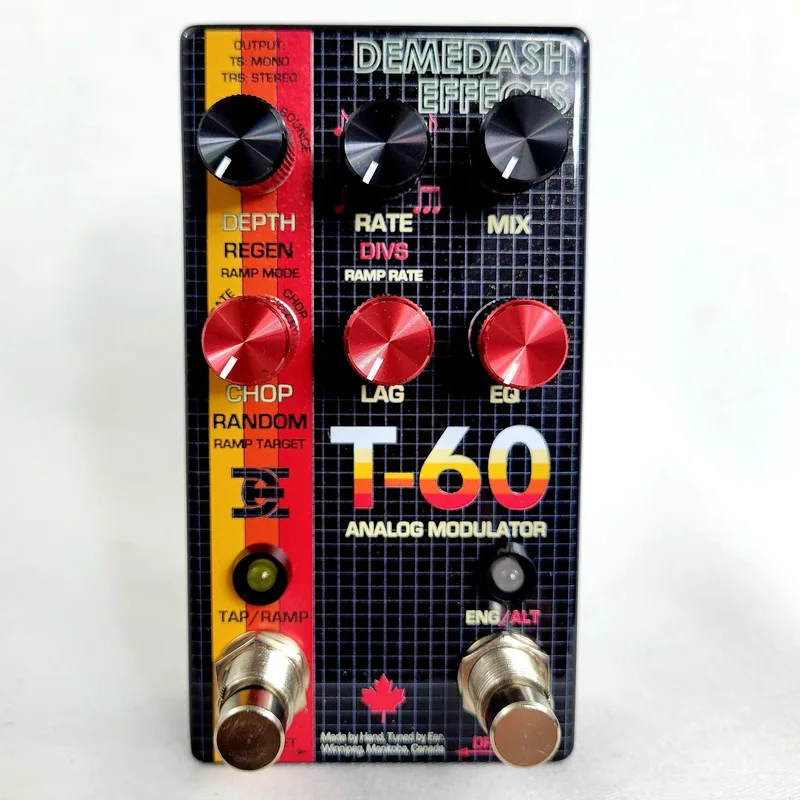


The Demedash Effects T-60 is a stereo analog modulation pedal from Canadian boutique builder Demedash Effects, a maker better known for the T-120 Videotape Echo. Announced in 2022 as the company's first modulation pedal, it delivers chorus, vibrato, flange, phasing and filter-like effects from a compact 125B enclosure12.
Where a conventional chorus pedal gives you one modulation curve, the T-60 runs two LFOs at once: one fully random, and one periodic, a mix of sine and triangle wave whose proportion shifts with the rate so the character stays consistent at any speed3. Demedash pitches it as a character pedal in the same spirit as the T-120, one that lets you "instantly overlay a worn-out layer of stretched tape to your playing"34.
A tape-flavored modulator: chorus, vibrato and flange
The T-60 is built on the classic analog bucket brigade (BBD) chip, the same device found in tape-less analog delays and choruses1. Delicious Audio described it as "an analog device with tap tempo hosted in a compact case delivering stereo Vibrato, Chorus & Flange"1. Which of those effects you get depends on the delay between the dry and wet signals: shorter times yield phasing, filter-like and flangey effects, while longer times yield thick chorus and wide vibrato2.
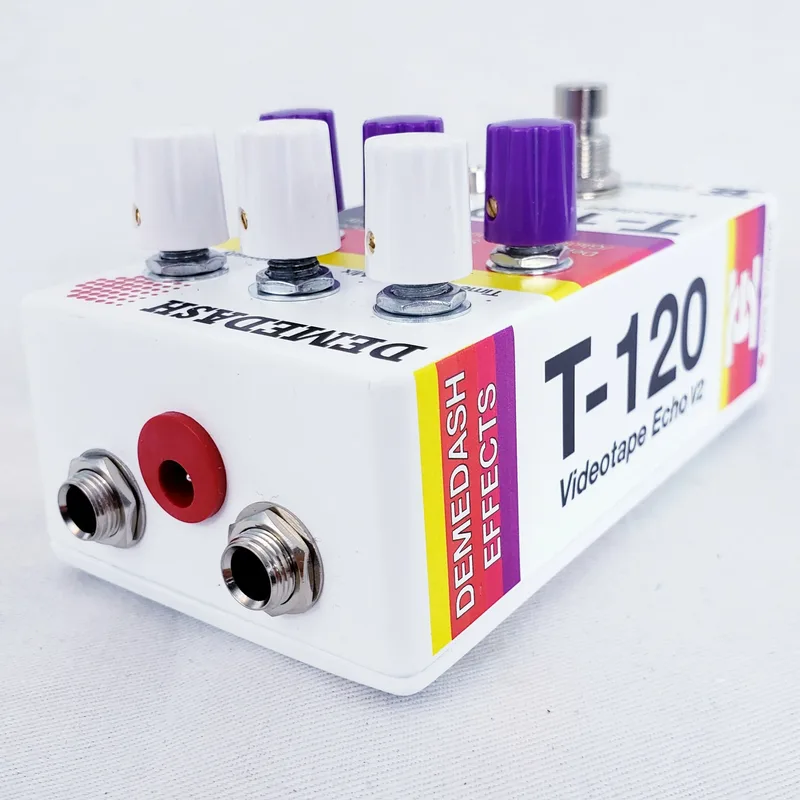
The tape connection is more than cosmetic. Demedash's own copy for the pedal invites you to "let it wander" and let "the years in the attic speak for themselves," framing the T-60 as a sibling to the T-120 Videotape Echo, whose sound is modeled on low-bandwidth tape fed through an uncalibrated, unbalanced mechanism15. Where the T-120 is a delay and pitch shifter, the T-60 applies that same worn-tape character to modulation.
Analog signal path, digital brain
The T-60 is not fully analog in the strictest sense. Its audio path is: the signal passes through a bucket brigade chip, and the maker describes the result as "the gorgeous sound of a classic analog BBD device"3. But the modulation driving that chip is generated digitally by a microcontroller. Delicious Audio called this "the T-60's true powerhouse," noting that the builder "employs digital technology" for control of the modulation while keeping the signal path analog1.
That hybrid design is what makes the pedal's less conventional features possible, including two simultaneous LFOs, ramping of the Rate or Chop controls, and tap tempo21.
The controls
| Control | What it does |
|---|---|
| Rate | Controls the modulation's speed1 |
| Depth | Controls the modulation's depth1 |
| Mix | Fine-tunes the balance of dry and wet signal1 |
| Lag | Sets the bucket brigade clock speed, controlling latency between dry and wet signals3 |
| Random | Mixes the two LFO outputs in any proportion3 |
| Chop | Applies sample-and-hold to the periodic LFO; reduces the Random LFO's smoothness3 |
| Regeneration | Re-enforces the comb-filter effect via feedback, increasing resonance and thickening the flange, vibrato or chorus3 |
The Lag knob is the heart of the pedal's range. The bucket brigade clock circuit has a wide range of clock speeds available through it: short lag gives flanger, medium gives chorus, and longer lag gives vibrato31.
Random and Chop are where the T-60 departs from a standard chorus. The Random control blends the periodic and random LFOs in any proportion, from conventional smooth modulation to wandering, unpredictable wobble3. Chop then roughens both: on the periodic LFO it applies a sample-and-hold effect, "pixelating it and turning it into a staircase waveform," while the Random LFO loses smoothness and resolves into randomly generated square levels3. Together they produce rhythmic, glitching effects in both LFOs2.
Regeneration feeds the wet signal back on itself, reinforcing the comb filtering at the heart of flange and chorus and adding resonance3. As Delicious Audio put it, the control lets you "re-enforce the comb-filter effect via feedback, increasing resonance and thickening" the sound1.
The right footswitch is a tap tempo switch for the rate that doubles as a momentary switch for the Ramp effect when held, letting you sweep Rate or Chop on the fly21. Switching is soft, and the bypass is buffered2.
Stereo outputs and power
The T-60 is mono in, stereo out, with the stereo output available through a TRS plug in the output jack2. The two channels are built differently: the left provides dry minus wet (subtractive mixing) and the right provides dry plus wet (additive mixing)3. When used in mono mode, the subtractive mix is output3.
Power comes from a 9V DC supply drawing 90mA. There is no battery compartment and no adapter in the box2.
With no battery option and a 90mA draw, the T-60 needs a proper 9V DC power supply or an isolated pedalboard output rather than a battery or a low-current daisy chain.
Availability and finishes
Demedash lists the T-60 as available while supplies last3, and the store page has shown it sold out2. It has been offered in Black Print and Stamped & Polished finishes2. As a small-builder pedal, stock tends to arrive in batches rather than sit continuously available.
Videos
aBunchOfPedals
Pedalboard of the Day
Eric Merrow
Questions
Is the Demedash T-60 fully analog?
The signal path is fully analog, built around a classic bucket brigade (BBD) chip of the kind found in analog delays and choruses. The modulation itself is generated digitally: a microcontroller produces the LFOs that drive the bucket brigade clock, which is what allows two simultaneous LFOs and features like ramping and tap tempo.
What does the Chop knob do on the T-60?
Chop applies a sample-and-hold effect to the periodic LFO, pixelating it into a staircase waveform, and reduces the smoothness of the Random LFO into randomly generated square levels. The result is rhythmic, glitching modulation in both LFOs, from stepped pitch wobble to abrupt random jumps.
What does the Lag knob control?
Lag sets the speed of the bucket brigade clock circuit, which controls the delay time between the dry and wet signals. Short lag settings give flanger and phasing effects, medium settings give chorus, and longer settings give wide vibrato.
What does the T-60 output in mono mode?
The T-60 is mono in and stereo out, with the left channel carrying a subtractive dry-minus-wet mix and the right an additive dry-plus-wet mix. When you run it in mono, the subtractive mix is what comes out of the jack.
Is the Demedash T-60 still available?
Demedash lists the T-60 as available while supplies last, and the product page has shown it sold out. It is a small-builder pedal produced in finishes such as Black Print and Stamped & Polished, so availability comes in waves.
What size enclosure does the T-60 use?
It uses a 125B enclosure, measuring 4.7 by 2.5 by 1.6 inches. That is a compact but not miniature footprint, roughly the size of many standard boutique modulation pedals.
Sources (5)
- Demedash T-60 Stereo Multi-Modulation Pedal, Delicious Audio, 2022-04-26
- T-60 Analog Modulator, Demedash Effects
- T-60 Analog Modulator, Demedash Effects
- T-120 Videotape Echo V2 by Demedash Effects, RockBoard PedalPedia, 2026
- T-120 Videotape Echo, Demedash Effects