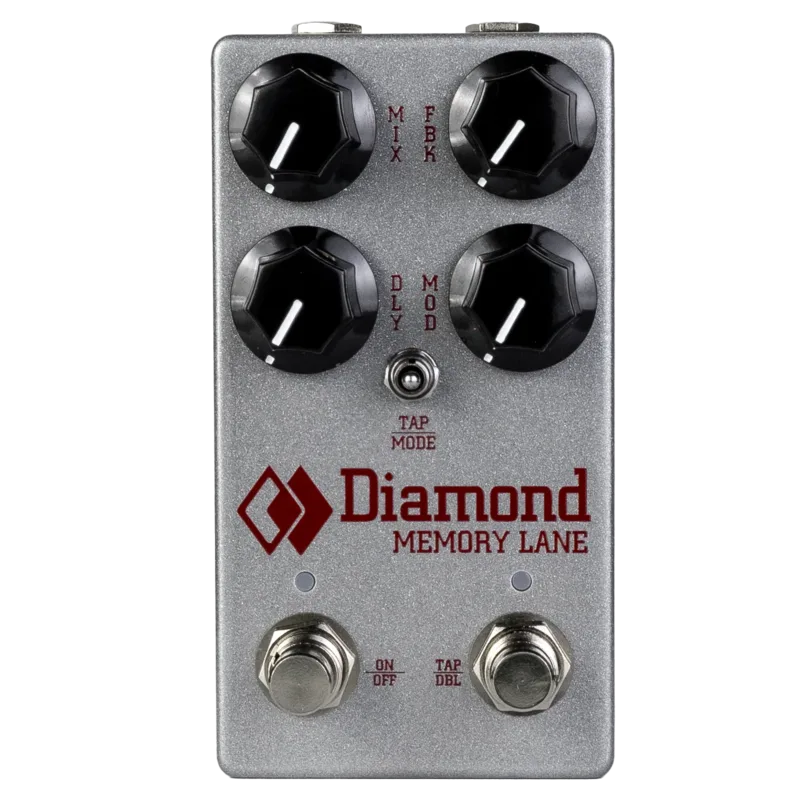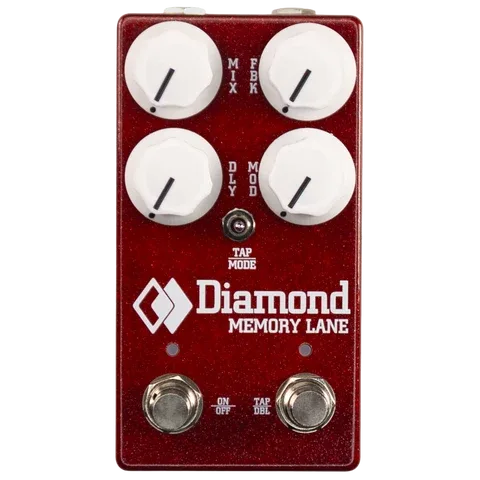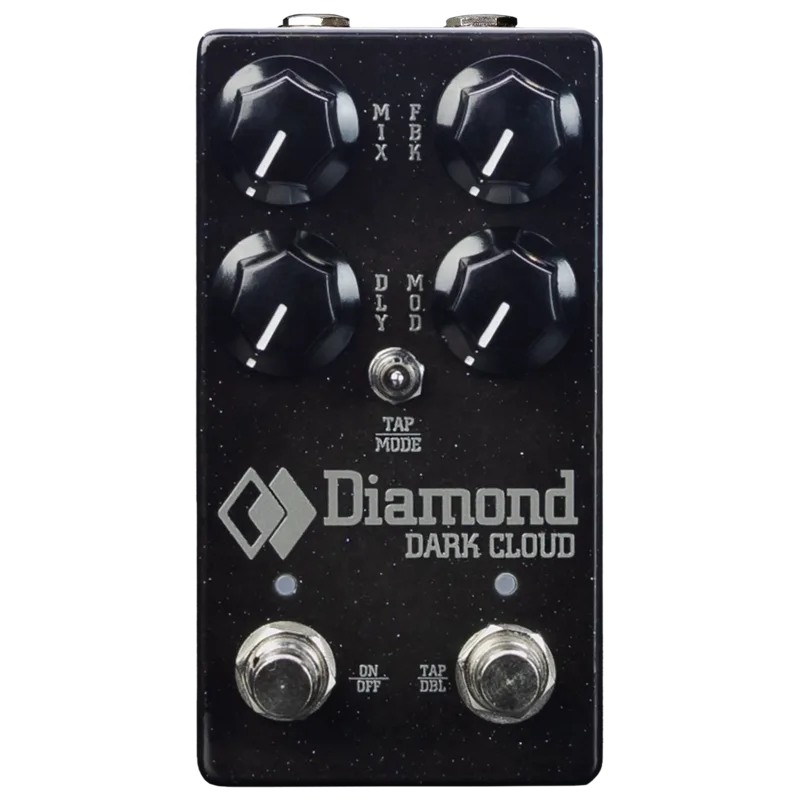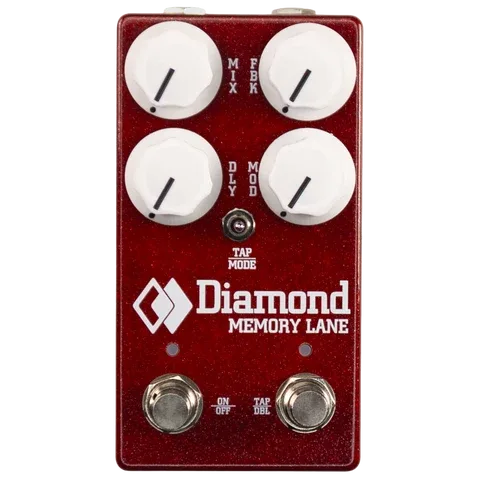

The Diamond Memory Lane STM32 Limited Maple Leaf Edition is a compact delay pedal from Diamond Pedals, listed at $249.001. It is a redesign of the company's Memory Lane modulated delay, built to capture the character of the original by implementing an embedded system that operates as a drop-in replacement for a BBD (bucket brigade device), surrounded by a custom companding and anti-aliasing circuit similar to the original's1. Where a BBD passes copies of the signal along a chain of capacitors, this delay line does the same job using RAM to pass the copies, with an internal clock defining the sampling rate2. Switching is buffered bypass with trails1.
Diamond describes the pedal as one that "captures the lush warmth of classic analog delays with the clarity, control, and reliability of modern digital design," and says it "delivers beautifully voiced repeats that sit effortlessly behind your playing"12.
How it works: the dBBD architecture
The original analog Memory Lane was built around a BBD (bucket brigade device) chip and a Compandor circuit. The STM32 edition is designed to capture that character by implementing an embedded system that operates as a drop-in replacement for a BBD, surrounded by a custom companding and anti-aliasing circuit similar to the original's. Where a BBD passes copies of the signal along a chain of capacitors, this delay line uses RAM to pass the copies, with an internal clock defining the sampling rate12.
Diamond calls this its digital Bucket Brigade Delay (dBBD) architecture, blending analog companding, precision filtering, and a custom-voiced delay line1. Warm mode pushes the emulation closer still, with the maker saying it can "capture the BBD's capacitive losses"1. Gearnews describes the build as using industrial-grade converters, warm analog circuitry, and protection against electrical mistakes4.
The four delay modes
The modes are selected with the Tap/Mode switch, and Gearnews notes they "offer a versatile range of delay textures"4.
| Mode | What it does |
|---|---|
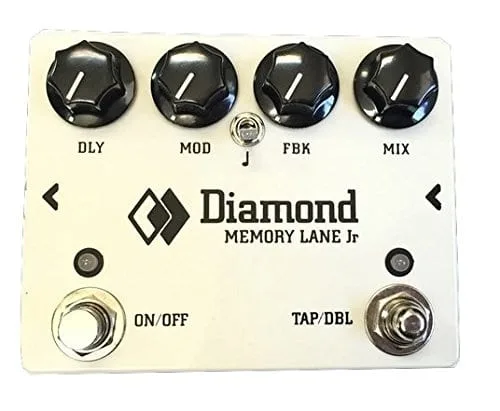
| MLjr | Classic fixed-rate delay with silent tempo changes, true to the Memory Lane Jr1 |
| Vintage | Warm, saturated repeats that capture the soul of vintage analog delays1 |
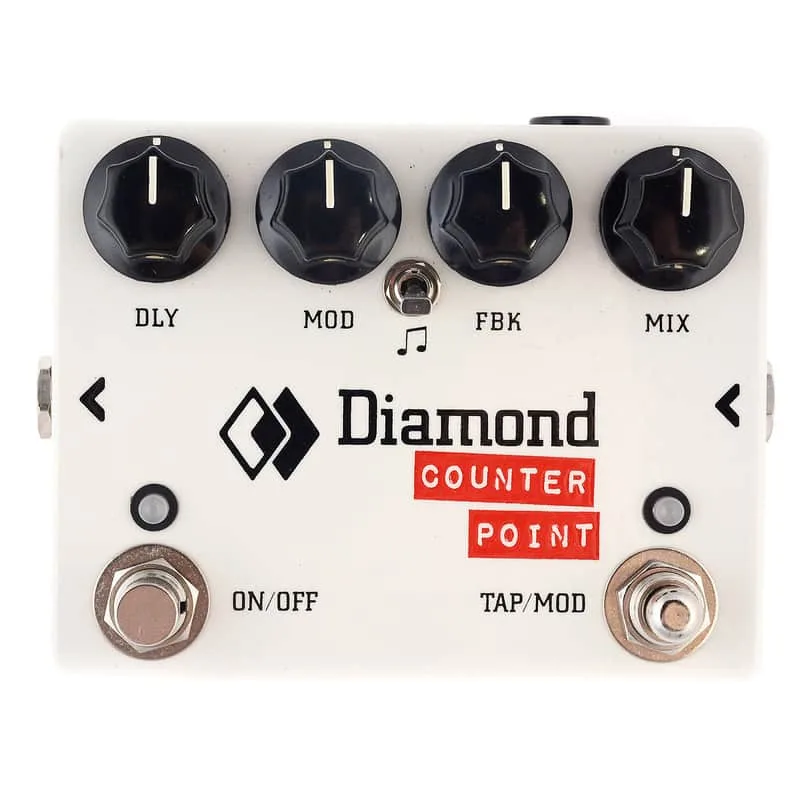
| Galloping 2-Head | A rhythmic, dual-head pattern inspired by the Counter Point delay1 |
| Ambient 3-Head | Expansive, cascading repeats for layered soundscapes1 |
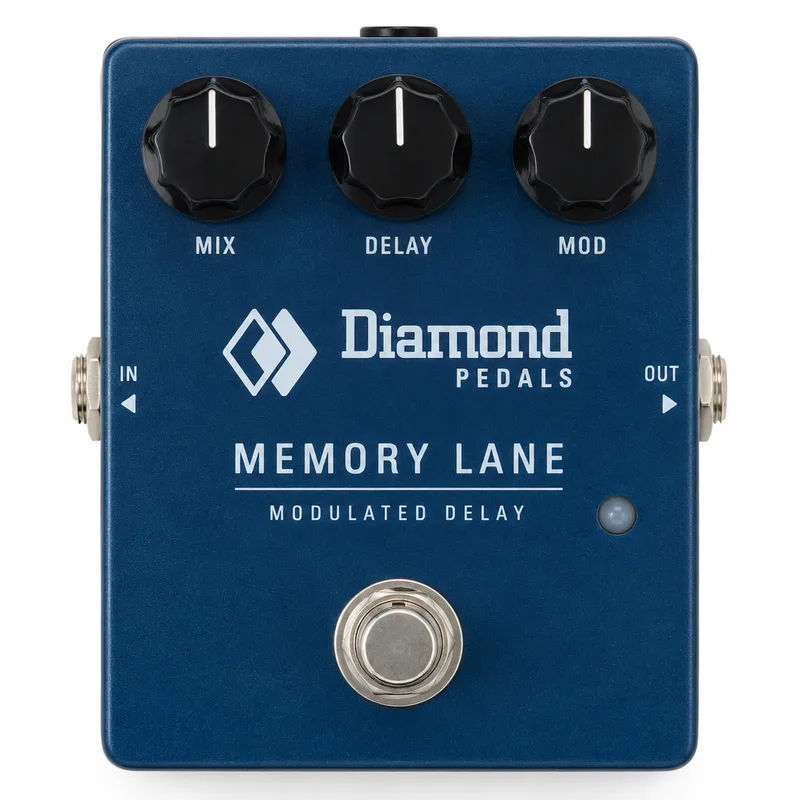
Guitar Pedal X points out the change from the earlier revival-phase Memory Lane, which had three modes (Modern, Warm, Vintage); the STM32 edition has four, with only Vintage carried over5.
Controls, tap tempo and the Doubler
The control set, as listed by Guitar Pedal X, consists of Mix, Feedback, Delay (up to 2400 ms), Modulation, and Tap [Mode]5. Gearnews reports a dedicated Tap Tempo footswitch alongside the on/off footswitch4.
Tap tempo offers three subdivisions, each shown by a colored LED13:
- Quarter note (green LED)
- Dotted eighth note (yellow LED)
- Half note (red LED)
A useful extra: when held down, the tap tempo footswitch doubles the delay, and Gearnews reports the Doubler can be set to momentary or latching mode4.
Power and connections
The pedal runs on 9 to 15 V DC, negative tip, through a 2.1 mm barrel jack, drawing 50 mA at 9 V1. Guitar Pedal X describes it as powered by a regular 9 V DC supply, center negative, 2.1 mm, with roughly 50 mA of current draw51. Input impedance is greater than 1 MΩ and output impedance is less than 10 kΩ1.
The 2.1 mm barrel jack and negative-tip polarity match standard pedalboard power supplies. The maker does not list a battery option.
The enclosure keeps a small footprint: 4.8 x 2.64 x 1.58 inches and 300 g, and Gearnews notes "the pedal's footprint remains very compact"14.
Where it came from
The circuit traces directly back to the original analog Memory Lane. Diamond designed the STM32 edition to capture that pedal's character by implementing an embedded system that operates as a drop-in replacement for the BBD at the heart of the original, surrounded by a custom companding and anti-aliasing circuit similar to the original Memory Lane's1. The delay line operates the same way as a BBD but uses RAM to pass the copies of the signal, with an internal clock defining the sampling rate2.
All Diamond pedals are designed and built entirely in the company's own shop in Montreal, Quebec1, which Guitar Pedal X describes as hand-made in Montreal, Canada5. The pedal carries a three-year warranty against defective parts and faulty workmanship, for the original owner only, non-transferable, and voided by tampering, modification, abuse, misuse, unauthorized repair, or improper power supply2.
Videos
The Pedal Zone
Questions
Is the Memory Lane STM32 analog or digital?
It is a digital design with analog circuitry. The core is an STM32 ARM Cortex processor running Diamond's digital Bucket Brigade Delay (dBBD) architecture, which surrounds the delay line with analog companding and anti-aliasing circuitry similar to the original analog Memory Lane, so it aims for the character of a BBD delay in a modern build.
Does the Memory Lane STM32 have trails?
Yes. The pedal uses buffered bypass with trails, so repeats continue to ring out after you switch the effect off rather than cutting dead. The switching is buffered rather than true bypass.
What is the maximum delay time on the Memory Lane STM32?
Up to 2.4 seconds, or 2400 ms. The full delay range runs from 25 ms to 2.4 seconds, set by the Delay knob and refined with tap tempo and its three subdivisions.
Where is the Diamond Memory Lane made?
All Diamond pedals are designed and built entirely in Diamond's own shop in Montreal, Quebec, Canada. Guitar Pedal X also describes the Memory Lane STM32 edition as hand-made in Montreal.
What is different about the Maple Leaf Edition?
It is the limited-edition version of the Memory Lane STM32, the redesigned Memory Lane built on a new STM32 ARM Cortex processor. Compared with the earlier revival-phase Memory Lane, which had three modes (Modern, Warm, Vintage), it offers four modes: MLjr, Vintage, Galloping 2-Head and Ambient 3-Head, with delay time extended to 2.4 seconds.
Sources (5)
- Memory Lane STM32, Diamond Pedals
- Memory Lane STM32, Diamond Pedals
- Memory Lane STM32, Diamond Pedals
- Diamond Pedals Memory Lane: dBBD Delay, gearnews.com, 2025-10-22
- Guitar Pedal X, Guitar Pedal X, 2025-10-21