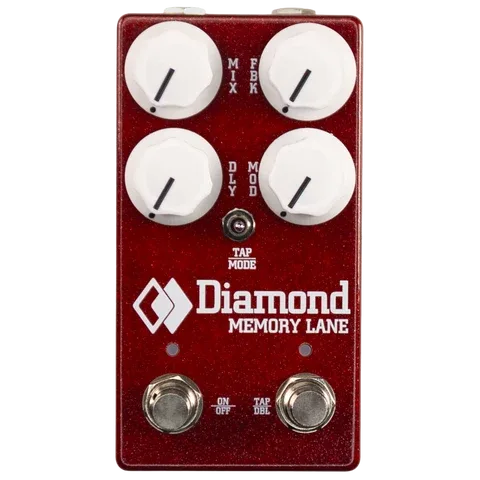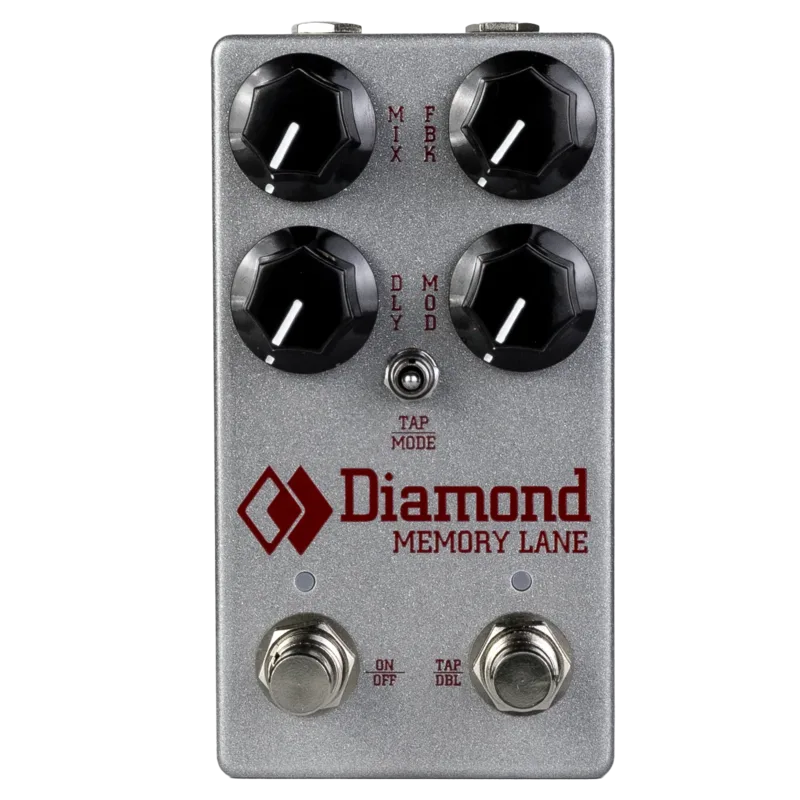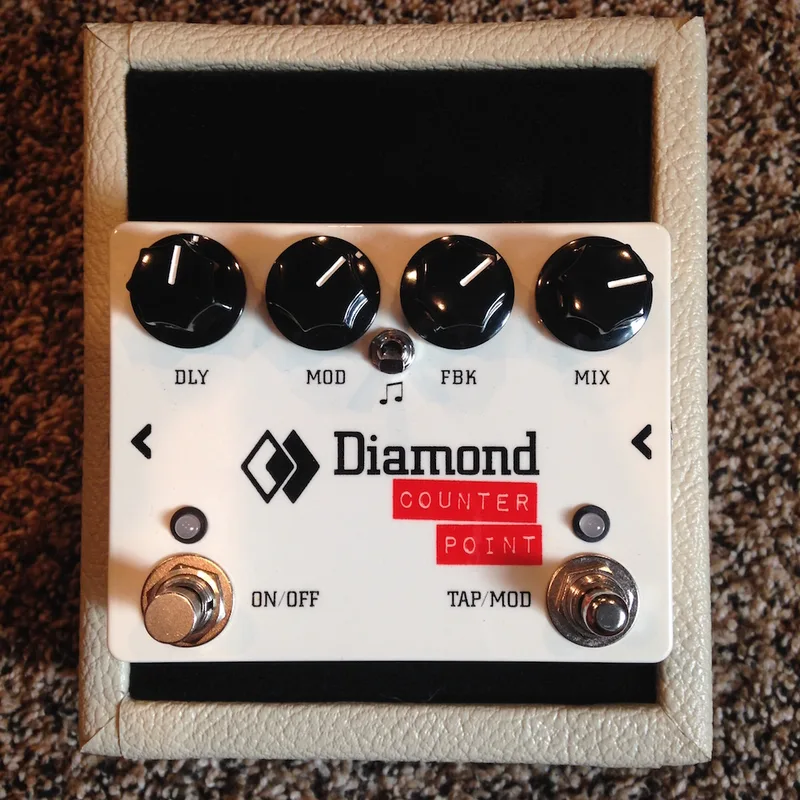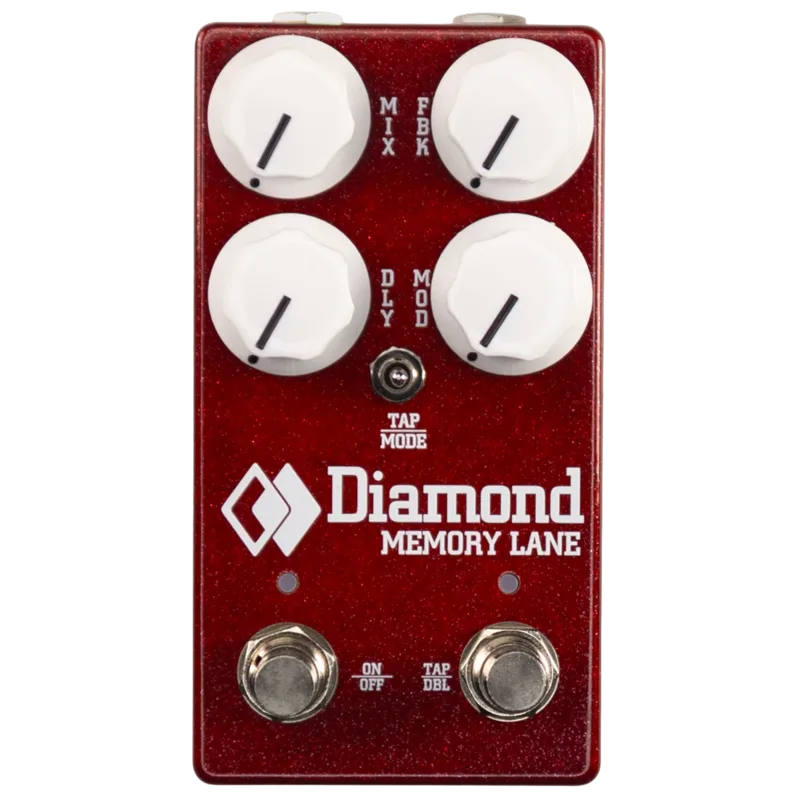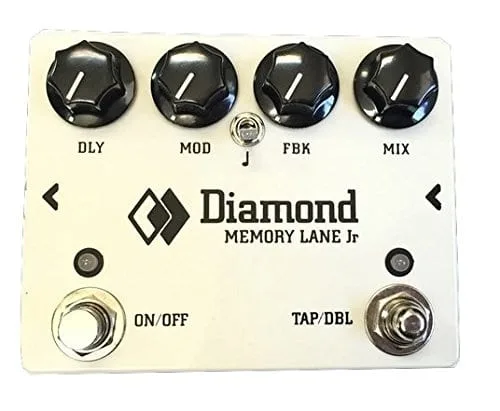


The Diamond Memory Lane Jr is a compact delay pedal from Diamond Pedals, released in 2011 as the successor to the company's all-analog Memory Line delays. Where the original Memory Lane and Memory Lane 2 used an analog bucket brigade chip, the Jr digitally records up to 1.2 seconds of your playing and then gives that signal what Delicious Audio's reviewers called "the all-analog treatment at the processing stage, preserving that intangible w[armth]"12. The result is a digital pedal with analog-voiced repeats, in a smaller box and at a lower price than its analog big brother.
The Jr arrived because the original Memory Lane, which the presenters of That Pedal Show describe as "the very first ever analog delay of tap tempo", was discontinued when its delay chip went out of production32. The Jr was followed in 2014 by the Jr 22, and the Jr's circuit lineage was later carried forward into Diamond's current Memory Lane STM32, whose MLjr mode is described by Diamond as "true to the Memory Lane Jr."4
What it does: digital recording, analog-voiced repeats
The Jr's core idea is a hybrid signal path. The delay line records digitally, which the Delicious Audio review described as "schumtz-free", while the processing around it is analog, which is where the repeats get their warmth1. That sets it apart from the two pedals that came before it in Diamond's delay line: the Memory Lane Analog Delay and the Memory Lane 2, which were all-analog designs16. The trade-off was delay time, since the Memory Lane 2's analog chip maxed out at half the Jr's 1.2 seconds1.
The repeats also carry modulation, the warble that analog and tape delays are known for. On the Jr, the Delicious Audio review found the modulation "makes for some cool whale noises at its highest setting and an almost chorus-like effect everywhere [else]"1. On That Pedal Show, the presenters highlighted the pedal's modulation on the repeats as one of the things you might want from it3.
The controls and subdivision switch
The front panel keeps things simple, with three main knobs and a sprung subdivision switch1.
| Control | What it does |
|---|---|
| DLY | Sets the actual delay time, from 16ms up to 1200ms5 |
| MIX | Puts in or takes away the delayed signal from your overall sound5 |
| Feedback | Sets how many repeats regenerate5 |
| Subdivision switch | Sprung switch that subdivides repeats into dotted eighth notes and eighth note triplets, changeable on the fly without clicking1 |
The subdivision switch is the Jr's most distinctive control. Because it is sprung and does not click on and off, you can change subdivisions mid-phrase1. On That Pedal Show, the presenters explained that you have to engage the subdivisions switch to manipulate the delay time while playing, and that holding the switch makes the delay run either twice as fast or half as fast, with the repeats dropping an octave down or jumping an octave up3.
The modulation control is described differently in different accounts. Delicious Audio reports that the Jr had fixed modulation, with no Depth and Speed controls, and that the later Memory Lane DLX added those controls2. Pedal of the Day's 2014 review of the Jr, however, lists "adjustable modulation" among its features5. The modulation control may therefore vary between the Jr and the Jr 2, or between individual units.
History and versions
Diamond's delay line ran: the original Memory Lane, then the Memory Lane 2, then the Jr6. The analog Memory Lane was retired after version 2 because it was based on a chip that went out of production2. The Jr replaced it in 2011 as a more compact, digital yet analog-voiced successor, and the Jr 2 followed in 20142.
The Memory Lane Jr. sits in a line of Diamond delays that are now retired. The original Memory Lane is out of production2, and both the Memory Lane Analog Delay and the Memory Lane 2 are listed among Diamond's retired pedals, no longer in production76. At $279, the Jr. was positioned as the more attainable member of the family next to its $600 analog big brother, the Memory Lane 21.
What reviewers said
The Delicious Audio review took a measured view of the Jr: "Memory Lane Jr. doesn't do anything too exciting or outlandish, but if you're looking for an intelligently designed boutique delay on a working man's budget, Memory Lane Jr. is a class act"1. At $279, the reviewers found it "more attainable by most guitarists than its $600 analog big brother, Memory Lane 2"1.
Pedal of the Day's Mike B, writing in 2014, was more enthusiastic, saying that whatever the pedal gives up in features "it makes up for it ten-fold in sound quality and production"5. On That Pedal Show in 2019, the presenters called the Jr's sound exceptional and said they would compare it side by side with an Analog Man and a "DX twenty something" on Mick's board3.
"that's gorgeous really it sounds exceptional"
In that demo, the presenters walked through the pedal's subdivision switch behavior and its modulation, and showed how the repeats respond when the switch is held3.
Videos
ProGuitarShopDemos
shnobel
Mike Hermans
Questions
Is the Diamond Memory Lane Jr analog or digital?
It is a hybrid. The Memory Lane Jr digitally records up to 1.2 seconds of your playing, then passes the signal through an all-analog processing stage that preserves the warmth of an analog delay. Reviewers described it as digital yet analog-voiced, unlike the all-analog Memory Lane and Memory Lane 2 that came before it.
Is the Memory Lane Jr true bypass?
Yes, and buffered too. Internal switches let you select either true bypass or buffered bypass with delay trails, so you can set it to suit the rest of your pedalboard. The later Memory Lane DLX and the current STM32-based Memory Lane use buffered bypass instead.
What is the difference between the Memory Lane Jr and the original Memory Lane?
The original Memory Lane was an all-analog delay built around a bucket brigade chip, and it was retired after version 2 because that chip went out of production. The Jr, released in 2011, is smaller and more affordable, records digitally, and offers up to 1200ms of delay where the Memory Lane 2's analog chip maxed out at half that.
How long is the delay on the Memory Lane Jr?
The DLY knob sets delay time from 16ms up to 1200ms, or 1.2 seconds. The Memory Lane 2's analog chip topped out at half that, and the later DLX and current STM32 Memory Lane both extended the maximum delay time.
Sources (7)
- Pedal Review: Diamond's Memory Lane Jr., Delicious Audio, 2013-05-30
- Diamond Memory Lane DLX Delay, Delicious Audio, 2020-07-08
- Boss EQ-200, JHS Cheese Ball, JAM Ripply Fall, Diamond Memory Lane Jr, That Pedal Show (YouTube), 2019-10-29
- Memory Lane STM32, Diamond Pedals
- Diamond Pedals Memory Lane Jr. Delay, Pedal of the Day, 2014-12-11
- Diamond Pedals Memory Lane Delay, Pedal of the Day, 2016-02-07
- Diamond Pedals Memory Lane Deluxe Delay, Pedal of the Day, 2020-09-10