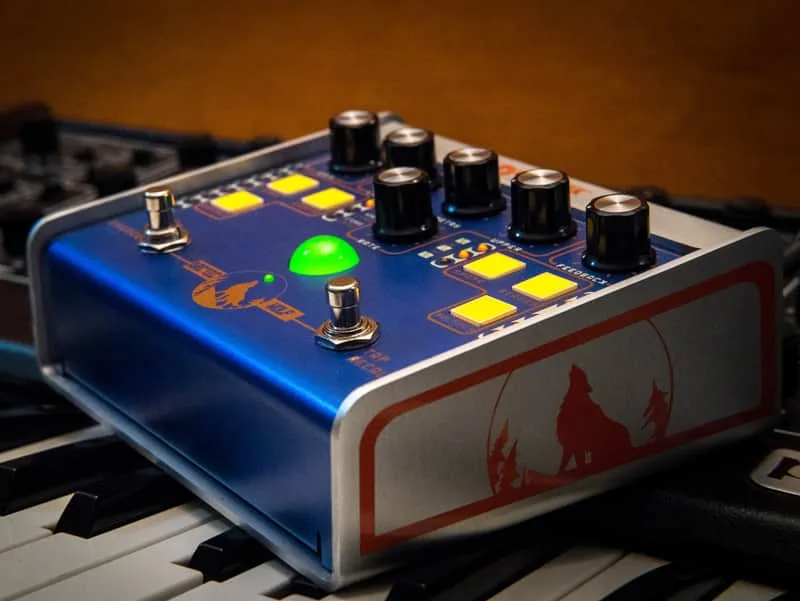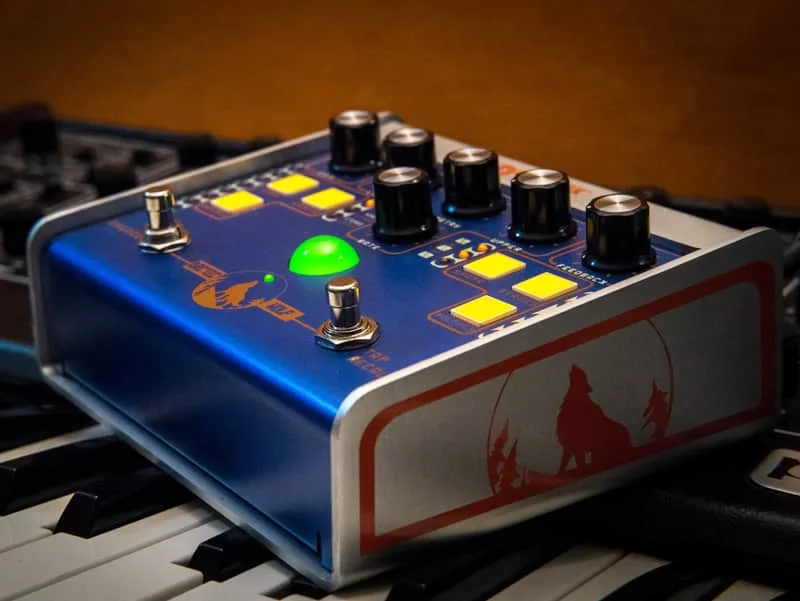

The Dogmatek Arctic Wolf Twin Modulator is a phaser pedal from New Zealand pedal company Dogmatek, their first product. Its primary function is a phaser, but it also covers tremolo, ring modulation and up to 18dB of boost1. It is an analog/digital hybrid: the signal path is fully analog for what Dogmatek describes as lush, transparent phasing, while the control side is digital, bringing tap tempo, eight presets and a wide range of waveform options2.
What sets it apart from most phasers is its circuit. Premier Guitar reports it uses a rare "pulsed switch" system to create its sound, different from the standard LFO and FET designs found in typical phasers2.
A phaser that also does tremolo, ring modulation and boost
The Arctic Wolf's rate control has an unusually wide range. Premier Guitar's reviewer found it spans from sweeps so slow you barely perceive them to fast, audio-range pulses that generate clangorous ring modulation3. At the low end it behaves as a conventional phaser; pushed into audio range it becomes a ring modulator, and the square waveform setting produces a choppy tremolo-style effect3.
The boost side offers up to 18dB of gain, which Delicious Audio summed up as "Let your amp feel the bite of the Arctic Wolf"1. A dedicated gain control sets the pedal's output, and you can choose whether the boost remains in effect even when the pedal is bypassed, so it can double as a standalone clean boost3.
Despite the word "twin" in the full product name, the Arctic Wolf employs a single LFO, but with true stereo inputs and outputs. You can configure it to accept stereo input, mono input, or two discrete mono inputs3. Delicious Audio described the stereo behavior as the phaser swirling to the left, pausing, then building wildly across to the right, and noted the manufacturer claims absolute originality in the stereo character of the phaser1.
The controls
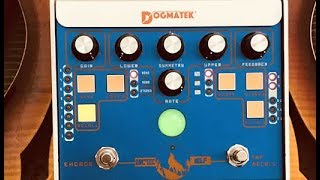
The Arctic Wolf front panel combines knobs with multi-function buttons:
| Control | What it does |
|---|---|
| Rate | Sets the speed of the phase, or can be driven by an external expression pedal4 |
| Symmetry | Adjusts the rise and fall times of the waveform, sharp rise with slow fall or vice versa4 |
| Upper / Lower | Set how long the waveform stays at its top or bottom before returning to phase, precisely selecting the phasing's top and bottom ranges14 |
| Gain | Sets the pedal's output, with an option to keep it active when bypassed3 |
| Feedback | A traditional feedback control3 |
| Shape button | Selects waveform modes: Triangle, Square, Sine, S/H (random, robotic) or Manual4 |
| Stages button | Chooses 4, 6 or 12 phasing stages, from subtle to intense4 |
| Config button | Sets input and output configuration, with four mono and stereo options4 |
The waveform options deserve a closer look. Premier Guitar's reviewer described four waveform types: triangle (the traditional phaser sweep), a smoother sine wave, a choppy square, and a random/chaotic sample-and-hold, plus a manual mode where the effect position is controlled by CV or an expression pedal3. The press release also lists symmetry control alongside the five selectable waveforms2.
There is no dedicated depth control and no wet/dry blend, though the traditional feedback control is there for regenerating the sweep3.
Tap tempo and presets
A single footswitch serves for tap tempo and preset recall. You switch modes by pressing the switch for two seconds, and saved sounds require 1.5 seconds to load3. There is also a tempo-multiply function that generates rate multiples up to 16 times that of your taps, so fast speeds do not require fast tapping3. The press release highlighted this as allowing on-the-fly recalling of settings without bending down and messing with the pedal2.
The eight preset slots can be selected via the Tap/Recall switch or via an external footswitch4. One practical note from Premier Guitar's review: after recalling a preset, the knobs no longer reflect the current settings, so you cannot see at a glance what a recalled sound is doing3.
Expression and CV control
The rear panel includes a jack for expression pedal input and CV in and out3. The CV jacks let you connect an external control voltage (LFO) to drive the effect, and an external expression pedal can adjust the phase speed4. The expression pedal itself is not included3.
What reviewers said
Premier Guitar reviewed the pedal in 2021 and gave it a positive verdict, summing it up as3:
"Innovative phase shifter with unusual features. Fine sound. Good price."
On its core sound, the reviewer found the analog phasing voice "not far removed from, say, a vintage MXR phaser"3. Pedal of the Day called it "a genuine beast of a modulation pedal" that smashes typical effect pedal stereotypes4, and Delicious Audio, at the announcement stage, said it "looks very sexy and sounds great"1.
Power and practical notes
The Arctic Wolf runs on regular 9V power, but the power supply must provide at least 300 milliamps3. That current draw rules out most simple daisy-chain supplies sized for analog pedals.
The pedal lives in a light folded-aluminum enclosure sized approximately 7" x 6" x 2.5", made in New Zealand3. Street price at the time of the 2021 review was $3103.
Videos
Premier Guitar
Dogmatek Effects Pedals
Dogmatek Effects Pedals
Questions
Is the Dogmatek Arctic Wolf Twin Modulator analog or digital?
It is an analog/digital hybrid. The signal path is fully analog, which Dogmatek says gives lush, transparent phasing, while the control side is digital, which is what makes tap tempo, presets and waveform selection possible.
Does the Arctic Wolf have tap tempo?
Yes. A single footswitch handles tap tempo and preset recall, and a tempo-multiply function can generate rate multiples up to 16 times that of your taps for faster speeds without frantic tapping.
Does the Arctic Wolf work in stereo?
Yes. It has true stereo inputs and outputs, and can be configured for stereo input, mono input, or two discrete mono inputs. Despite the word twin in its name, it uses a single LFO driving the stereo effect.
How many presets does the Arctic Wolf store?
Eight. Presets can be selected with the Tap/Recall footswitch or an external footswitch. Note that after recalling a preset, the knob positions no longer reflect the current settings.
Can I use an expression pedal with the Arctic Wolf?
Yes. The rear panel has an expression pedal input plus CV in and out jacks, so you can control the phase speed externally or drive the effect from an external control voltage. The expression pedal itself is not included.
Where is the Dogmatek Arctic Wolf made?
New Zealand. Dogmatek is a New Zealand pedal company and the Arctic Wolf is built there, in a light folded-aluminum enclosure measuring approximately 7 by 6 by 2.5 inches.
Sources (4)
- New Manufacturer: Dogmatek And The Arctic Wolf Twin Modulator, Delicious Audio, 2017-10-06
- Dogmatek Releases the Arctic Wolf Twin Modulator, Premier Guitar, 2017-11-08
- Dogmatek Arctic Wolf Review, Premier Guitar, 2018-06-18
- Dogmatek Effects Pedals Arctic Wolf Twin Modulator Phaser, Pedal of the Day, 2018-09-13