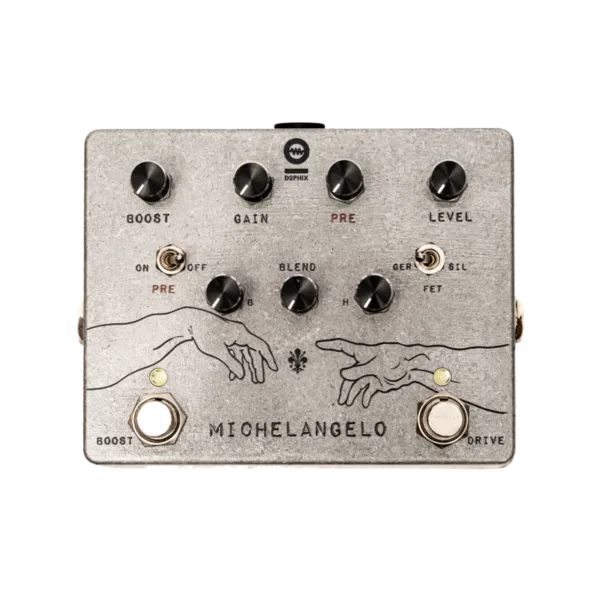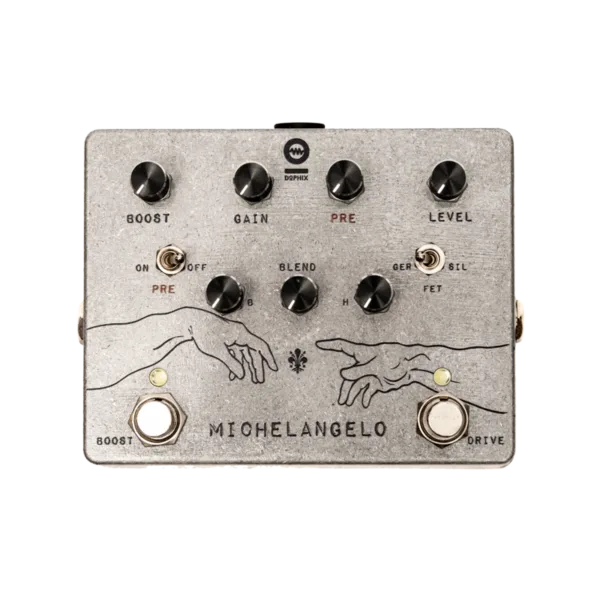



The Dophix Michelangelo Overdrive Plus is an analog overdrive and boost pedal from Italian maker Dophix, with each side independent of the other1. Its core circuit is built entirely of JFET transistors, which Dophix says give a dynamic and warm sound that recreates the feel of a tube head, combining what the maker calls the dynamism of valve sound with the definition of a pedal effect2. On top of the drive stage it carries a preamplifier and an output boost, both separately controllable and activated through a dedicated BOOST footswitch2.
The Dophix Michelangelo Overdrive Plus is an analog overdrive pedal whose core circuit is built entirely of JFET transistors, which Dophix says give a dynamic and warm sound recreating a tube (valve) head2. It offers a preamplifier and an output boost, both separately controllable and activated through a dedicated BOOST footswitch, with two independent true bypass footswitches: DRIVE activates and deactivates the drive effect, and BOOST activates the boost2. MusicRadar listed its price at $3203.
The controls
The Michelangelo Overdrive Plus puts its drive sound together from a set of knobs and toggles that Dophix and reviewers describe as follows5.
| Control | What it does |
|---|---|
| Gain | Sets up the drive sound, alongside Level5 |
| Level | Sets the output level of the drive sound5 |
| Two EQ knobs | Further tweak the drive sound after Gain and Level5 |
| Blend | Blends the effect with the dry signal; MusicRadar found it "allows for nice fine-tuning of gain"4 |
| Pre | Controls the preamplifier level, acting on the amplitude of the input signal feeding the amplification and distortion section2 |
| Boost | Adjusts the output boost, activated by the Boost footswitch1 |
| Diode selector (Ger/FET/Sil) | Selects the diode voicing4 |
| Pre toggle | Positions the boost before or after the gain stage4 |
The preamplifier is a separate gain stage in its own right: Dophix explains that it acts on the amplitude of the input signal into the amplification and distortion section, so the Pre knob shapes how hard the drive stage itself is hit2.
The Pre toggle changes how the boost side behaves. MusicRadar describes it as "a toggle switch that allows you to position it before or after the gain stage"4. Pedal of the Day spells out the practical difference:
"If the Pre switch is in the Off position, it can only be activated by the Boost footswitch; if it's On, it's on."
So with the switch off you get a footswitchable boost on demand, and with it on the boost is always engaged in the chain, either pushing the front of the gain stage or lifting the output after it142.
Two true bypass footswitches control the whole pedal: DRIVE activates and deactivates the drive effect, and BOOST activates and deactivates the preamp, the output boost, or both2. That means you can run the boost side into a clean amp on its own, or stack it with the drive.
Three clipping modes: silicon, germanium and JFET
The headline feature is the three-position switch that selects three distortion modes using silicon, germanium and JFET semiconductors26. MusicRadar frames the same switch as the circuit's three distinct diode voicings, "with silicon, germanium and FET selectable via a three-way toggle switch"4.
For a player, this is the difference between three characters of clipping in one box. Silicon diodes are the tighter, brighter voicing common to most classic overdrives; germanium is the softer, more compressed and rounder clipping associated with vintage fuzz and early overdrive circuits; and the FET position clips in a way that leans into the pedal's JFET core, where Dophix says the dynamic and warm tube-like character lives24. Rather than buying three pedals to compare those voicings, the selector moves between them on the fly, and the Blend knob then dials in how much of the clipped signal sits against your clean signal4.
Where it comes from and what it costs
Dophix is an Italian builder, and MusicRadar notes that Michelangelos "are built to order in Firenze and will take around 30 days to reach your pedalboard"4. The pedal is built around JFET transistors throughout its core circuit, which Dophix describes as giving a dynamic and warm sound recreating a tube (valve) head2.
On price, the figures differ by date and region. Dophix's product page lists €400 as the original price2. Guitar World's review gives $320, £275, €2905, and MusicRadar's 2019 launch coverage put it at €290, approximately $3253. The maker's page is the most recent figure to weigh against the older press numbers.
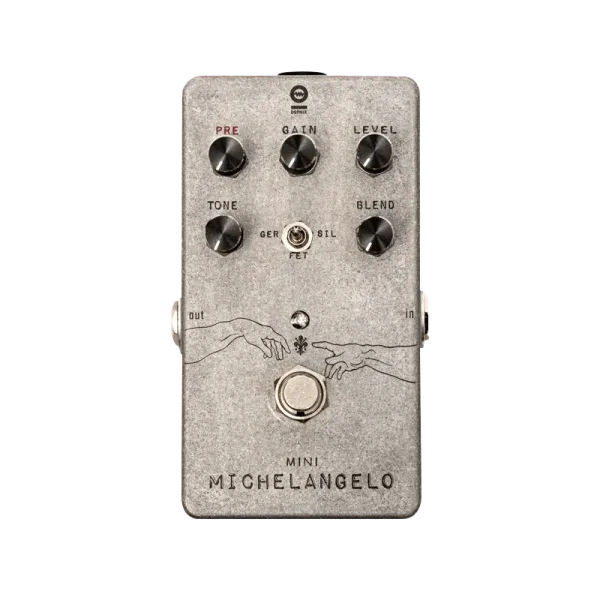
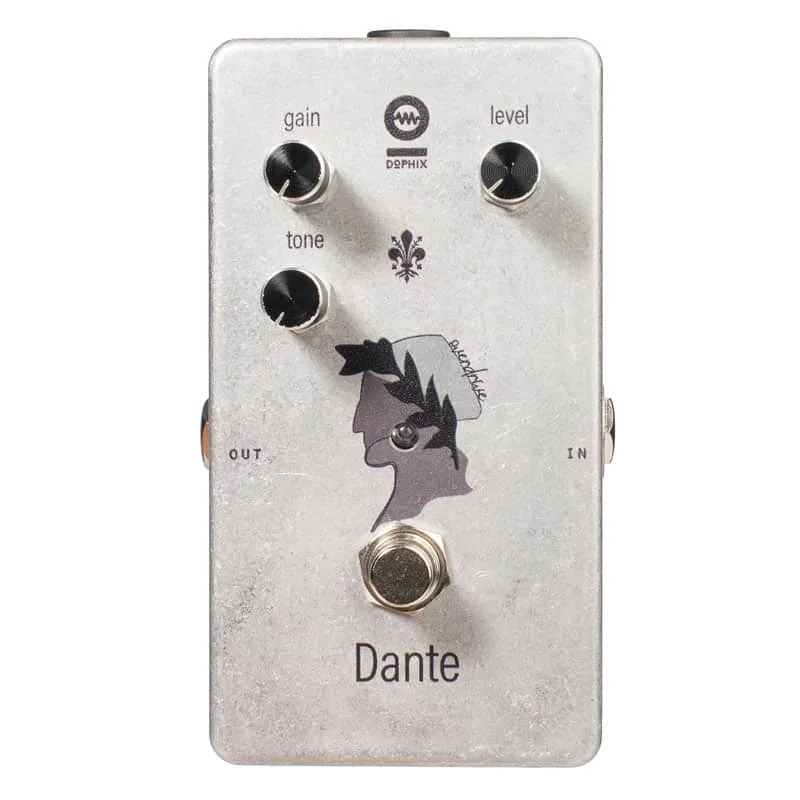
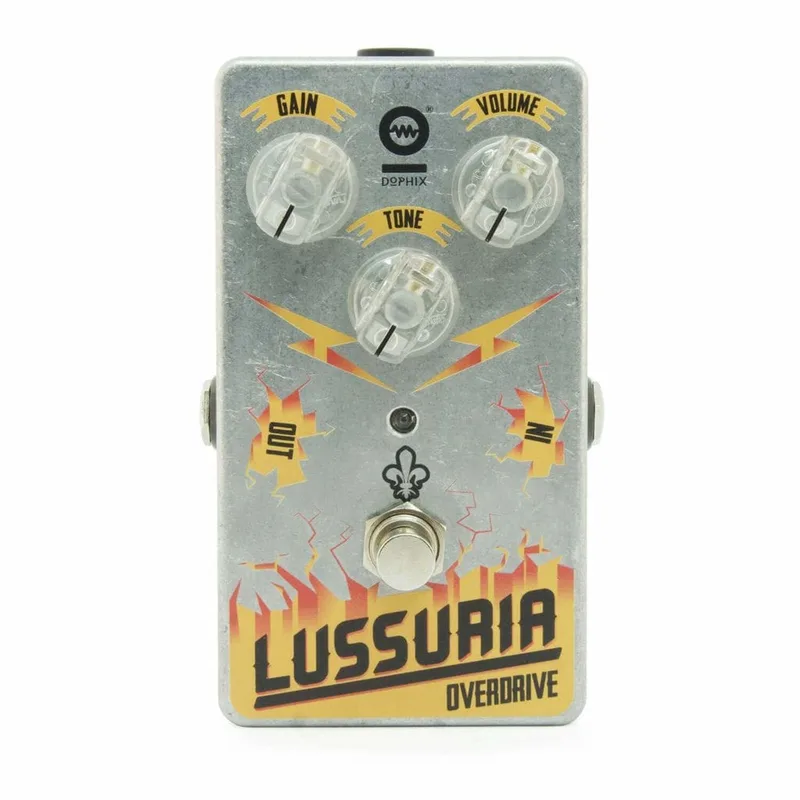
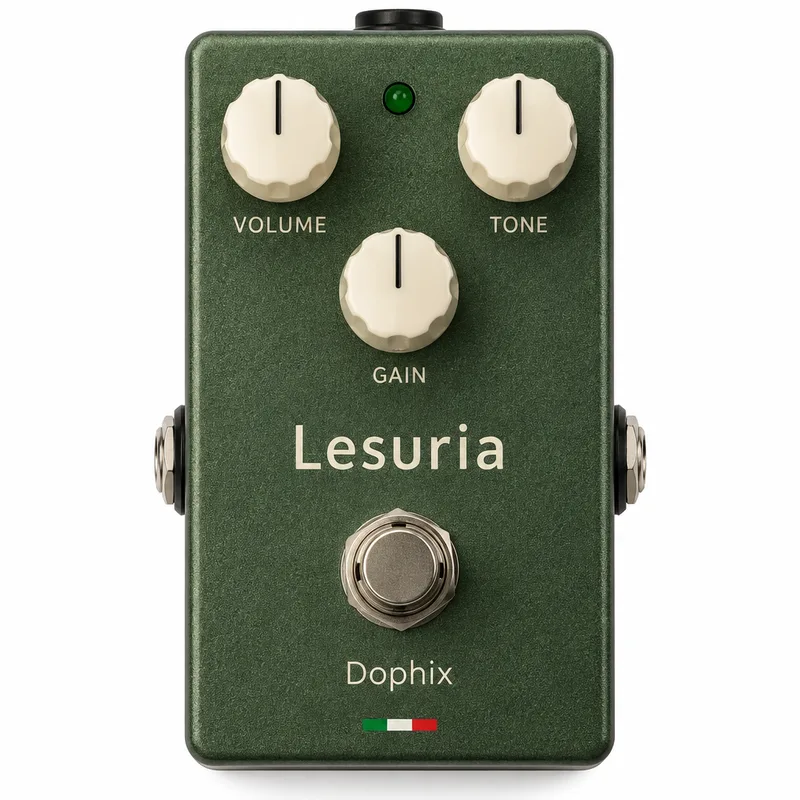
Dophix has since extended the Michelangelo family: a Michelangelo overdrive mini was previewed at the NAMM Show 2026 in Los Angeles, with pre-orders open and shipping expected within one month, and the line sits alongside pedals like the Dante and Lussuria overdrives.
What reviewers said
MusicRadar's launch coverage called it "a real work of art" and noted the vintage 1970s JFETs and +15dB preamp boost, while observing that at approximately $325 it was not cheap3. Guitar World's reviewer, Trevor Curwen, described the working method: "Level and Gain controls set up the drive sound that can be further tweaked by two EQ knobs"5. Delicious Audio, writing from the Montreal Sonic Circuit event in 2022, went furthest:
"by that standard Dophix's Michelangelo Overdrive Plus is an ingenious sonic masterpiece"
Pedal of the Day's 2019 review emphasized the pedal's structure as an overdrive and boost with each side independent of the other, and walked through the Boost knob adjusting the output boost activated by the Boost footswitch1.
Videos
DOPHIX
DOPHIX
Mike Hermans
Questions
Where is the Dophix Michelangelo made?
MusicRadar reports that Michelangelo pedals are built to order in Firenze, Italy, and take around 30 days to reach your pedalboard. Dophix is an Italian effects maker whose line also includes the Dante, Lussuria and Venere overdrives.
Is the Dophix Michelangelo true bypass?
Yes. Dophix specifies two independent true bypass footswitches: DRIVE activates and deactivates the drive effect, and BOOST activates and deactivates the preamp, the output boost, or both.
Can the Michelangelo Overdrive Plus run on a battery?
Yes. Dophix lists it as taking an external or battery-powered 9V power supply, so a 9V battery is an option. RockBoard's PedalPedia lists its current draw at 19mA.
How does the Pre switch work on the Michelangelo?
The Pre toggle positions the boost before or after the gain stage. Pedal of the Day explains that with the Pre switch off, the boost can only be activated by the Boost footswitch; with it on, the boost is always on.
Is there a mini version of the Dophix Michelangelo?
Yes. Dophix previewed the Michelangelo overdrive mini at the NAMM Show 2026 in Los Angeles, with pre-orders open and shipping expected within one month.
Sources (7)
- Dophix Michelangelo Overdrive Plus, Pedal of the Day (www.pedal-of-the-day.com), 2019-07-03
- Michelangelo overdrive plus, Dophix (www.dophix.com), 2024-10-04
- Cowabunga! Dophix's Michelango Overdrive Plus is a real work of art, MusicRadar, 2019-08-15
- Dophix Michelangelo Overdrive Plus review, MusicRadar, 2020-06-05
- Dophix Michaelangelo Overdrive Plus review, Guitar World, 2020-07-13
- Michelangelo Overdrive Plus by Dophix, RockBoard PedalPedia, 2026
- Dophix Michelangelo Overdrive Plus, Delicious Audio, 2022-01-17