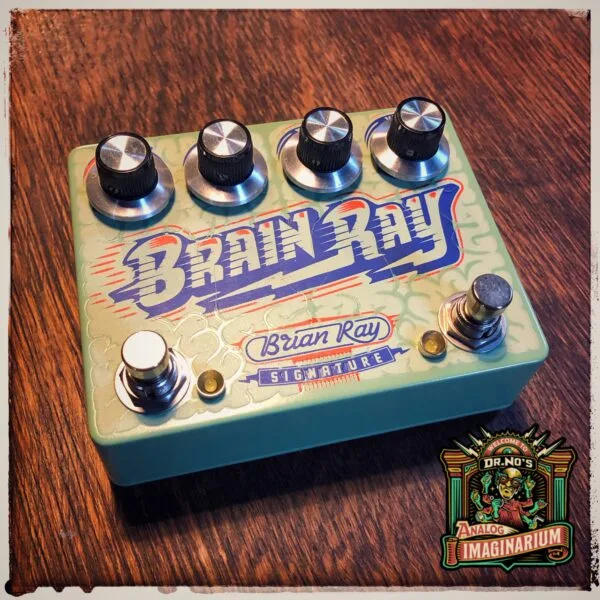
The Brain Ray is a fuzz pedal with a built-in clean boost, made by Dr. No effects as a commissioned collaboration with guitarist Brian Ray, who plays with Paul McCartney, Etta James and The Bayonets. The fuzz side uses three extremely rare NOS AC-128 germanium transistors, and the clean boost sits as a separate circuit alongside it1. It belongs to the wider family of fuzz pedals, with the boost placing it near the territory of boost pedals as well.
Where it came from
Dr. No worked on the Brain Ray through 2011 and 2012 as a collaboration and commission request with Brian Ray. The maker has called it his first but also last commissioned creation. Brian Ray had already been using Dr. No's Octofuzz and had taken note of the builder's work, which led to the project1.
The brief was to take the best of several Tonebenders that Ray owned and liked, combine their qualities, and add a clean boost circuit. The fuzz itself had evolved from an earlier two-silicon-transistor design into the three-germanium-transistor version with the separate boost1. Tone Bender-style circuits have a long family tree: Premier Guitar has noted that such designs "have each spawned almost innumerable iterations, copies, spin-offs, and re-imaginations"2.
The name
Brian Ray himself came up with the name XRay, which later changed into Brain Ray, playing with his own name1.
Availability
Only five Brain Rays were ever made. No webshop as of February 20241.
In February 2024, unit No#01/05, one of two from Dr. No's own archive, was made available on the webshop at 550.00 EUR1. With a run of five and the archive units now surfaced, the pedal is effectively unobtainable through normal retail.
Questions
How many Dr. No Brain Rays were made?
Only five Brain Rays were made. The unit listed on the Dr. No webshop in February 2024 was numbered No#01/05 and was one of just two from Dr. No's own archive that were made available for sale.
What transistors does the Brain Ray use?
The Brain Ray uses three extremely rare NOS AC-128 germanium transistors in its fuzz section, according to the maker's product page. Germanium transistors like these are no longer produced, which is part of why the run was so small.
Is the Brain Ray based on a Tone Bender?
Yes, in spirit. Dr. No has said the commission was to take the best of several Tonebenders that Brian Ray owned and liked, combine their qualities, and add a clean boost circuit. The fuzz also evolved from an earlier two-silicon-transistor design into the three-germanium-transistor version.
Who is the Brain Ray named after?
The pedal is named after guitarist Brian Ray, who plays with Paul McCartney, Etta James and The Bayonets. Brian Ray himself came up with the name XRay, which later changed into Brain Ray, playing with his own name.
Can you still buy a Brain Ray?
No. No webshop as of February 2024, and with only five units ever made, it is effectively unavailable. The archive unit No#01/05 was listed at 550.00 EUR before selling.
Sources (2)
- The Brain Ray collaboration commissioned by Brian Ray, Dr. No effects webshop, 2024-02-26
- Hartman Electronics Silicon Crystal Valve Pedal Review, Premier Guitar, 2013-04-15