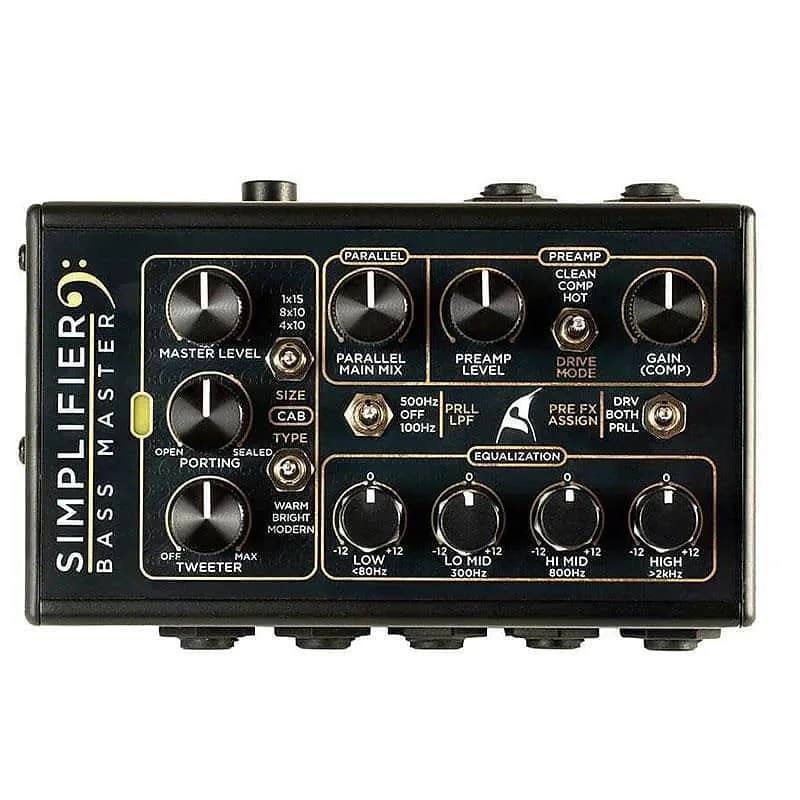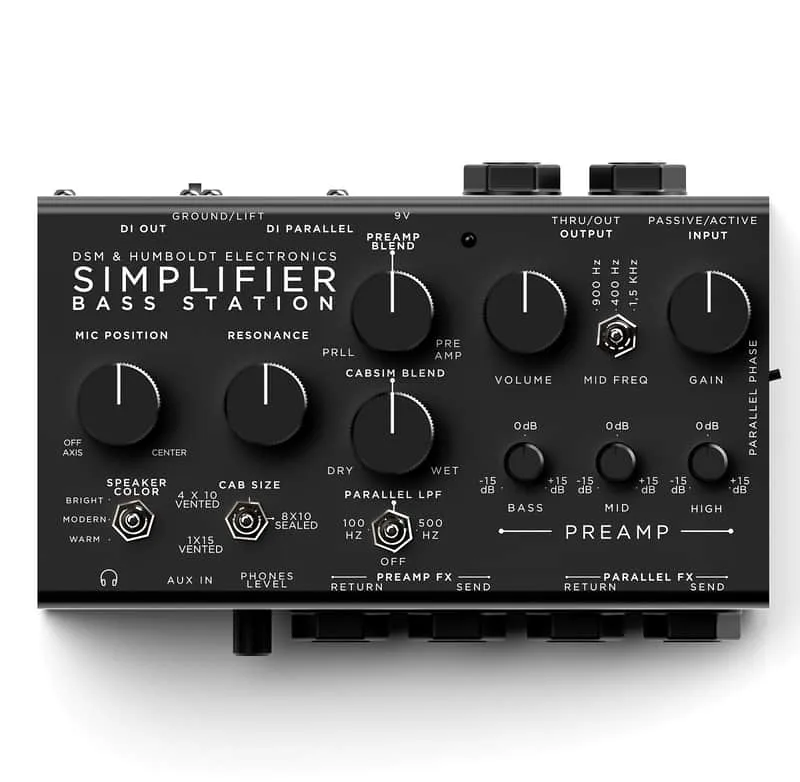


The DSM & Humboldt Simplifier Bass Station is an analog bass preamp pedal from DSM & Humboldt Electronics, built to deliver a full bass amp tone straight into a PA or a recording interface. The preamp stage is based on the Ampeg SVT, and it pairs that circuit with an analog cabinet simulation based on the Omnicabsim by DSM Noisemaker1. DSM & Humboldt describes it as everything you ever needed to go direct to the FOH or record bass tones without sacrificing anything2.
Preamp and EQ
The preamp gives you gain, level and a three-band EQ with a semi-parametric mid control2. The EQ is flexible, with plus or minus 15dB per band, and the midrange is switchable between 400Hz, 900Hz and 1500Hz1. As for how the SVT-style circuit behaves, DSM & Humboldt says that across most of the gain settings the amp is tight and clear, but with higher gains it will grunt and growl like a real Ampeg SVT1.
Cabinet simulation
The cabinet simulation is analog, not digital, and it offers three cabinet choices1:
- Closed back 8x10: tight and punchy lows
- Vented 1x15: warm creamy mids and thick lows
- Vented 4x10: a more open, wider range response
On top of the cabinet selection, a Speaker color switch with Warm, Bright and Modern settings simulates the different materials and geometry of bass speakers1. Resonance and Mic position controls let you adjust the exact amount of high end brightness and the cabinet character1. For more on this family of circuits, see the speaker simulation type page.
Parallel routing and the low pass filter
The pedal routes the signal in parallel, with a selectable LPF on the parallel path and a dual FX loop covering the preamp and the parallel signal separately1. The parallel low pass filter is switchable between 100Hz, Off and 500Hz1.
The point of the parallel blend is that mixing the clean signal with the preamp tone lets you overdrive the preamp while retaining a huge low end response and natural dynamics2. Players who push the gain hard, whether with the pedal alone or alongside overdrive and distortion pedals, can keep the low end intact by blending in the clean path.
Going direct
The Simplifier Bass Station is aimed at players who run direct: to the front of house mixer at a gig, or into an interface for recording3. With the SVT-style preamp and the analog cabinet simulation on board, the idea is that you get a mic'd-up bass rig tone from a pedal, with no cabinet or microphone needed.
Price
Guitar.com's review coverage listed the Simplifier Bass Station at £299 GBP as of 28 June 20224. That figure is in UK pounds as published, and it dates from the review's publication, so it may not reflect current pricing.
Videos
Andertons Music Co
DSM / Humboldt
DSM / Humboldt
Questions
What cabinets does the Simplifier Bass Station simulate?
It offers three cabinet simulations: a closed back 8x10 with tight and punchy lows, a vented 1x15 for warm creamy mids and thick lows, and a vented 4x10. On top of the cabinet choice, a Speaker color switch with Warm, Bright and Modern settings simulates different bass speaker materials and geometry, and Resonance and Mic position controls adjust the high end brightness and cabinet character.
Is the Simplifier Bass Station analog?
Yes. The cabinet simulation is analog, based on the Omnicabsim by DSM Noisemaker, and the preamp stage is based on the Ampeg SVT. DSM & Humboldt describes the whole unit as a bass preamp with analog cabinet simulation rather than a digital modeler.
What power does the Simplifier Bass Station use?
It runs on 9V DC, center negative, and draws 80mA. That current draw is worth keeping in mind when planning a daisy chain supply with other pedals on a board.
What does the parallel low pass filter do?
The pedal routes a clean parallel signal alongside the preamp tone, and that parallel path has a switchable low pass filter with settings of 100Hz, Off and 500Hz. Blending the clean signal with the preamp tone lets you overdrive the preamp while keeping a huge low end response and natural dynamics.
Can you use the Simplifier Bass Station direct to a PA or recording interface?
Yes, that is its intended use. DSM & Humboldt describes it as everything you ever needed to go direct to the FOH or record bass tones, with the analog cabinet simulation standing in for a bass cabinet. It also includes a dual FX loop for the preamp and the parallel signal.
Sources (4)
- BASS STATION, DSM/HUMBOLDT, 2026
- BASS STATION, DSM/HUMBOLDT, 2026
- Simplifier Bass Station by Humboldt Electronics, RockBoard PedalPedia, 2026
- Walrus Audio Badwater review: An essential tool for the accidental bassist, Guitar.com, 2022-06-28