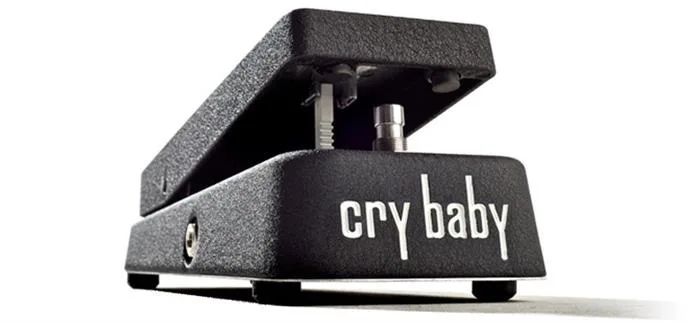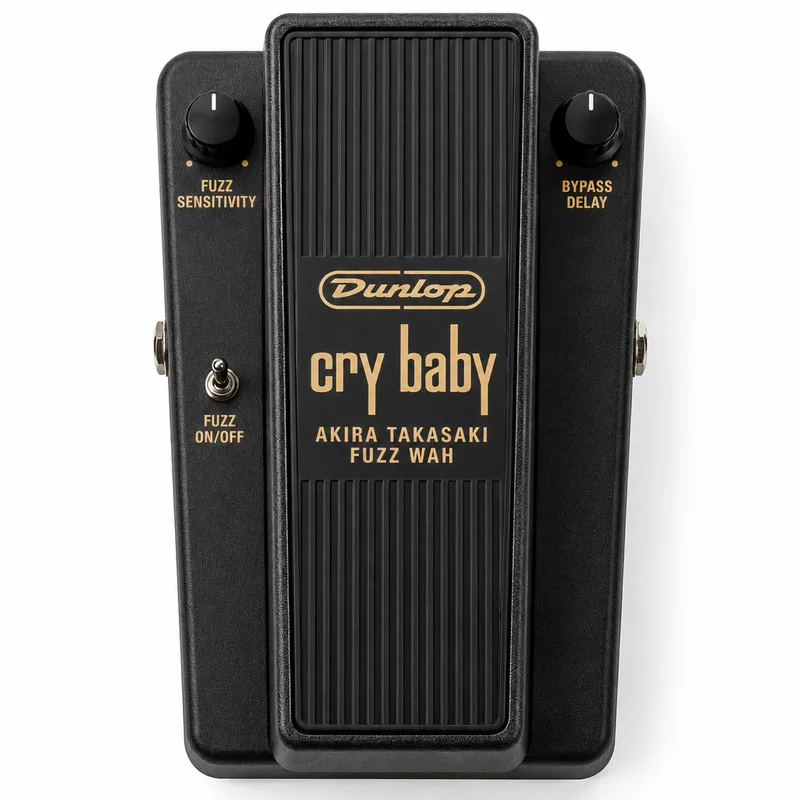
The Dunlop AT95M Cry Baby Akira Takasaki Fuzz Wah is a wah pedal with a fuzz circuit built into the same enclosure, made with Akira Takasaki, guitarist of Loudness. The pedal's own manual, which names it the "CRY BABY(R) AKIRA TAKASAKI FUZZ WAH", describes its basic operation: the pedal is bypassed (off) while your foot is off the rocker, and the wah engages by pressing the toe down, indicated by a rear blue LED1. An external BYPASS DELAY knob with a center detent sets the rocker effect's ring-out time: rotating it counterclockwise increases the ring-out time, while rotating it clockwise decreases it1.
How it works on your board
The AT95M behaves like a standard Cry Baby with an extra layer. The pedal is bypassed while your foot is off the rocker; pressing the toe down engages the wah, indicated by a blue LED at the rear1. A FUZZ ON/OFF switch toggles the fuzz effect on or off, with a green LED showing when it is on1. With the fuzz engaged, the pedal carries up to +60 dB of gain, against +22 dB in wah mode alone1, so it moves from a filter pedal to a full fuzz voice under the wah sweep.
Dunlop's manual gives these specifications, measured at 1 kHz1:
| Specification | Wah mode | Fuzz-wah mode |
|---|---|---|
| Max gain | +22 dB | +60 dB |
| Max output level | +8.7 dBu | +5.0 dBu |
| Input impedance | 1.1 MΩ | 480 kΩ |
| Output impedance | 4.3 kΩ | 3.8 kΩ |
| Noise floor, heel down | -98 dBu | -72 dBu |
| Noise floor, toe down | -91 dBu | -60 dBu |
| Noise floor, effect off | -105 dBu | -105 dBu |
The noise floor figures show the trade the fuzz brings: with the fuzz on, the pedal is noticeably noisier than the wah alone, which is typical of a high-gain fuzz circuit1.
Controls
| Control | Location | What it does |
|---|---|---|
| FUZZ ON/OFF switch | External | Toggles the fuzz effect on or off; green LED indicates on1 |
| FUZZ SENSITIVITY knob | External | Adjusts the intensity of the fuzz effect1 |
| FUZZ VOLUME knob | Internal | Adjusts pedal volume when fuzz mode is engaged1 |
| BYPASS DELAY knob | Internal | Sets wah ring-out time after the rocker returns to its heel position1 |
The BYPASS DELAY knob has a center detent: rotating it counterclockwise increases the ring-out time, and clockwise decreases it1. That control shapes how the wah tail decays once you lift your foot, which changes how notes bloom after a wah phrase.
The wah sweep
Dunlop's manual gives a resonant frequency of 480 Hz with the rocker heel down and 2.2 kHz with the toe down1. The announcement from Dunlop describes the pedal as having an adjustable low-frequency sweep2, which is the Takasaki-specific part of the design: the range the filter covers can be moved lower than a stock Cry Baby's sweep.
Power and connections
The AT95M is buffered bypass, not true bypass1. On a short board this makes little practical difference, but players who build all-true-bypass boards should know before adding it to a chain.
- Power: 9VDC, drawing 7 mA1
- Battery: one 9-volt battery, accessed via the underside of the pedal1
- Adapter: the Dunlop ECB003 9-volt adapter, or an MXR Brick Series power supply1
- Input: INPUT jack for connection from your guitar1
- Output: OUTPUT jack for connection to your amplifier1
At 7 mA, the pedal is a light load on any brick or daisy-chain supply1.
Related fuzz wahs
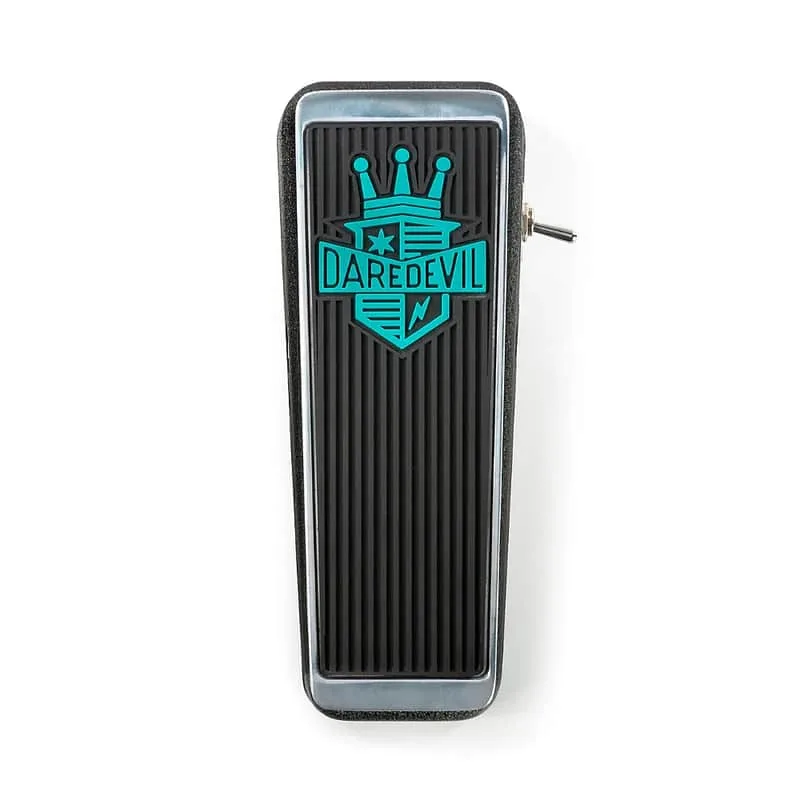
Dunlop also makes the Dunlop DD95FW Cry Baby Daredevil Fuzz Wah, another fuzz wah in the Cry Baby line. The AT95M's operation follows the standard Cry Baby pattern described in its manual: the pedal is bypassed while the foot is off the rocker, the wah engages by pressing the toe down with a rear blue LED as the indicator, and an external BYPASS DELAY knob with a center detent adjusts the rocker effect's ring-out time, counterclockwise for longer, clockwise for shorter1.
Questions
Does the Dunlop AT95M take a battery?
Yes. According to Dunlop's manual, the Cry Baby Akira Takasaki Fuzz Wah runs on one 9-volt battery, accessed through the underside of the pedal. It can also be powered from an external supply: the Dunlop ECB003 9-volt adapter or an MXR Brick Series power supply, at 9VDC. Current draw is low at 7 mA, so a battery lasts a long time and the pedal is an easy load on a daisy chain or brick.
Is the AT95M true bypass?
No. Dunlop's manual lists the AT95M as buffered bypass, not true bypass. The pedal is bypassed while your foot is off the rocker, and the wah engages when you press the toe down, indicated by a blue LED at the rear. A buffer keeps the signal strong through long cable runs, which matters on larger pedalboards.
What do the internal Fuzz Volume and Bypass Delay knobs do?
The internal FUZZ VOLUME knob adjusts the pedal's volume when fuzz mode is engaged, letting you match the fuzz level to your clean signal. The internal BYPASS DELAY knob sets how long the wah effect rings out after the rocker returns to its heel position. It has a center detent: rotating it counterclockwise increases the ring-out time, and clockwise decreases it.
What is the frequency sweep of the AT95M wah?
Dunlop's manual gives a resonant frequency of 480 Hz with the rocker heel down and 2.2 kHz with the toe down. That is the range the wah filter sweeps as you rock the pedal, from a darker, bass-heavy heel position to a bright, cutting toe position.
What power supply does the AT95M need?
The AT95M needs 9VDC. Dunlop specifies the Dunlop ECB003 9-volt adapter or an MXR Brick Series power supply. It also runs on one 9-volt battery accessed via the underside of the pedal. Current draw is 7 mA, which is light enough for most pedalboard power supplies.
Sources (2)
- AT95.pdf, Jim Dunlop, 2023
- Jim Dunlop combines fuzz and a low-frequency wah sweep on Japanese shred legend Akira Takasaki's signature Cry Baby, musicradar.com, 2023-08-15