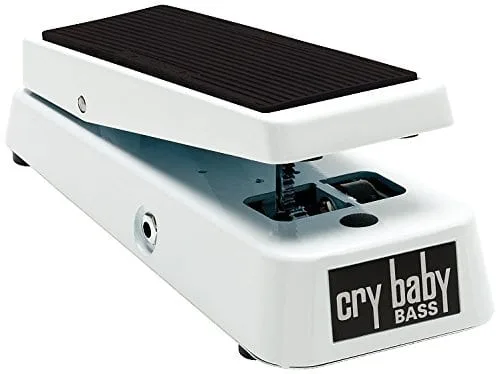


The Dunlop Cry Baby Bass Wah 105Q is a wah pedal voiced for bass, made by Dunlop and released in 19991. Where a guitar wah sweeps its filter across the range where a guitar lives, the 105Q applies the wah effect to the mids and highs while leaving the lows thick and full, so your fundamental holds down the bottom while the effect does its work above it2. Dunlop describes it as combining auto-return switching with circuitry specifically optimized to keep the low end full3.
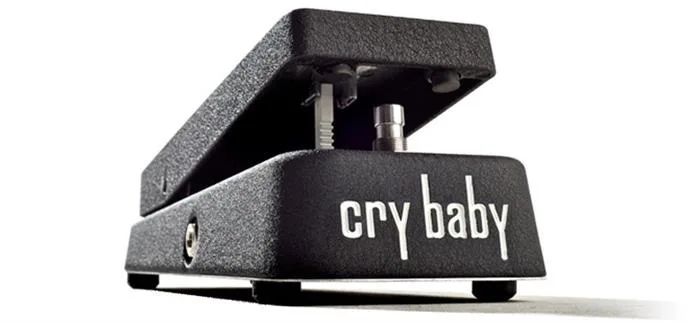
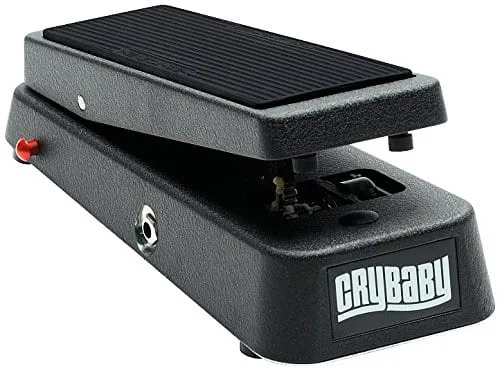
Dunlop calls the 105Q the most popular bass wah for years, and it is still in the current lineup at a list price of $159.994. It is an analog pedal5, built in the familiar Cry Baby treadle format: a rocker controlling a rack and pinion gear attached to an internal tone pot, with toe down giving more treble and heel down more bass6.
What it does: a wah voiced for bass
A wah pedal is a bandpass filter whose center frequency you control with your foot. On the 105Q, Dunlop tuned that filter for bass by applying the effect to the highs and mids only, leaving the lows untouched2. RockBoard's independent listing puts it the same way: the wah effect hits the mids and highs while a strong fundamental holds down the bottom5.
The circuit differs from a standard Cry Baby in another way: Dunlop's buying guide notes the 105Q uses an envelope filter circuit in place of the inductor found in a conventional wah2. The enclosure is the classic Cry Baby shape, with the 105Q Bass edition finished in what Guitar World's reviewer called a funky white color6.
The filter sweep: 180 Hz to 1800 Hz
The manual gives the filter's center frequency as 180 Hz with the rocker heel down and 1800 Hz toe down, with gain at the center frequency of +25 dB heel down and +32 dB toe down7. For comparison, the guitar-voiced 95Q Cry Baby sweeps 390 Hz to 2 kHz8, so the 105Q's whole range sits lower, which is what keeps it useful on low B strings and bass fundamentals.
| Position | Center frequency | Gain at center frequency |
|---|---|---|
| Heel down | 180 Hz | +25 dB |
| Toe down | 1800 Hz | +32 dB |
Auto-return switching and the controls
The 105Q does not use a click-on, click-off footswitch like a standard wah. Instead, silent "auto-off" switching puts the pedal into bypass mode when you take your foot off the rocker7. Dunlop's history of the line describes it as engaging automatically when you step on the rocker, so you step in and out of the effect without a separate switch1. The manual classifies the bypass as buffered7.
The controls, per the manual and Dunlop's buying guide:
| Control | What it does |
|---|---|
| VARIABLE Q knob | Adjusts the frequency range of the wah effect7 |
| BOOST switch | Increases output as set by the VOLUME knob7 |
| VOLUME knob | Controls the amount of gain added by the BOOST switch, up to 20 dB7 |
| Q control | Sets the effect response from sharp to smooth2 |
Guitar World's review describes the same adjustments from the outside: two trim pots on the left-hand side, one for volume and one for the peak Q point of the filter. Lower Q settings gave very usable but much more subtle wah effects, while the reviewer found many bass players will prefer the Q point pot at maximum, where it delivers a simulated auto-wah character controllable by the treadle6.
"Lower Q settings gave very usable but much more subtle wah effects."
Power
The 105Q runs on 9 volts DC7. RockBoard lists the adapter requirement as 9V DC center negative with a 4 mA current draw5, while Dunlop's manual specifies 3.5 mA7; either figure is far below what a typical power brick output supplies. Power options are one 9-volt battery accessed via the bottom of the pedal, a Dunlop ECB003 or ECB003E adapter, or a DC Brick power supply7. Input impedance is 1 MΩ and output impedance 1 kΩ7.
The 3.5 mA draw means the 105Q is an easy load for a shared or daisy-chained power supply, and a battery is a realistic long-term option on a small board.
Where it came from and who uses it
Dunlop released the 105Q Cry Baby Bass Wah in 1999, in the same era as the 95Q guitar wah of 2000, which Dunlop says combines GCB95 standard wah circuitry with the features and functionality of the 105Q1. Guitar World's Nick Wells names Tim Commerford of Rage Against The Machine as a player who got his own signature sound with it, pointing to "Calm Like A Bomb" from The Battle of Los Angeles6. As of the 2023 review, the pedal was still widely available from most music shops, with second-hand units around half price6.
How it differs from the alternatives
Dunlop's bass wah family has grown around the 105Q:
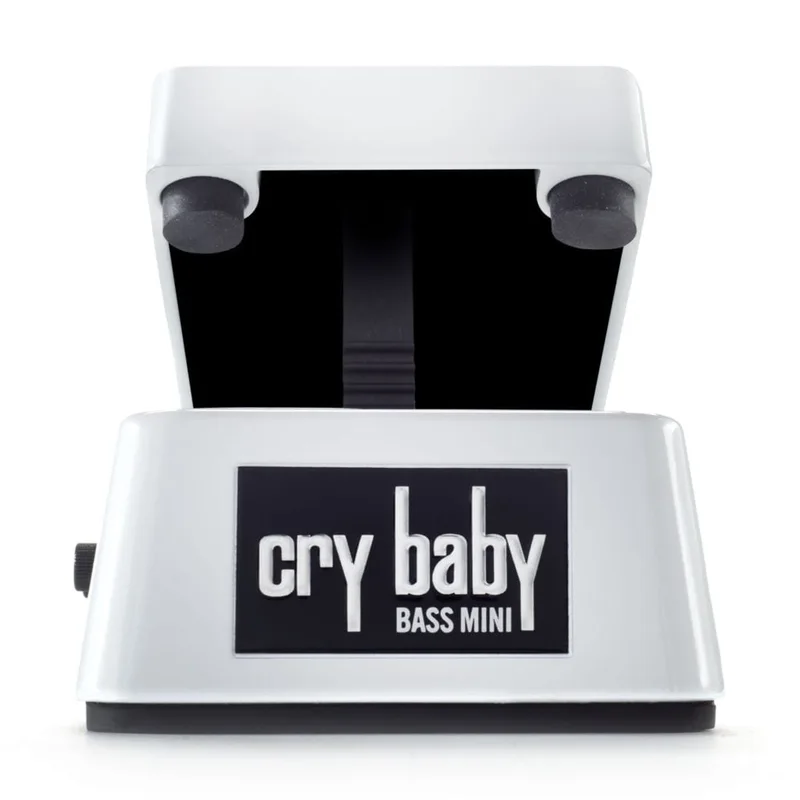
- Cry Baby Mini Bass Wah: the same sound and functionality as the 105Q at half the size and lighter weight, with similar circuitry, the same 180 Hz to 1800 Hz resonant frequency range, and auto-return switching4910. Its Q control adjusts wah frequency width, and its VOL control spans 0 dB to -21 dB10. Guitar World's review of the mini found it works for four-, five-, or six-string bass as well as baritone or downtuned guitars11.
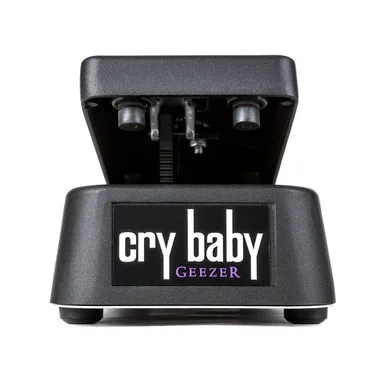
- Geezer Butler Cry Baby Bass Wah: Dunlop's first signature Cry Baby Bass Wah, announced in August 2017 and designed with Black Sabbath's Geezer Butler to complement his sound1213. It is based on a modified 95Q rather than the 105Q2.
The mini's smaller footprint is the main practical difference for pedalboard planning; the 105Q keeps the full-size treadle, which gives more travel underfoot for shaping the sweep4211.
Videos
jimdunlopusa
BassTheWorld.com
Reverb
Questions
Does the Dunlop 105Q take a 9V battery?
Yes. The 105Q runs on one 9-volt battery accessed through the bottom of the pedal, or on a Dunlop ECB003 9-volt adapter or a DC Brick power supply. Current draw is low, listed at 3.5 mA in the manual, so a battery lasts a long time if you use the adapter-free option on a small board.
What is the difference between the 105Q and the Cry Baby Mini Bass Wah?
The Mini Bass Wah (CBM105Q) delivers the same sound and functionality as the 105Q at half the size and a lighter weight, using similar circuitry. Its Q control adjusts the same wah frequency width, and it also uses auto-return switching. The tradeoff is the smaller treadle, which some players find harder to rock precisely than the full-size 105Q rocker.
Can you use a bass wah on guitar?
Yes. Guitar World's reviewer noted the Mini Bass Wah works for four-, five-, or six-string bass as well as baritone or downtuned guitars, and the 105Q's manual simply describes its input jack as taking a cable from your guitar. The sweep is tuned low, so standard-tuned guitarists may find it darker than a guitar wah.
When did the Cry Baby Bass Wah 105Q come out?
Dunlop released the 105Q Cry Baby Bass Wah in 1999, according to the company's own history of the Cry Baby line. It followed the standard Cry Baby revisions of the 1990s and has stayed in the lineup since, which Dunlop describes as making it the most popular bass wah for years.
Is there a Geezer Butler version of the 105Q bass wah?
Not of the 105Q itself. Dunlop's first signature Cry Baby Bass Wah, designed with Black Sabbath's Geezer Butler, was announced in August 2017 and is based on a modified Cry Baby 95Q rather than the 105Q. It is a separate product in the Cry Baby bass wah family.
Sources (13)
- Evolution of the Cry Baby Wah at Dunlop, Dunlop (lifestyle.jimdunlop.com), 2017-04-27
- RANGE OF EXPRESSION: FIND YOUR CRY BABY® WAH, Dunlop (lifestyle.jimdunlop.com), 2021-10-08
- CRY BABY® BASS WAH, Dunlop (www.jimdunlop.com)
- CRY BABY® MINI BASS WAH, Dunlop (jimdunlop.com)
- 105Q Cry Baby Bass Wah by Dunlop, RockBoard PedalPedia, 2026
- Dunlop Cry Baby Bass Wah: the most recognizable effects pedal ever made?, Guitar World, 2023-04-05
- 105Q.pdf, Dunlop Manufacturing, Inc., 2019
- 95Q.pdf, Dunlop Manufacturing, Inc., 2019
- Dunlop CBM105Q Cry Baby Mini Bass Wah Review, Premier Guitar, 2017-01-13
- CBM105Q.pdf, Jim Dunlop, 2019
- Review: Dunlop Cry Baby CBM105Q Mini Bass Wah, Guitar World, 2016-08-11
- GEEZER BUTLER CRY BABY® WAH, Dunlop (www.jimdunlop.com)
- Dunlop Unveils the Geezer Butler Cry Baby Wah, Premier Guitar, 2017-08-25