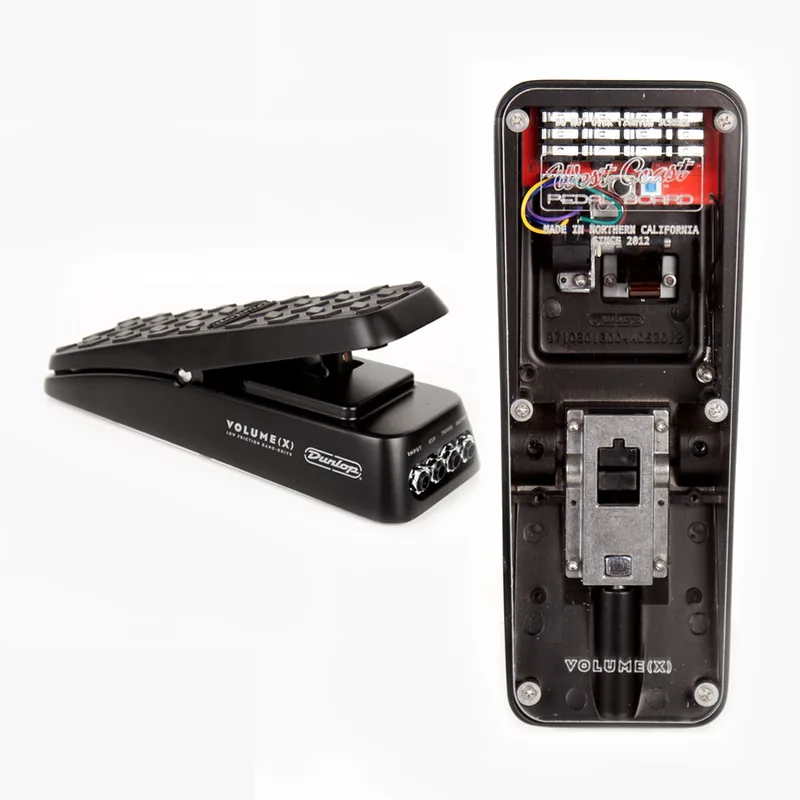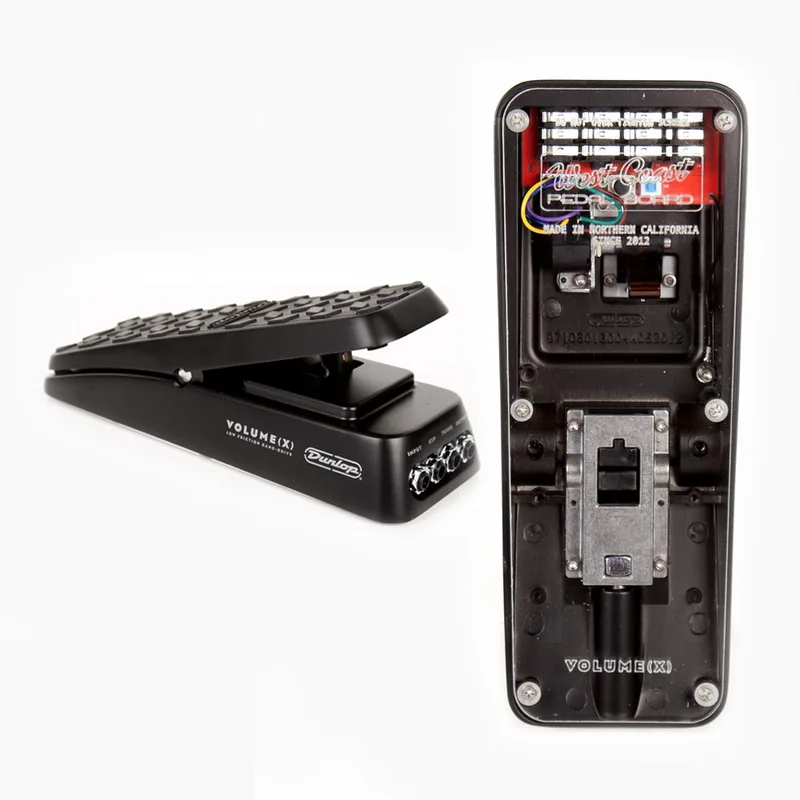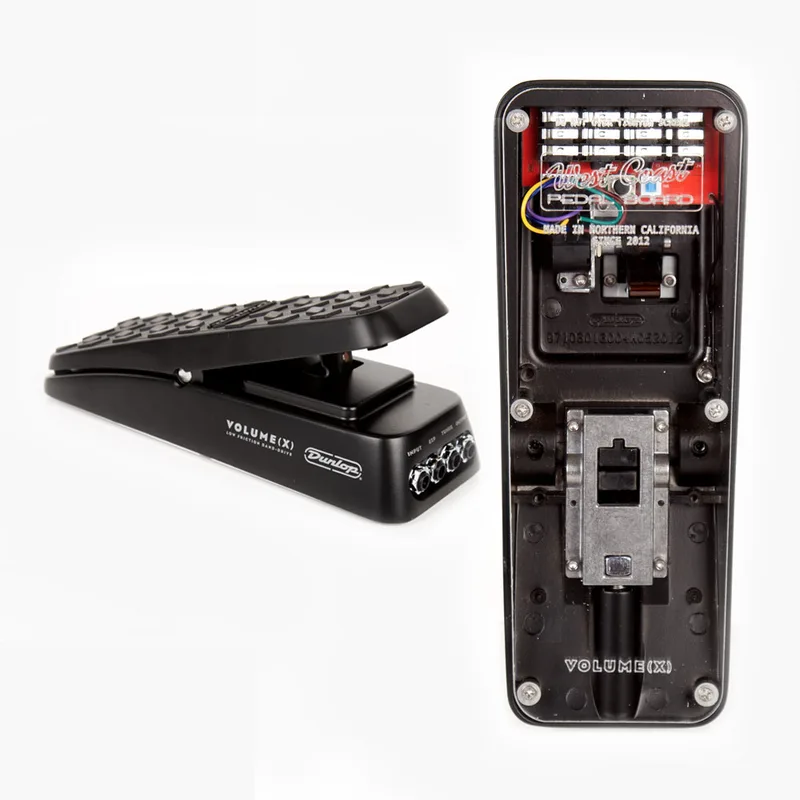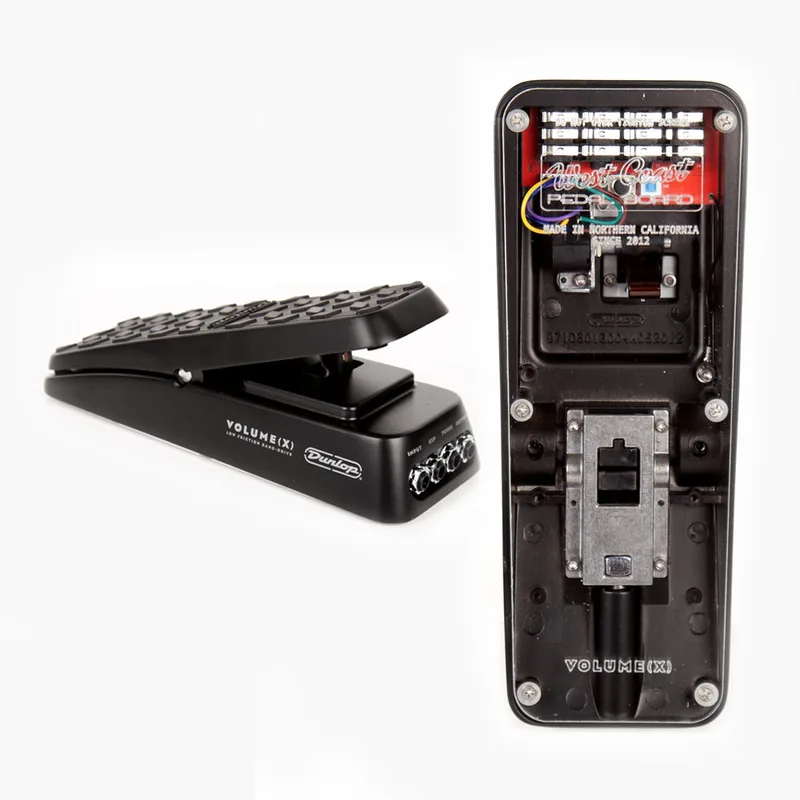


The Dunlop DVP3 Volume (X) is a full-size rocker pedal that does two jobs: it is a passive volume pedal for controlling your level, and, with a cable to its FX jack, an expression pedal for sweeping a parameter on another effects pedal. MusicRadar's reviewer Mike Astley-Brown described it as "both a passive volume pedal and an expression pedal", built on the success of Dunlop's earlier DVP1 volume pedal1. Dunlop's own manual puts it simply: "Control your volume levels or effects pedals with exacting precision"2.
Volume mode and expression mode
The pedal's two roles are set by how you wire it and which internal pot value is in play. In volume mode it uses a 250 kΩ pot and acts as a passive volume pedal in your signal chain. In expression mode it uses a 10 kΩ pot: you "run a stereo or TRS cable from the Volume (X)'s FX jack to your effects pedal's expression jack", and the rocker then controls a parameter on that pedal rather than your level2.
Two internal controls shape expression mode. An internal 50 kΩ pot, wired in series with the expression pot, sets the minimum heel-down value, and an internal polarity switch lets the pedal match the device it is connected to23. Guitar World's buying guide also notes a flexibility feature: "In expression mode you can reverse the heel-up and toe-down functions, adding an extra bit of flexibility"5.
Connections
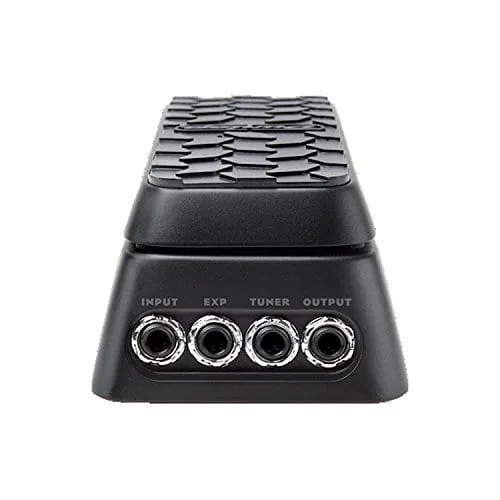
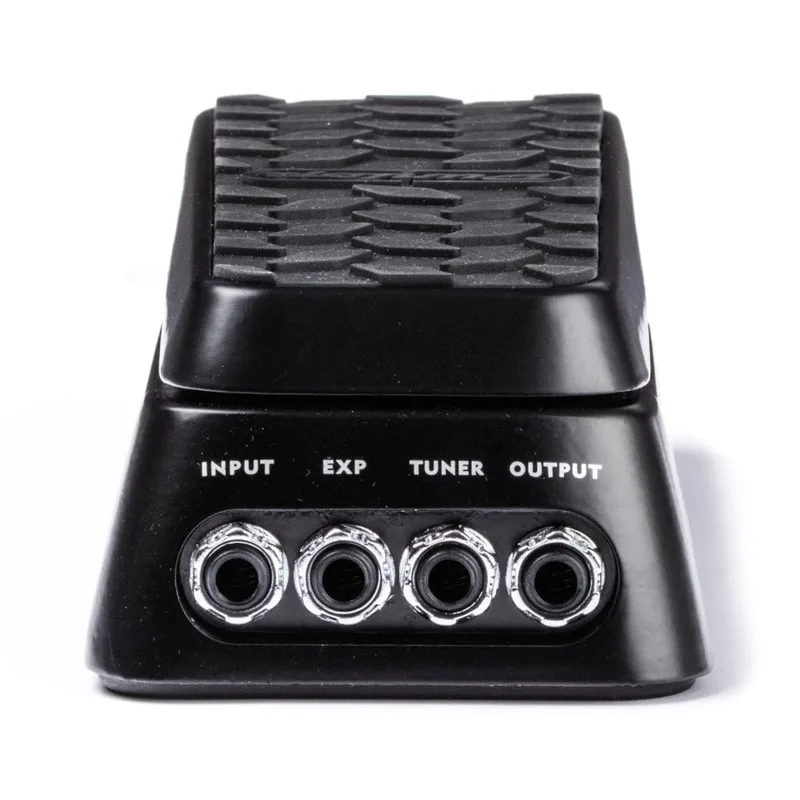
| Jack | What it does |
|---|---|
| Input | Signal in from your instrument or previous pedal1 |
| Output | Signal out to your amp or next pedal1 |
| FX | Expression output for effect parameter control, using a stereo or TRS cable2 |
| Tuner out | Feed for a tuner; the signal to the tuner is active regardless of rocker position2 |
The tuner output is worth flagging for players building a board: because the signal to the tuner stays live at any rocker position, you can tune silently with the volume rolled all the way back2.
Where it came from
The DVP3 builds on the DVP1, the volume pedal Dunlop released in 2010 with an MSRP of $16967. MusicRadar's review of the DVP1 noted that it "revamps the basic volume pedal by making use of some clever thinking"8, and the DVP3 carries that dual-purpose idea further by adding the expression connection on the front of the pedal, in addition to the input, output and tuner out jacks1. Dunlop also makes a smaller version: the company says "the DVP4 Mini Volume (X) Pedal does everything that the larger DVP3 does at half the size"7.
What reviewers said
MusicRadar's reasons to buy were durability and versatility: "Durable. Works well as both an expression and a volume pedal." On value, the same review concluded "it's not the cheapest volume/expression pedal, but it's one of the most durable"1. The reviewer also tried it as an expression controller and found that "plugging in a TRS cable and using it as an expression pedal works perfectly with the EHX pedals we try"1.
Guitar World's 2022 expression pedal guide took a similar line on construction: its reviewer called the build quality "absolutely fantastic" and judged the pedal "more than capable of putting up with regular gigging"3.
Price
Dunlop's own parts page currently lists the DVP3 at $149.994, a figure also shown on Dunlop's MXR Clone Looper page9. At launch, Guitar World's March 2022 guide gave a price of $156 in the US and £120 in the UK3.
Videos
CAM Compares
jimdunlopusa
Andrea Strathmeyer
Questions
What is the difference between volume mode and expression mode on the Dunlop DVP3?
In volume mode the DVP3 uses a 250 kΩ pot and controls the level of your signal as a passive volume pedal. In expression mode it uses a 10 kΩ pot and sends control voltage down a stereo or TRS cable from the FX jack to another pedal's expression input, so the rocker changes a parameter such as delay time or modulation depth instead of your volume.
Does the Dunlop DVP3 have a tuner out?
Yes. The DVP3 has a dedicated tuner output, and the signal to the tuner is active regardless of the rocker position, so your tuner keeps receiving a note even when the pedal is heel-down and silent to the amp.
What does the FX output do on the Dunlop DVP3?
The FX jack is the expression output. You run a stereo or TRS cable from it to your effects pedal's expression jack, and the rocker then controls a parameter on that pedal. An internal 50 kΩ pot, wired in series with the expression pot, sets the minimum heel-down value.
How much did the Dunlop DVP3 cost at launch?
Guitar World listed a launch price of $156 in the United States, or £120 in the UK, in its March 2022 buying guide. Dunlop's own parts page currently lists the DVP3 at $149.99.
Does the Dunlop DVP3 have a polarity switch?
Yes. The DVP3 has an internal polarity switch, alongside its internal 50 kΩ pot, so it can be set to suit the expression input of the pedal it is controlling.
Sources (9)
- Dunlop DVP3 Volume (X) review, MusicRadar, 2013-08-16
- DVP3.pdf, Dunlop Manufacturing, Inc., 2019
- Best expression pedals: get creative with our top choices, Guitar World, 2022-03-30
- VOLUME (X)™ PEDAL, Jim Dunlop (www.jimdunlop.com)
- Best volume pedals 2025: control your tone with these essential pedal picks, Guitar World, 2023-12-08
- Gear Watch: Dunlop DVP1 Volume Pedal, No Treble, 2010-07-11
- VOLUME (X)™ MINI PEDAL, Dunlop (www.jimdunlop.com)
- Dunlop DVP1 Volume Pedal review, MusicRadar, 2012-02-01
- MXR® CLONE LOOPER™ PEDAL, Dunlop (jimdunlop.com)