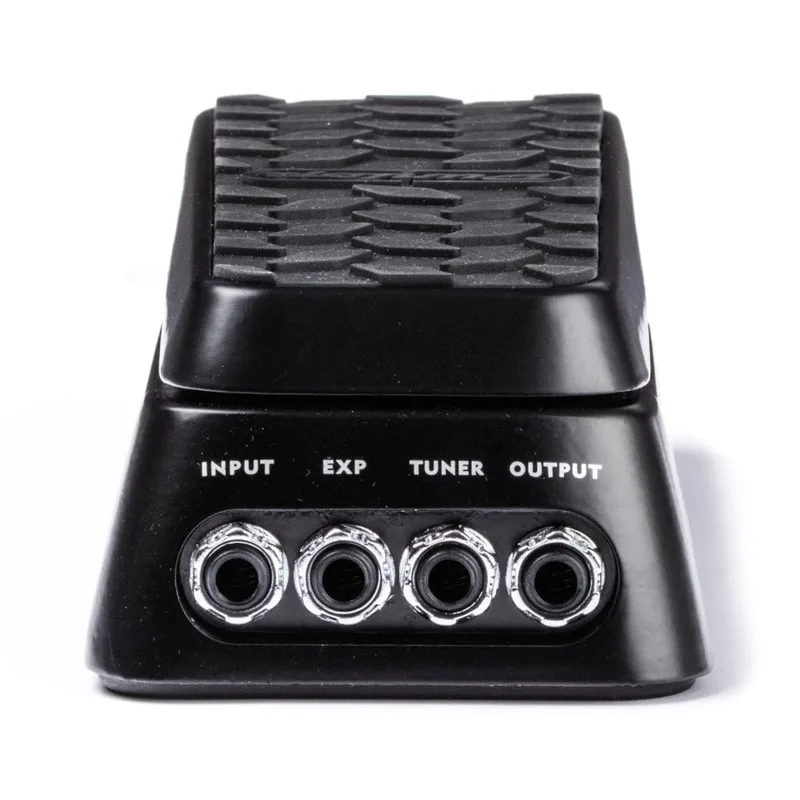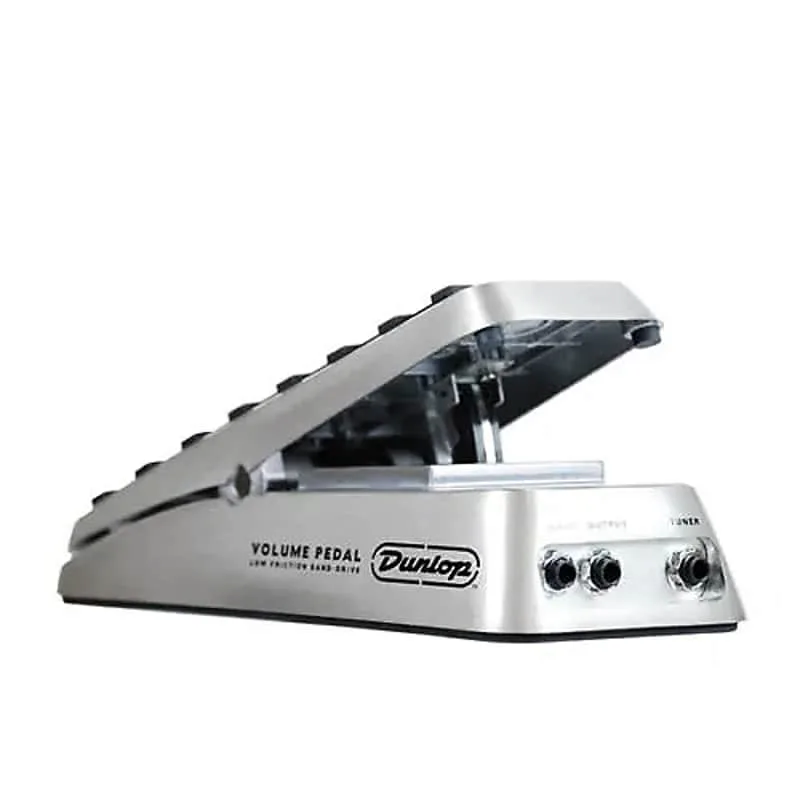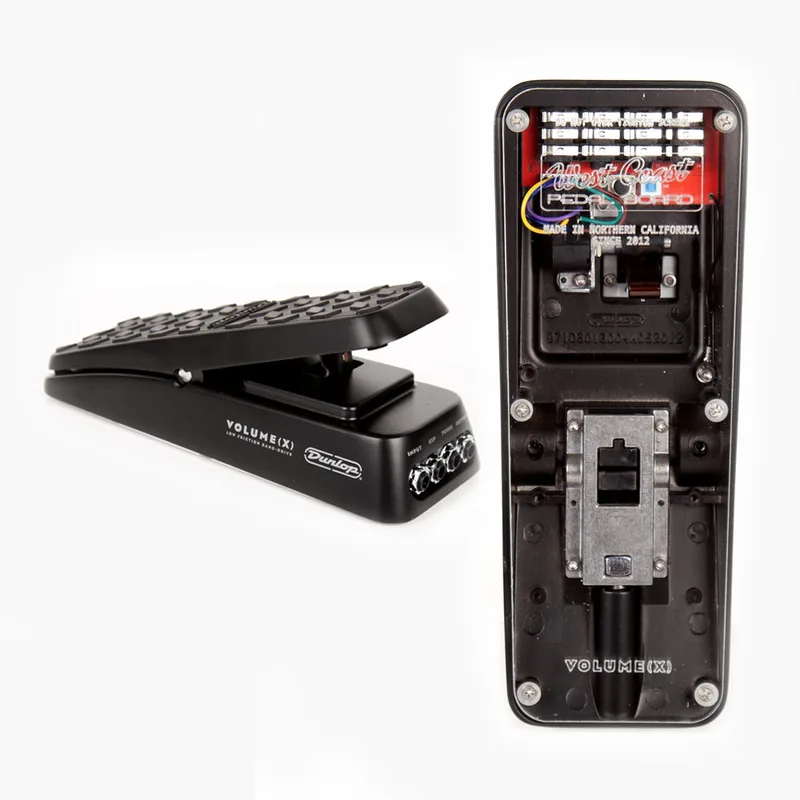


The Dunlop DVP3 Volume (X) is a passive volume pedal that doubles as an expression pedal. You plug your guitar into it and rock the treadle to swell from silence to full volume, or connect it to any effects pedal with an expression input and use the same treadle to control that pedal's parameters by hand, or rather by foot1. It builds on the success of Dunlop's earlier DVP1 Volume Pedal, keeping that pedal's non-slip grip rubber tread and fully adjustable rocker tension while adding expression control1.
Because it is a passive unit, it needs no power source to operate2. Dunlop positions it as the larger sibling in the line: the smaller DVP4 Mini Volume (X) "does everything that the larger DVP3 does at half the size"3.
How it works and how it is wired
The pedal has two operating modes, each with its own potentiometer value. In volume mode it uses a 250 kΩ pot for signal control through the input and output jacks; in expression mode it uses a 10 kΩ pot, with a stereo or TRS cable running from the Volume (X)'s FX jack to your effects pedal's expression jack2. Guitar World's buying guide puts it simply: "With the use of a TRS cable, you can use it to control any pedal with an expression input"4.
There is also a tuner out jack, an independent feed for a tuner separate from the main signal path14. In volume mode, the output signal is muted when the rocker pedal reaches the full heel-down position, so you can cut your sound while tuning2.
| Jack or control | What it does |
|---|---|
| Input | Guitar or signal in for volume mode |
| Output | Volume signal control out2 |
| Tuner out | Independent feed for a tuner14 |
| FX (expression) jack | TRS cable out to an effects pedal's expression jack2 |
| Tension screw (under heel) | Adjusts treadle torque1 |
| Internal push-switch | Reverses heel-down and toe-down function in expression mode1 |
| Internal 50 kΩ pot | Sets the minimum heel-down value in expression mode, wired in series with the expression pot2 |
Adjusting the pedal to taste
Two internal adjustments shape how the DVP3 behaves as an expression pedal. An internal push-switch reverses the function of the heel- and toe-down positions, so a pedal whose parameter you want to sweep in the opposite direction can be accommodated1. An internal potentiometer adjusts the minimum value of the heel-down position: turn it clockwise to raise the minimum level or counterclockwise to lower it, with the factory setting fully counterclockwise21. The manual describes this as a 50 kΩ pot wired in series with the expression pot2.
The treadle itself is adjustable too. Its torque is set by a screw beneath the heel end of the pedal1, a feature inherited from the DVP1, whose rear-mounted tension screw adjusted sweep action stiffness5.
Treble response
As a passive volume pedal, the DVP3 does color the sound slightly. MusicRadar's review found that "it does cause a little treble loss compared with plugging straight into your amp, but it's no worse than any other passive volume pedal"1. That is the trade-off for a design that draws no power, and players who find it a problem can look at a buffer pedal elsewhere in their chain.
DVP3 versus DVP1
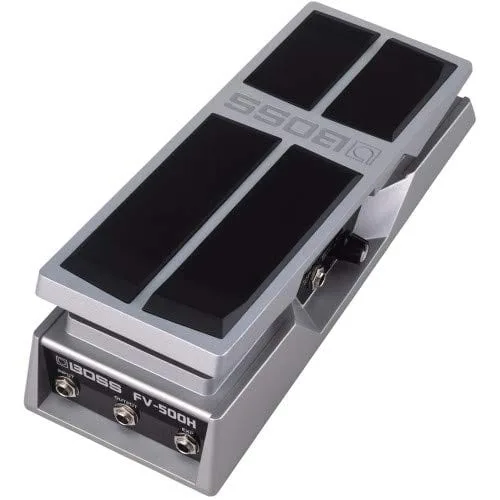
The DVP1 was a straightforward passive volume pedal with input and output jacks plus an independent tuner feed, and a rear-mounted tension screw for the sweep action5. The DVP3 keeps its non-slip grip rubber tread and adjustable rocker tension, and adds the expression connection on the front1. MusicRadar's DVP1 review called it "a pedal that combines fuss-free performance with confidence-inducing durability" but noted it was a bit pricey and lacked the minimum volume facility of the BOSS FV-500H5; the DVP3's internal pot addresses that gap in expression mode by setting a minimum heel-down value2.
Dunlop also sells replacement electronic parts for the Volume (X) pedal, though these are aimed at qualified technicians, and the company recommends professional installation or repair for anyone without experience6.
What reviewers said
MusicRadar's review, by Mike Astley-Brown, covered both roles. As a volume pedal, "the Volume (X) transitions smoothly from silence to full volume," and as an expression pedal, "plugging in a TRS cable and using it as an expression pedal works perfectly with the EHX pedals we try"1. On value, the reviewer judged that "it's not the cheapest volume/expression pedal, but it's one of the most durable," with the rock-solid aluminum construction justifying the high asking price1.
"The switches can be awkward, but smooth action and solid build quality make this the volume pedal to beat."
Guitar World's expression pedal buying guide was similarly positive about the build, with the reviewer finding "the build quality of this pedal to be absolutely fantastic and it feels like it's more than capable of putting up with regular gigging"7. The same guide noted the pedal "plays two roles, giving you complete control over your pedalboard"7.
Videos
CAM Compares
Voix Musifan
jimdunlopusa
Questions
What cable do I need to use the Dunlop DVP3 as an expression pedal?
A stereo TRS cable. Run it from the Volume (X)'s FX jack to the expression jack on your effects pedal. With that cable the DVP3 can control any pedal that has an expression input, and MusicRadar's reviewer found it worked perfectly with the Electro-Harmonix pedals they tried.
How do I adjust the treadle tension on the DVP3?
The treadle torque is set by a screw beneath the heel end of the pedal. Turn it to make the rocker stiffer or looser to taste. This continues the fully adjustable rocker tension that Dunlop carried over from the earlier DVP1.
How do I reverse heel and toe operation on the DVP3 in expression mode?
Inside the pedal there is a push-switch that reverses the function of the heel-down and toe-down positions in expression mode. There is also an internal potentiometer that sets the minimum value of the heel-down position, so you can raise or lower the floor of the sweep.
Does the DVP3 Volume (X) cause treble loss?
Yes, a little. MusicRadar's review found it causes some treble loss compared with plugging straight into an amp, but no worse than any other passive volume pedal. That is the trade-off of a passive design, which needs no power source to operate.
What is the difference between the DVP3 and the DVP1?
The DVP3 builds on the DVP1 and adds expression pedal function, which the DVP1 does not have. It keeps the DVP1's non-slip grip rubber tread and adjustable rocker tension, and adds an expression connection on the front alongside the input, output and tuner out jacks.
What is the tuner out jack on the DVP3 for?
The tuner out jack feeds a tuner independently of the main signal path, so you can tune silently. In volume mode the output signal is muted when the rocker reaches the full heel-down position, which lets you cut your signal while the tuner feed keeps working.
Sources (7)
- Dunlop DVP3 Volume (X) review, MusicRadar, 2013-08-16
- DVP3.pdf, Dunlop Manufacturing, Inc., 2019
- VOLUME (X)™ MINI PEDAL, Dunlop (www.jimdunlop.com)
- Best volume pedals 2025: control your tone with these essential pedal picks, Guitar World, 2023-12-08
- Dunlop DVP1 Volume Pedal review, MusicRadar, 2012-02-01
- VOLUME (X)™ PEDAL, Jim Dunlop (www.jimdunlop.com)
- Best expression pedals: get creative with our top choices, Guitar World, 2022-03-30