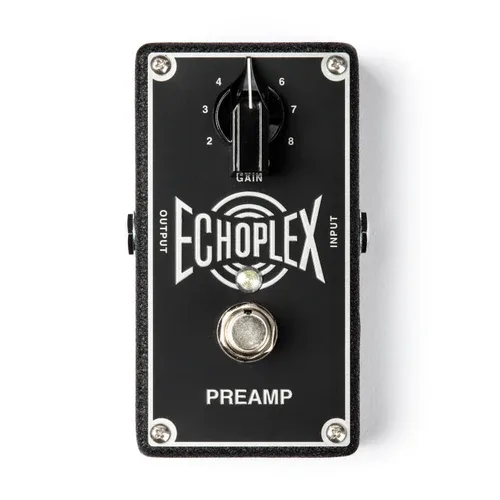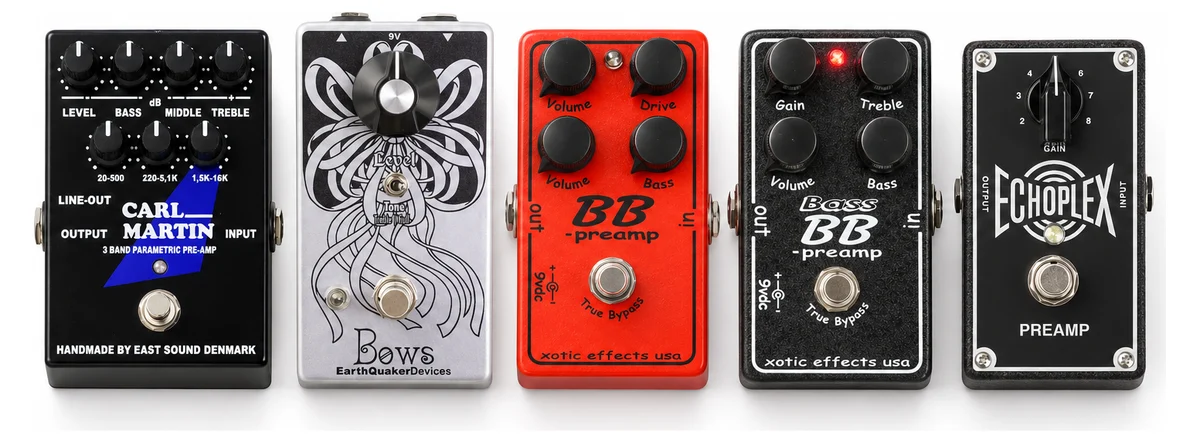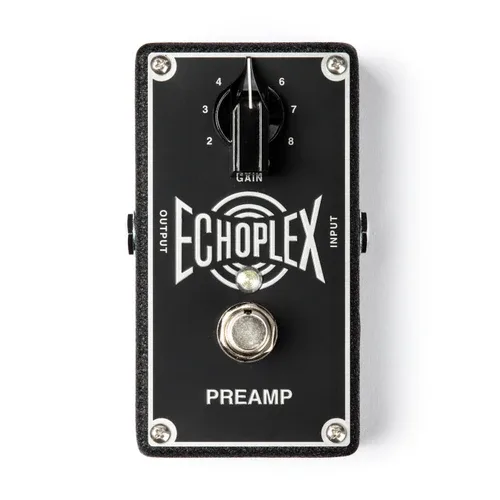


The Dunlop EP101 Echoplex Preamp is a compact analog preamp pedal that recreates the front end of the Echoplex EP-3 tape echo, the unit players prized as much for its tone conditioning as for its echo effect1. It has a single Gain control that boosts the signal by up to +11dB, with light asymmetrical clipping at higher settings for a bit of organic grit2. Dunlop announced it at NAMM 2014, with shipping in February 20143.
What it does: up to 11dB of FET boost
The EP101 is a boost and preamp pedal built around a Field-effect Transistor (FET), just like the original EP-32. The Gain control lets you push your signal by up to +11dB12. Below the top of its range it works as a clean boost; at higher settings the FET circuit produces light asymmetrical clipping, which Dunlop describes as "a bit of nice organic grit"3. That puts it in the territory between a clean boost and a light overdrive, set entirely by where you leave the knob.
The gain knob and footswitch
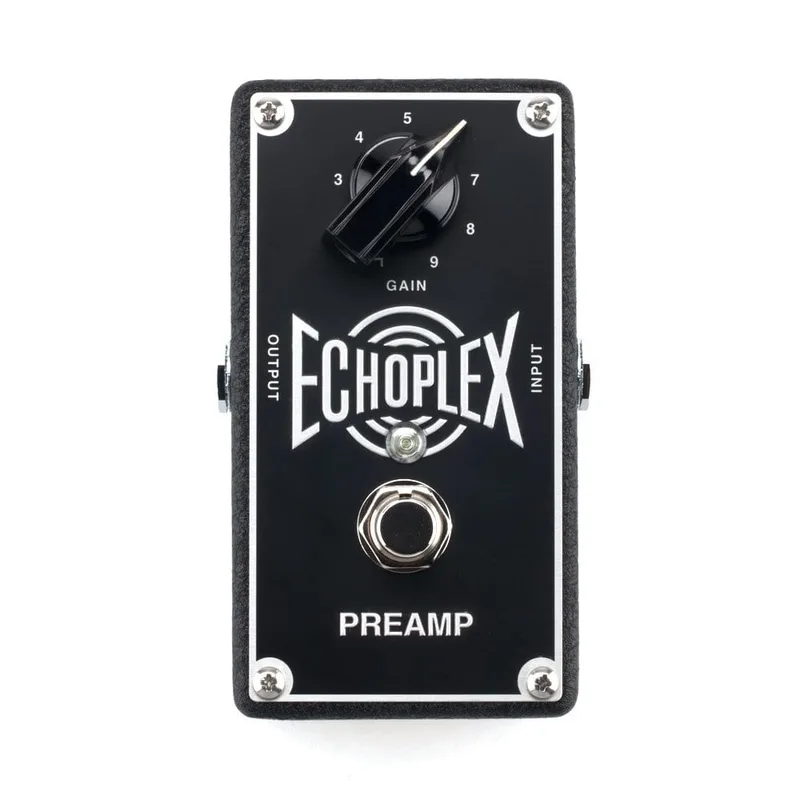
The pedal keeps the original's control layout down to the details: Guitar World noted at launch that it carries "a replica EP-3 knob"3. Operation is simple:
| Control | What it does |
|---|---|
| GAIN knob | Controls the amount of gain added to the signal1 |
| FOOTSWITCH | Toggles effect on/bypass; a blue LED indicates on1 |
That is the whole interface. Guitar World's review video described it as featuring "only a gain control (with the same style knob found on an Echoplex) that provides up to 11dB of boost"5.
Where the grit starts is documented precisely: per Dunlop's manual, "Starting at position 7, the Echoplex Preamp will produce light overdrive clipping"1. So positions 1 through 6 are effectively clean boost territory, and 7 upward adds increasing clipping.
Power and specifications
The EP101 runs on one 9-volt battery, installed by removing the bottom plate, or on a 9-volt AC adapter such as the Dunlop ECB003/ECB003E, or a DC Brick power supply1. Guitar World's review video also confirmed it "operates either with a nine-volt battery or optional adapter"5. At launch, Dunlop said the pedal "contains power management circuitry to guarantee constant headroom performance throughout the normal life of a 9-volt battery"3.
Full specifications from the maker's manual1:
| Specification | Value |
|---|---|
| Max gain | +11 dBV |
| Max input level | -5 dBV |
| Max output level | +5.5 dBV |
| Input impedance | 730 kΩ |
| Output impedance | 55 kΩ |
| Noise floor (gain at max) | -95 dBV A-weighted |
| Bypass | True bypass |
RockBoard's product listing gives the power figures as 9V DC center negative at 12mA, and lists the circuit as analog2.
From the Echoplex EP-3 tape echo
The Echoplex EP-3 was a tape echo unit whose preamp section became as famous as its delay. MusicRadar's Trevor Curwen describes the original use case: players ran "an Echoplex EP-3 tape echo before your amp, but not necessarily with the echo effect engaged," because of the EP-3's FET-based preamp6. Guitar World's review of the later EP103 made the same point, noting that "most guitarists prefer the EP-3 for its preamp (which Dunlop recently duplicated with the EP101 Echoplex Preamp pedal)"7.
Aion FX, which has studied the circuit in depth, explains what makes that preamp stage special8:
"It's a pretty simple JFET gain stage, but it does something special with the phase response of the signal."
Aion FX also documents some original-versus-pedal differences worth knowing. The original EP-3 ran on a 20V supply8, and there were two versions of the EP-3: the early version, which was brighter, and the late version, which was a little darker and fatter, the difference being a single capacitor added to the first JFET stage in the later version8. The EP101 is a recreation of the front end, not a reproduction of the whole tape machine.
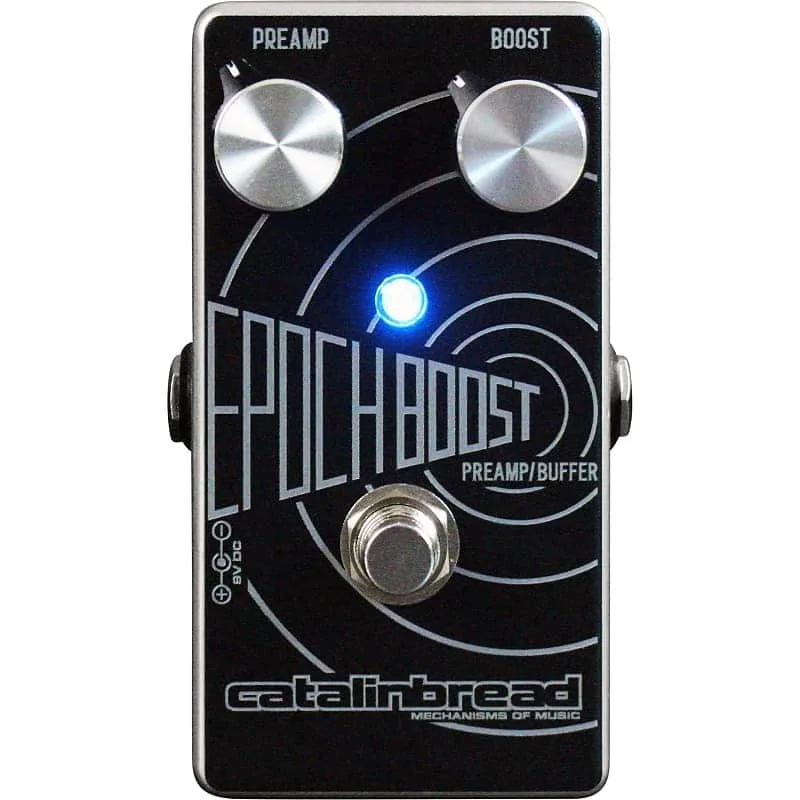
Dunlop is not the only maker with an EP-3 preamp pedal. Catalinbread's Epoch Pre covers similar ground, with a Boost function activated by its own footswitch that Pedal of the Day described as adding "an instant push and oomph to your signal"92. The EP101 differs by keeping everything on one Gain knob, closer to the original unit's single-control simplicity.
Videos
Guitar World
Rob Chapman
Chuck's Guitar Geekery
Questions
Is the Dunlop EP101 true bypass?
Yes. The EP101 uses true bypass switching, so with the effect off the signal passes through without the preamp circuit in the path. A blue LED on the footswitch shows when the effect is engaged.
Does the Echoplex Preamp run on a battery?
Yes. It runs on one 9-volt battery, installed by removing the bottom plate, or on an optional 9-volt adapter such as the Dunlop ECB003/ECB003E or a DC Brick power supply. Dunlop says power management circuitry keeps headroom constant through the battery's normal life.
At what gain setting does the EP101 start to overdrive?
According to Dunlop's manual, starting at position 7 on the Gain knob the Echoplex Preamp produces light overdrive clipping. Below that it works as a clean boost, with light asymmetrical clipping at higher settings adding organic grit.
Is the EP101 the same as the EP-3 preamp?
It recreates the front end of the Echoplex EP-3's preamp using a Field-effect Transistor like the original, but it is a modern pedal, not a copy of the whole unit. The original EP-3 ran on a 20V supply and came in two versions with slightly different voicing.
Should the Echoplex Preamp be always on?
Many players used the original EP-3 as an always-on tone conditioner even without the echo engaged, which is the idea behind the pedal. The EP101's true bypass means you can also switch it in only when you want the boost.
Sources (9)
- EP101.pdf, Dunlop Manufacturing, Inc., 2019
- EP101 Echoplex Preamp by Dunlop, RockBoard (rockboard.de), 2026
- NAMM 2014: Jim Dunlop Introduces EP101 Echoplex Preamp, Guitar World, 2014-01-28
- Artists - Iron Maiden - Dunlop, Jim Dunlop (jimdunlop.com)
- Review: Dunlop EP101 Echoplex Preamp, Guitar World, 2014-06-19
- Dunlop Echoplex Preamp review, MusicRadar, 2018-08-24
- Review: Dunlop EP103 Echoplex Delay Pedal, Guitar World, 2016-09-07
- Ares Vintage Preamp / Echoplex EP-3 Preamp, Aion FX, 2019-10-18
- Catalinbread Epoch Pre EP3 Preamp Buffer, Pedal of the Day, 2019-07-19