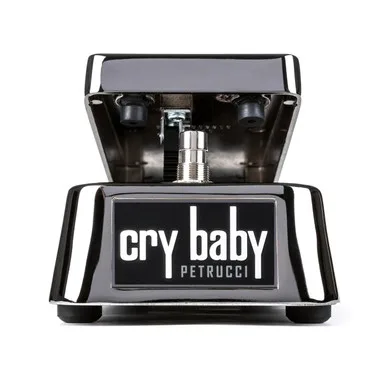


The Dunlop JP95 John Petrucci Cry Baby Wah is a signature wah pedal from Dunlop, released on February 10, 20161. It is based on the settings John Petrucci, guitarist of Dream Theater, developed over years on the Dunlop Cry Baby Rack Wah, a rack-mounted unit with numerous adjustable parameters2. Petrucci and Dream Theater engineer Richard Chycki worked with the Cry Baby design team to replicate and fine-tune those settings in a standard pedal format2.
The result is a Cry Baby that ships from the factory set to Petrucci's personal settings, with all the controls he used to find his Cry Baby voice built in2. Dunlop describes the sound as "huge and badass like an angry, screaming monster with the ultimate expressive range"2. Premier Guitar's reviewer went further, calling it "the most gargantuan-sounding wah pedal I've ever heard"3.
A Cry Baby set to John Petrucci's rack wah settings
For years Petrucci used the Cry Baby Rack Wah system, tweaking its numerous parameters until he found his sound2. Rather than build another rack unit, the JP95 puts those settings into a floor pedal: the tone range is based on the settings Petrucci had been using for years on his Dunlop rack wah3. The pedal comes from the factory set for Petrucci's sound, and the manual notes that it ships with John Petrucci's control settings by default4.
The housing is a sturdy, road-ready Cry Baby enclosure with a custom smoked chrome finish and a JP shield logo on the tread2. Premier Guitar's reviewer found the treadle "sweeps smoothly from toe to heel"3. Turning the pedal on and off works like a standard Cry Baby: push the toe down until you feel a click4.
The controls: internal Q, Volume and six-band EQ
All of the JP95's tone controls live inside the pedal, adjustable by removing the bottom plate1. There are no external knobs; the pedal is meant to run at Petrucci's settings out of the box, with the internals there for players who want to go further. As Dunlop puts it on the product page: "Want to fine-tune the sound to your own preference? Just take off the bottom plate and tweak away"2.
| Control | What it does |
|---|---|
| Q ADJ trimpot | Sets the width of the wah's bandpass. Clockwise gives a narrower bandpass emphasizing higher-end harmonics; counterclockwise gives a wider bandpass emphasizing lower-end harmonics4 |
| VOLUME trimpot | Sets overall effect volume. Clockwise increases, counterclockwise decreases. Dunlop describes the Volume control as adding gain24 |
| Six EQ trimpots | Boost or cut the labeled frequency by plus or minus 18 dBV. Clockwise boosts, counterclockwise cuts4 |
The six EQ bands sit at 100Hz, 200Hz, 400Hz, 800Hz, 1.6KHz and 3.2KHz, covering the range from 100Hz to 3.2KHz41. Guitar World's reviewer, Paul Riario, described this as "a six-band EQ (from 100 Hz to 3.2KHz) to shape the overall tone and frequencies of the wah range"5. The wah's filter itself sweeps from a heel-down low pass between 200Hz and 240Hz to a toe-down high pass between 1.2KHz and 1.5KHz4.
Inside the pedal there is also a TEST/NORM switch. It is for production testing only, and Dunlop says to always leave it in the NORM position for full functionality of all controls4.
Because the controls are internal, the JP95 differs from adjustable wahs that put those functions on the outside, and from fixed-voice Cry Babies that offer no tuning at all. Premier Guitar's reviewer noted that although the pedal comes from the factory set for Petrucci's sound, the internal controls "enable you to tune the wah in very precise ways"3. Petrucci's own settings are printed in the manual, so a player who tweaks can always find the way back4.
Power and connections
Setting the JP95 up is straightforward:
- Run an instrument cable from your guitar to the JP95's INSTRUMENT jack4.
- Run another instrument cable from the JP95's AMPLIFIER jack to your amplifier's input4.
- Rock your foot back and forth on the pedal to sweep the wah4.
The pedal can be powered by one 9-volt battery, accessed via the bottom of the pedal, or by an AC adapter such as the Dunlop ECB003 or ECB003EU24. Power requirements are 13mA at 9VDC4. It is also compatible with Dunlop's DC Brick, Iso-Brick and Mini Iso-Brick power supplies, which are not included2.
Because the battery and all the adjustment trimpots are under the same bottom plate, changing the battery means taking the plate off, the same operation as retuning the EQ.
Specifications
| Specification | Value |
|---|---|
| Nominal input | -8 dBV4 |
| Max output | +6 dBV4 |
| Output gain, toe down | +33 dBV4 |
| Output gain, heel down | +19 dBV4 |
| Noise floor | < -94 dBV, A weighted4 |
| Input impedance | 800K ohms4 |
| Output impedance | 5K ohms4 |
| Bypass | True Hardwire4 |
What reviewers said
Premier Guitar reviewed the JP95 in 2021 and was impressed by its size and character, calling it "the most gargantuan-sounding wah pedal I've ever heard"3. The reviewer also noted the smoked chrome finish and the smooth treadle sweep3. Guitar World's Paul Riario highlighted the internal volume control, "which also adds gain," and the six-band EQ for shaping the wah range5.
In Sweetwater's demo video, presenter Nick walked through the pedal's background and controls, noting that Petrucci's settings are in the manual for reference6.
At launch, Gearnews reported a UK recommended retail price of £235.597; Premier Guitar listed the US street price as $199 in its 2021 review3.
Videos
Pete Thorn
Guitar World
Questions
Does the JP95 take a 9V battery?
Yes. The JP95 is powered by one 9-volt battery, accessed via the bottom of the pedal, or by a 9V DC adapter such as the Dunlop ECB003. Current draw is 13mA at 9VDC, so it is also easy to run from a pedalboard power supply.
How do you adjust the JP95 internal EQ?
Take off the bottom plate. Inside are six EQ trimpots labeled 100Hz, 200Hz, 400Hz, 800Hz, 1.6KHz and 3.2KHz. Each can boost or cut its frequency by plus or minus 18 dBV: rotate clockwise to boost, counterclockwise to cut. The Q and Volume trimpots are in there too.
What frequencies does the JP95 six-band EQ cover?
The six internal EQ bands run from 100Hz to 3.2KHz, at 100Hz, 200Hz, 400Hz, 800Hz, 1.6KHz and 3.2KHz. Each band can be boosted or cut by up to 18 dBV to shape the overall tone and frequency range of the wah.
Does the JP95 boost volume?
Yes. The internal Volume trimpot sets the overall effect volume, and Dunlop describes it as adding gain. The manual lists output at +33 dBV toe down and +19 dBV heel down, against a nominal input of -8 dBV, so there is plenty of level on tap.
What power supply works with the Dunlop JP95?
Any 9V DC supply meeting its 13mA draw works, including the Dunlop ECB003 or ECB003EU adapter and Dunlop's DC Brick, Iso-Brick and Mini Iso-Brick power supplies, which are sold separately. A single 9-volt battery also powers it.
What are John Petrucci's JP95 settings?
The pedal ships from the factory set to John Petrucci's personal control settings, the ones he developed over years on his Cry Baby Rack Wah. His exact settings are printed in the JP95 manual, so you can always return to them after tweaking.
Sources (7)
- Dunlop Releases the JP95 John Petrucci Signature Wah, Premier Guitar, 2016-02-10
- JOHN PETRUCCI CRY BABY® WAH, Dunlop (www.jimdunlop.com)
- John Petrucci JP95 Cry Baby Wah Pedal Review, Premier Guitar, 2016-09-19
- JP95.pdf, Dunlop Manufacturing, Inc., 2019
- Review: Dunlop JP95 John Petrucci Signature Cry Baby Wah, Guitar World, 2016-04-29
- Dunlop JP95 John Petrucci Signature Cry Baby Wah Pedal Review, Sweetwater, 2018-04-27
- NAMM 2016: Dunlop unveil John Petrucci Signature JP95 Cry Baby Wah, gearnews.com, 2016-01-22
 John Petrucci