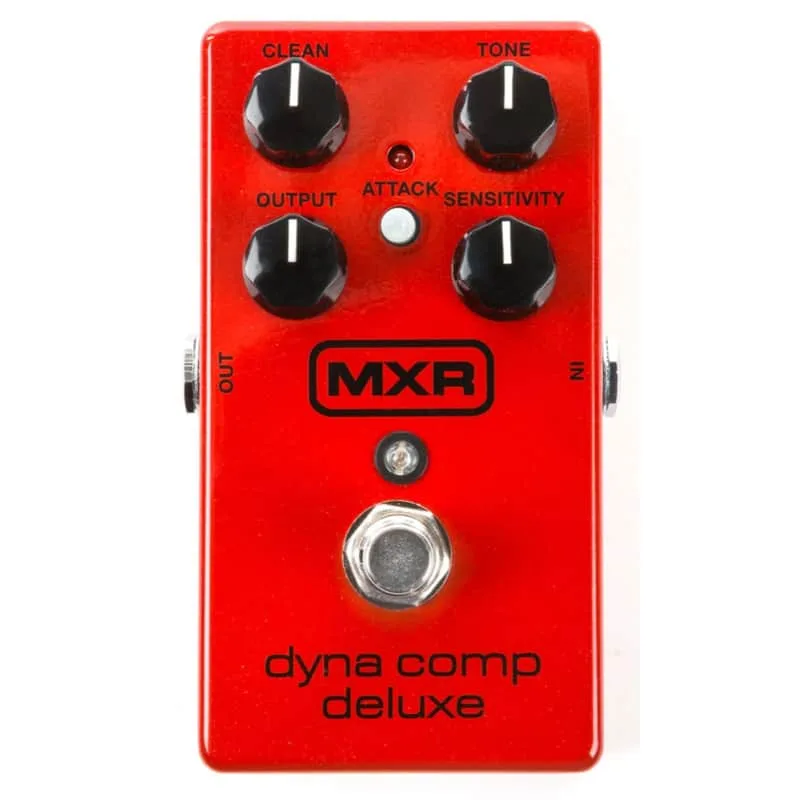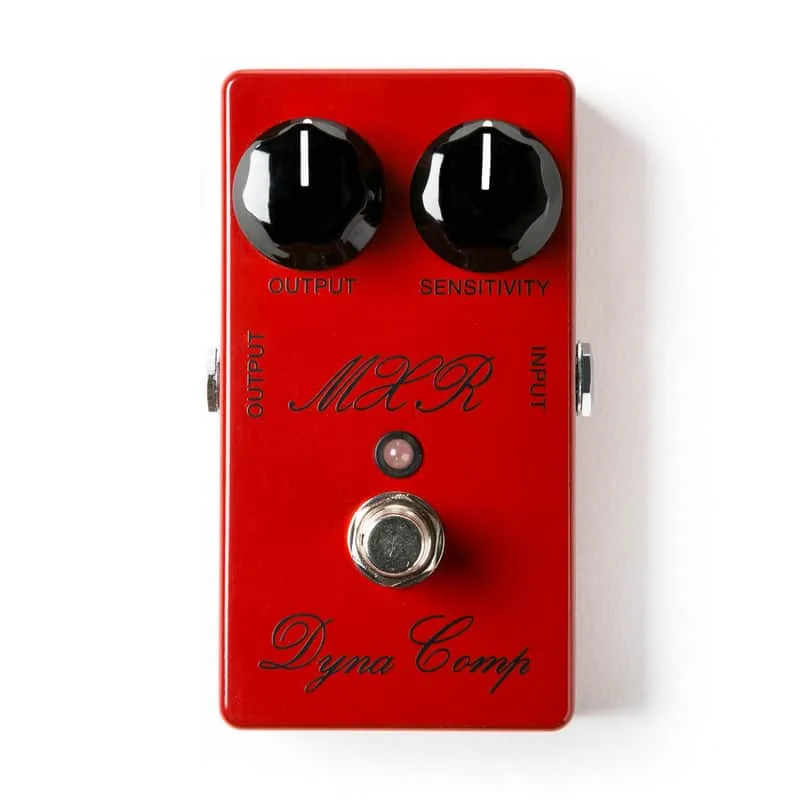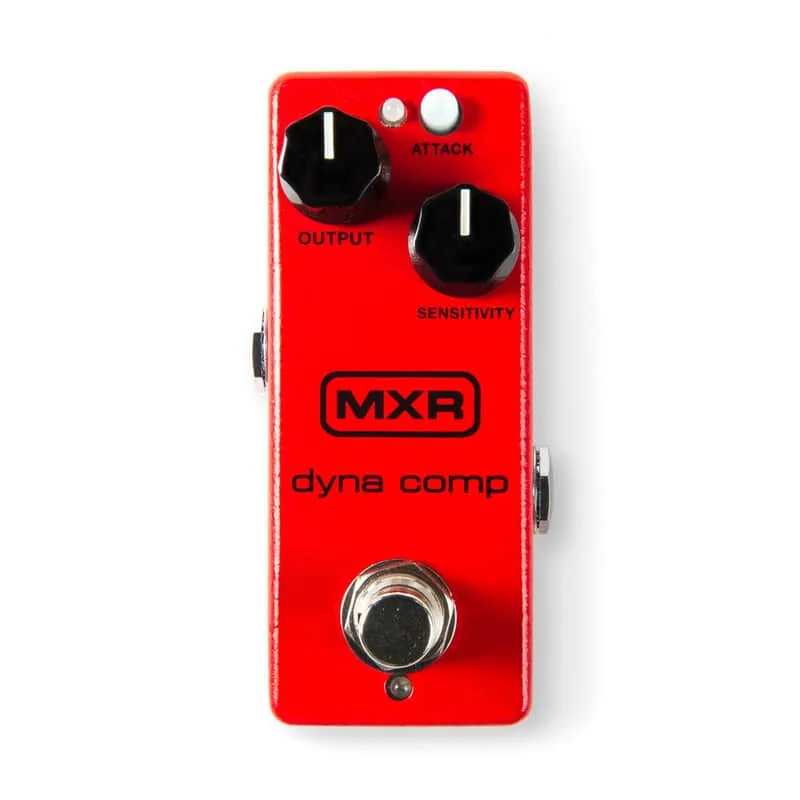

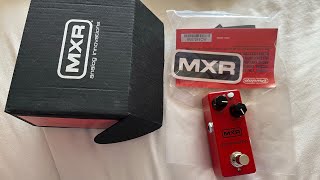

The Dunlop M291 Dyna Comp Mini Compressor is a compressor pedal from Dunlop's MXR line that puts the Dyna Comp circuit into a compact enclosure. Dunlop describes it as putting "the classic Dyna Comp Compressor sound in a much more pedalboard-friendly MXR mini housing," in a package the manual calls "nearly half the size of the original"12. It is aimed at players who want the Dyna Comp approach to compression without giving up pedalboard space, and it sits alongside the full-size Dunlop M228 Dyna Comp Deluxe Compressor and the Dunlop CSP102SL Script Dyna Comp Compressor in the wider family of compressor pedals.
Controls
The M291 keeps its control layout to three things on the top panel, all explained in the manual1:
| Control | What it does |
|---|---|
| SENSITIVITY knob | Sets the amount of compression; rotate clockwise to increase it |
| OUTPUT knob | Sets overall effect volume; clockwise increases it, counterclockwise decreases it |
| ATTACK switch | Toggles between the default slow attack time and a fast attack time, indicated by a red LED |
| FOOTSWITCH | Toggles effect on/bypass; blue LED indicates on |
The Attack switch is the addition Dunlop highlights: the manual calls it "an all-new Attack switch [that] toggles between slow and fast attack times"1. Slow attack is the default and is the traditional Dyna Comp behavior, where the opening of a note passes through before the compression clamps down; the fast setting, marked by the red LED, engages compression sooner.
Input, output and compression specs
Dunlop's manual gives the following specifications for the M2911:
| Specification | Value |
|---|---|
| Max compression | 36 dB |
| Input impedance | 800 kΩ |
| Output impedance | 15 kΩ |
| Max input level | -5 dBV |
| Max output level | -12 dBV |
| Noise floor | -95 dBV, A-weighted |
| THD | 0.2%, measured at -20 dBV, 1 kHz |
The input impedance of 800 kΩ is high enough that the pedal is intended to sit with the guitar plugged straight into its input, and the manual's setup runs a cable from the guitar into the M291 and another from its OUTPUT jack to the amplifier1.
Power
The M291 runs on a 9VDC supply and draws 4 mA, which is a light load even for a shared pedalboard power supply1.
The manual is explicit: "This pedal cannot be powered by a battery." Plan on a 9V DC center-negative supply or a pedalboard power output; there is no battery compartment option1.
How it compares to the original Dyna Comp
The M291's main difference from the original Dyna Comp is size and the added Attack switch. Dunlop's own history article describes the mini as delivering the Dyna Comp sound "in a much more pedalboard-friendly MXR mini housing"2, and the manual quantifies that housing as nearly half the size of the original1. The Attack switch, toggling between slow and fast attack times, is described in the manual as all-new to this version1. Players who want more controls beyond that, such as the tone and clean-blend options shown on the M228 Dyna Comp Deluxe in a Sweetwater demo by Dunlop's Brian Kehoe, would look to the full-size Deluxe rather than the Mini3.
Videos
ProGuitarShopDemos
Lost Groove Music
Stu's Guitar Channel
Questions
Can the Dunlop M291 Dyna Comp Mini run on a battery?
No. Dunlop's manual states plainly that the pedal cannot be powered by a battery. It runs on a 9VDC power supply and draws only 4 mA, so it is easy on a pedalboard power supply, but you will need a proper DC source rather than a 9V battery inside the housing.
What does the Attack switch do on the M291?
The Attack switch toggles between the default slow attack time and a fast attack time, which is indicated by a red LED. Slow attack gives the classic Dyna Comp response, while fast attack clamps the note's opening more quickly.
How much compression does the M291 Dyna Comp Mini offer?
Dunlop's manual lists a maximum compression figure of 36 dB. The SENSITIVITY knob sets the amount of compression, and rotating it clockwise increases how much compression is applied to the signal.
What do the LEDs on the M291 mean?
The blue LED shows that the effect is on, since the footswitch toggles the effect on and to bypass. The red LED indicates that the ATTACK switch is set to the fast attack time rather than the default slow attack.
How is the M291 different from the original Dyna Comp?
The M291 puts the Dyna Comp circuit in an MXR mini housing that Dunlop describes as nearly half the size of the original, making it more pedalboard-friendly. It also adds an all-new Attack switch that toggles between slow and fast attack times, a control the original does not have.
Sources (3)
- M291.pdf, Jim Dunlop, 2020
- A Dyna Comp-rehensive History, Dunlop (lifestyle.jimdunlop.com), 2018-10-25
- MXR M228 Dyna Comp Deluxe Compressor Pedal, Sweetwater, 2018-08-31