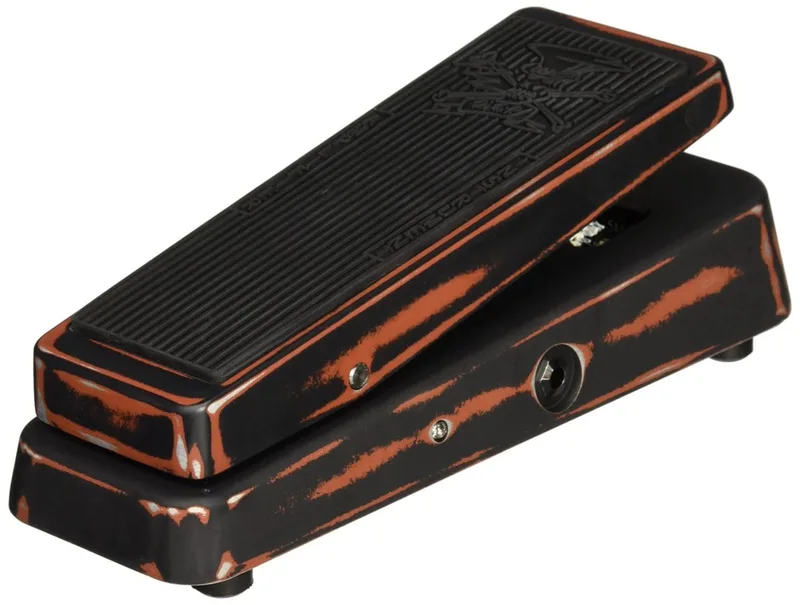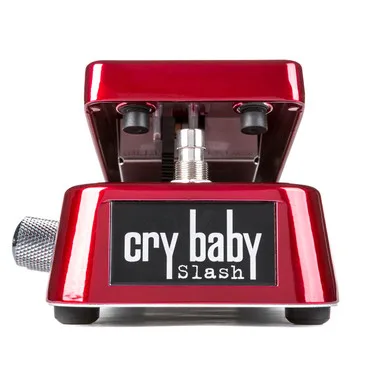


The Dunlop Slash Cry Baby Wah, model SW95, is Dunlop's signature wah pedal for Slash, and it is two effects in one housing: the Fasel-loaded Classic Cry Baby wah circuit plus a high-gain distortion circuit that can be switched in and out while you play1. Dunlop describes it as "a searing high gain distortion coupled with the Fasel-loaded Classic circuit for instant lead tone"2. The pedal carries Slash's hot rod metallic red finish2 and lists at $209.993.
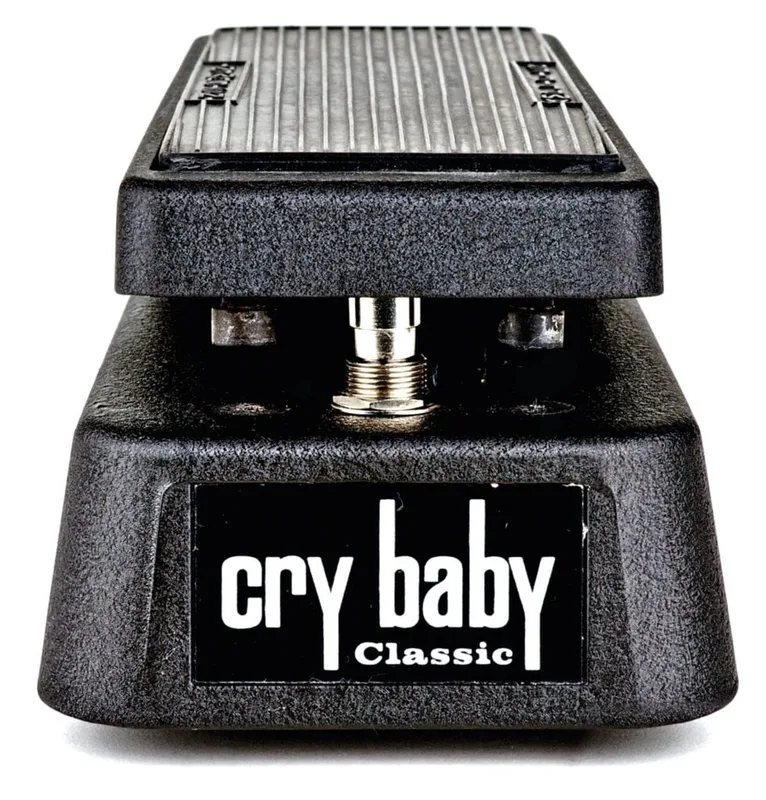
The Fasel inductor is the component that gives the older Cry Baby circuits their character; the same part appears in the Dunlop Crybaby Classic. Guitar World noted in its 2007 review that the SW-95's high-gain distortion circuit and classic Fasel inductor mirror Slash's own custom-built wah pedal4.
Controls and LEDs
The pedal is controlled from the top surface as you would expect from a Cry Baby: rocking the treadle sweeps the wah, and a footswitch toggles the pedal on and off5. On top of that sit the distortion-specific controls.
| Control | What it does |
|---|---|
| Treadle | Sweeps the wah frequency5 |
| Footswitch | Toggles the wah on/off5 |
| Distortion switch | Toggles the distortion on/off, with a blue LED showing when it is on5 |
| Gain knob | Sets the distortion amount1 |
| Volume knob | Sets the level of each effect1 |
Dunlop's buying guide describes the Gain and Volume controls as there "to dial in each effect"1. Guitar World's reviewer found the distortion engagement straightforward: push in the red mushroom-shaped knob on the right side of the pedal near the heel, and red LED indicators glow4.
The LEDs cover both halves of the pedal. Dunlop's product page says convenient LEDs indicate distortion on/off and wah on/off modes2, so on a dark stage you can see at a glance which effects are active.
How the distortion interacts with the wah
The distortion circuit is placed in front of the wah in the signal path, which Guitar World found "delivers a wider range of wah tone than if it were placed after" it4. That ordering has one side effect worth knowing before you buy: the reviewer noted that the volume drops dramatically at the full heel-down position with the distortion engaged, and that this happens with any distortion placed in front of a wah, not just this one4.
There is also a switching limitation. The distortion cannot work on its own; it can be turned on only when the wah is also on4. If you want a standalone distortion and a separate wah, this pedal does not split them.
Because the distortion only runs when the wah is engaged, the SW95 works best as a lead-voice pedal rather than as two independent effects on one board.
Power: 18 volts or two batteries
The SW95 is one of the higher-voltage Cry Babies. It runs on 18 volts DC5, supplied either through an AC adapter jack such as the Dunlop ECB004/ECB004E or a DC Brick power supply5, or by two 9-volt batteries5. The batteries sit behind a convenient top-loading battery door5, so a swap does not mean unbolting the pedal from a board. Current draw is 18 mA5.
At 18 volts, the SW95 cannot run from a standard 9V output or a single 9V battery. Plan for an 18V adapter, a DC Brick, or a stock of 9V batteries in pairs.
The Slash Cry Baby Classic: the distortion-free successor
Dunlop later released the Slash Cry Baby Classic, model SC95, which answers the SW95's main limitation by removing the distortion entirely. It is a straight wah with a custom-wound resonance inductor, a wide sweep, and LEDs to indicate effect status, listing at $189.9916. Where the SW95 needs 18 volts and two batteries, the SC95 runs on a single 9-volt battery accessed from the bottom of the pedal, a 9-volt adapter such as the Dunlop ECB003/ECB003EU, or a DC Brick supply75.
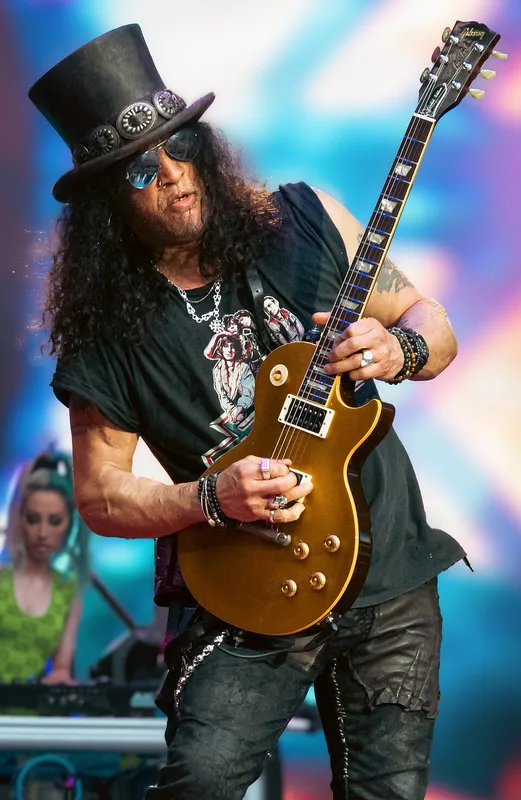
MusicRadar's Simon Bradley reported that the change reflects how the pedal was actually used: "Gone is the superfluous onboard distortion that hardly anyone, least of all Slash, actually really made use of"8. He quotes Slash himself on the newer version: "Dunlop has made a new version that doesn't have the preamp in it and that's what I was using"8.
| SW95 Slash Cry Baby | SC95 Slash Cry Baby Classic | |
|---|---|---|
| Distortion | Switchable high-gain circuit2 | None8 |
| Inductor | Fasel-loaded Classic2 | Custom-wound resonance9 |
| Power | 18V DC, two 9V batteries5 | 9V, one battery7 |
| Battery access | Top of pedal5 | Bottom of pedal7 |
| List price | $209.993 | $189.996 |
Where it sits in the Cry Baby line
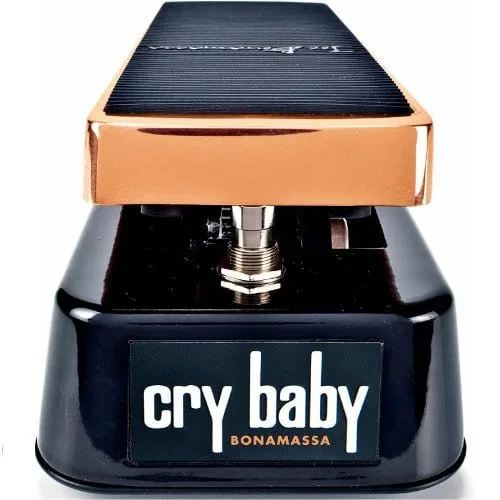
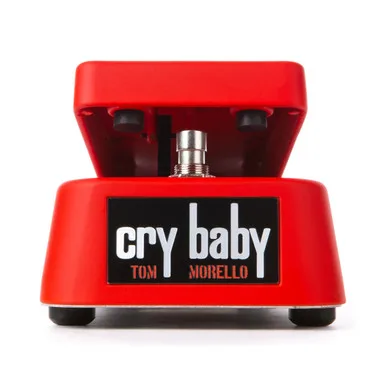
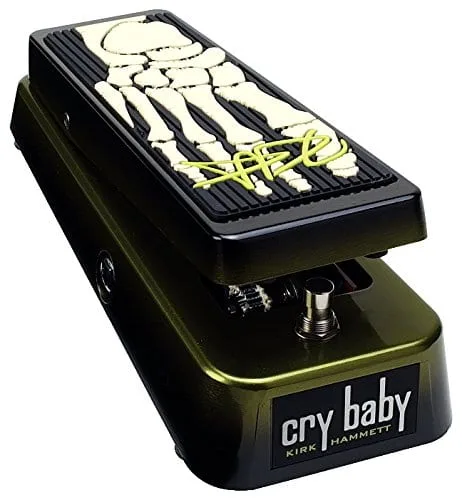
The SW95 belongs to Dunlop's large family of signature Cry Babies, which spans players from Joe Bonamassa to Tom Morello and Kirk Hammett. Its closest cousins in concept are the wah-plus-gain models: the Dimebag Cry Baby Wah pairs its wah with a switchable boost and LEDs indicating wah and boost status, where the Slash model adds a full distortion circuit with its own Gain and Volume controls instead.
For players who want a simpler Slash wah without the extra circuitry, the Classic model covers that ground; for players who want the wah and the gain in one treadle-shaped box, the SW95 is the version that has both812.
Videos
jimdunlopusa
Vans With Benefits
Swee Lee
Questions
Does the Slash Cry Baby wah take batteries?
Yes. The SW95 runs on two 9-volt batteries, reached through a battery door in the top of the pedal, so you can swap them without taking the pedal off the board. It can also be powered by an 18-volt adapter such as the Dunlop ECB004/ECB004E, or a DC Brick power supply.
What do the LEDs on the Slash Cry Baby show?
There are two sets of indicators. A blue LED shows when the distortion is switched on, and separate LEDs show whether the wah itself is on or off. Dunlop describes these as convenient LEDs that indicate distortion on/off and wah on/off modes, so you can see the pedal's state on a dark stage.
What is the difference between the Slash Cry Baby and the Slash Classic Cry Baby?
The SW95 Slash Cry Baby has a built-in high-gain distortion circuit with Gain and Volume controls, on top of the Fasel-loaded Classic wah circuit. The SC95 Slash Cry Baby Classic removes the distortion preamp entirely and uses a custom-wound resonance inductor, running on a single 9-volt battery instead of 18 volts. MusicRadar notes Slash himself used the version without the preamp.
Can the distortion be used without the wah?
No. Guitar World's review of the SW-95 states that the distortion does not work separately; it can be turned on only when the wah is also on. The distortion circuit sits in front of the wah in the signal path, which the reviewer found gives a wider range of wah tone than placing it after.
What power supply does the Slash Cry Baby need?
The SW95 needs 18 volts DC, supplied either by two 9-volt batteries or by an 18-volt adapter such as the Dunlop ECB004/ECB004E, or a DC Brick power supply. Current draw is 18 mA. This is double the 9 volts of the standard Cry Baby line, so a typical 9V daisy chain will not run it.
Sources (9)
- RANGE OF EXPRESSION: FIND YOUR CRY BABY® WAH, Dunlop (lifestyle.jimdunlop.com), 2021-10-08
- SLASH CRY BABY® WAH, Dunlop (jimdunlop.com)
- TOM MORELLO CRY BABY® WAH, Dunlop (jimdunlop.com)
- Dunlop Cry Baby SW-95 Slash wah review, Guitar World, 2007-07-19
- SW95.pdf, Dunlop Manufacturing, Inc., 2019
- KIRK HAMMETT COLLECTION CRY BABY® WAH, Jim Dunlop (jimdunlop.com)
- SC95, Dunlop Manufacturing, Inc., 2019
- Dunlop SC95 Slash Cry Baby Classic review, MusicRadar, 2012-07-14
- SLASH CRY BABY® CLASSIC WAH, Dunlop (www.jimdunlop.com)
 Slash