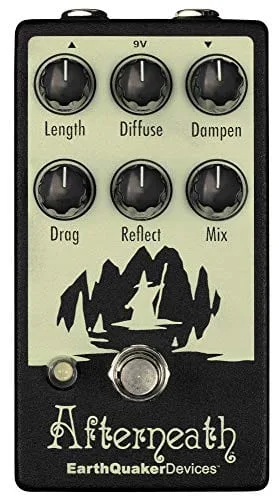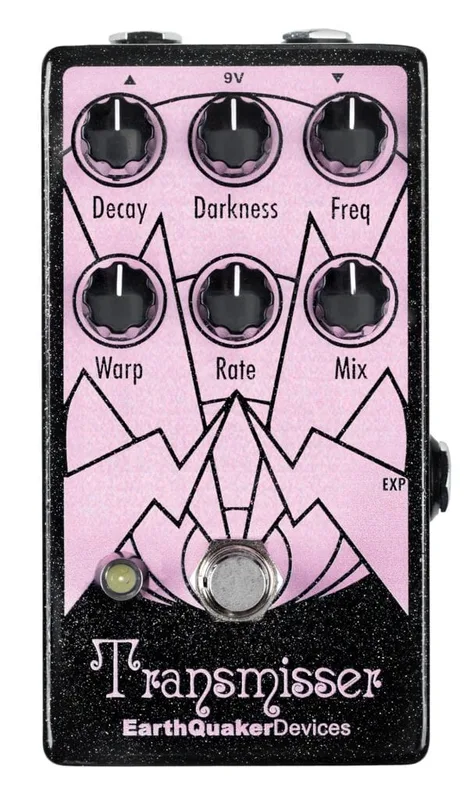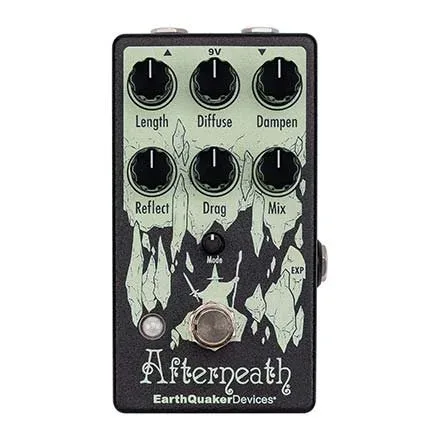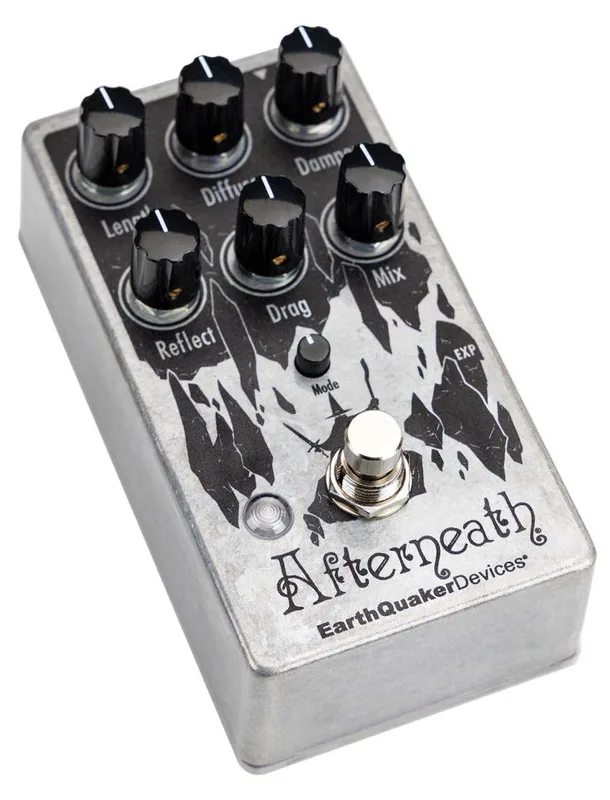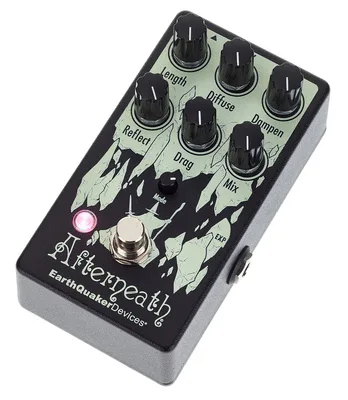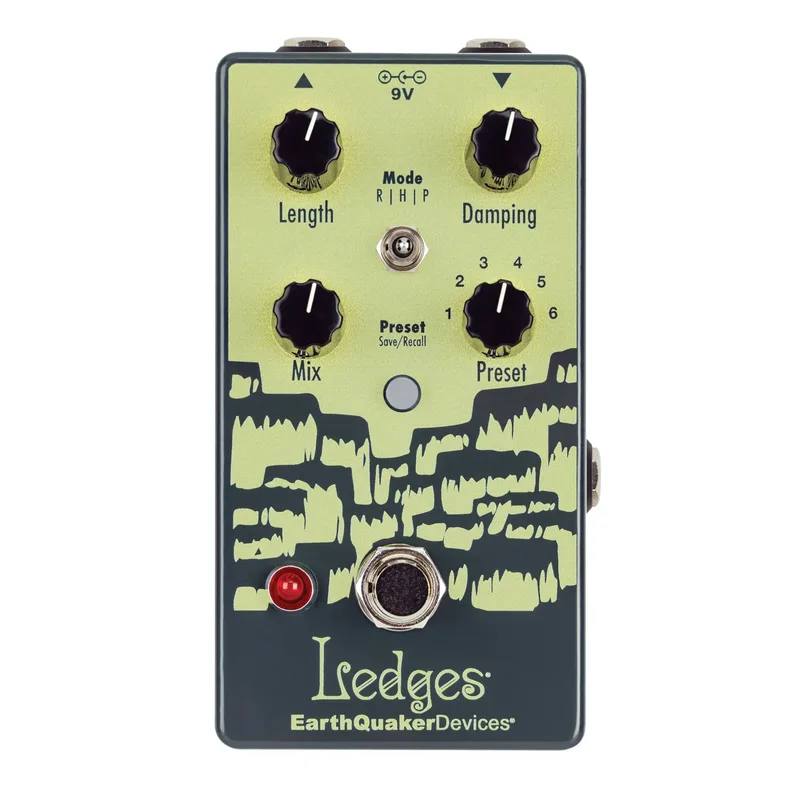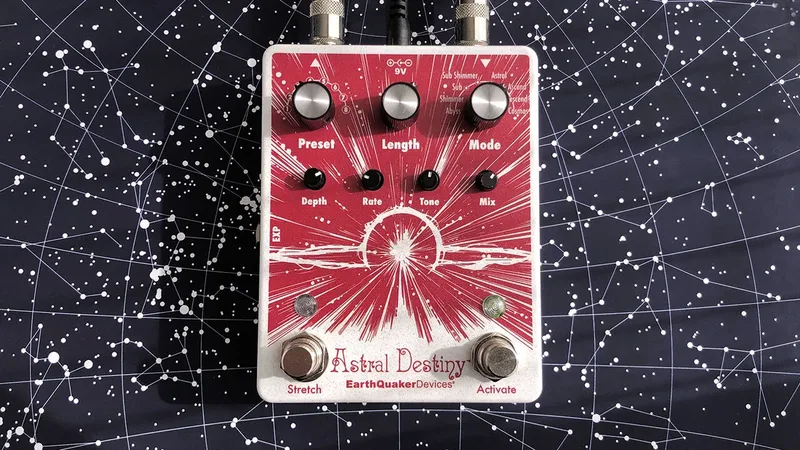


The EarthQuaker Devices Astral Destiny is a compact modulated octave reverb pedal: a reverb whose tail can carry an upper octave, a lower octave, or pitch bending, with chorus-style modulation built in and a Stretch footswitch that doubles the reverb length while bending pitch1. It arrived in early 2021 as the newest and, in the maker's own words, arguably most feature-packed reverb in the EarthQuaker Devices line2. Where pedals like the Afterneath V2 or Transmisser shape a single reverb character, the Astral Destiny packs eight distinct reverb modes and eight editable presets into one box.
Eight reverb modes, from Abyss to Cosmos
The Mode control is an 8-position rotary switch, and each position is a different reverb algorithm1. Four of the eight add an octave or interval to the reverb tail, and three of those bend pitch outright:
| Mode | What it does |
|---|---|
| Abyss | Huge reverb with no octave effect1 |
| Shimmer | Adds an upper octave to the reverb tail1 |
| Sub | Adds a lower octave to the reverb tail1 |
| Sub Shimmer | Combines the Sub and Shimmer behaviors1 |
| Astral | The pedal's core octave reverb voice1 |
| Ascend | Upward pitch bending1 |
| Descend | Downward pitch bending1 |
| Cosmos | Adds a regenerating fifth to the reverb tail1 |
EarthQuaker notes that Ascend, Descend and Cosmos are best used on sustained notes and chords, since the pitch-bending effect can clash and run into itself with faster playing3. Guitar.com made a similar point in its review, suggesting the pedal might be the first time shimmer has had a whole multi-mode stompbox to itself, while conceding the tonal variety is somewhat limited if you want to stay spacey and cosmic7.
The controls and eight presets
The panel is deliberately streamlined: five knobs, two rotary switches, two footswitches1.
| Control | What it does |
|---|---|
| Mode | 8-position rotary switch to select the reverb mode1 |
| Length | Controls the length of the reverb decay1 |
| Depth | Adjusts the intensity of the chorus effect1 |
| Rate | Sets the speed of the modulation1 |
| Tone | Boosts treble clockwise, cuts treble counterclockwise; center is flat1 |
| Mix | Level control for the reverb effect1 |
| Preset | 8-position rotary switch to recall presets1 |
The pedal ships with 8 factory presets, one per reverb mode, and each can be edited or completely overwritten. Length, Depth, Rate, Tone, Mix, the expression assignment and the Stretch length can all be stored and recalled1. Premier Guitar's reviewer called the control layout intuitive and streamlined, a point in the pedal's favor alongside its unique modulation tones and cool pitch-bending capabilities8.
The modulation itself is unusual. Premier Guitar found that, unlike the chorus-like modulation in most big-sounding reverbs, the Astral Destiny's modulations sound more like a cross between tremolo and pitch modulation8. EarthQuaker's own Dan Epstein points out the built-in chorus makes it easy to achieve a rotating-speaker effect, and his 2023 guide covers settings for surf, western, jazz, crunch, drone and jangle pop styles, well beyond shoegaze9.
The Stretch footswitch
The second footswitch is the pedal's signature trick. Stretch doubles the length of the reverb effect while adding a temporary change in pitch: tap it for an immediate pitch change, or hold it for temporary pitch bending1. Guitar.com described it as a stretch mode that doubles the reverb's trail length and adds an adjustable pitch-bending control3.
The main Activate footswitch simply turns the reverb on and off1. The pedal also has tails, so the reverb decays naturally when you bypass the effect rather than cutting off abruptly1.
Power, connections and the circuit
The Astral Destiny runs on a standard 9V DC supply with a 2.1mm negative center barrel, drawing 85 mA, and EarthQuaker warns against running it at higher voltages1.
The pedal is buffered bypass and requires power to pass signal. Unlike a true-bypass pedal, it cannot sit unpowered in your chain and let signal through, and it is not a candidate for a battery1.
The expression jack is flexible. Any TRS expression pedal can take control of Length, Depth, Rate, Tone or Mix, and the jack also accepts control voltage over a 0 to 3.3V range, with sleeve as ground, ring as 3.3V and tip as the wiper1. That makes it usable with synth and modular gear as well as ordinary expression pedals. Input impedance is 500 kΩ and output impedance is 100 Ω1.
Inside, the pedal is FV-1 based, built on the Spin Semiconductor FV-1 DSP chip, and EarthQuaker describes it as a bit larger than the others in their reverb line2. The dry signal path is all analog and the effect signal path is fully digital4. Each unit is built one at a time in Akron, Ohio, and the enclosure artwork is by Matt Horak13. The maker covers it with a limited lifetime warranty: if it breaks, they will fix it1.
What reviewers said
Reviews were positive, with one recurring caveat. Premier Guitar concluded that:
"the simple, smart, and well-conceived Astral Destiny is a superb tool for performance and composition"8
for players whose bedrock is big, octave-colored reverb sounds, while listing one con: it could use one more conventional reverb voice8. Guitar.com's reviewer put the maximum decay time at somewhere around 12 swirling seconds10, and the site later included the pedal in its best affordable effects pedals of 2021 feature, noting that if you want to get spacey and cosmic, this is the pedal for you7. GuitarPlayer listed it at $199 street at launch5; by 2026 Guitar World's Towers review carried a $249 price for the Astral Destiny6.
Videos
Sweetwater
Premier Guitar
EarthQuakerDevices
Questions
Is the EarthQuaker Astral Destiny true bypass?
No. The Astral Destiny uses buffered bypass, so there is always an active buffer present in the signal path, and the pedal requires power to pass signal at all. If it is not powered, your signal does not get through, so it is not a pedal you can leave unpowered on a board.
What chip does the Astral Destiny use?
The Astral Destiny is built around the Spin Semiconductor FV-1 chip, the same DSP at the heart of many compact reverb pedals. EarthQuaker Devices describes it as FV-1 based and notes it is a bit larger than the other pedals in their reverb line.
How long can the Astral Destiny reverb decay?
The Length control sets the reverb decay, and Guitar.com's reviewer measured the maximum decay time at somewhere around 12 seconds. The Stretch footswitch doubles the length of the reverb effect on top of that, while adding a temporary change in pitch.
Can I use an expression pedal with the Astral Destiny?
Yes. Any TRS expression pedal can be assigned to control the Length, Depth, Rate, Tone or Mix knobs. The expression jack also accepts control voltage over a 0 to 3.3 volt range, with sleeve as ground, ring as 3.3 volts and tip as the wiper, which opens it up to synth and modular control.
Is the Astral Destiny analog or digital?
It is a hybrid. The dry signal path is all analog, while the effect signal path is fully digital, running on the FV-1 chip. Your untouched guitar signal stays analog; only the reverb itself is processed digitally.
Sources (10)
- Astral Destiny An Octal Octave Reverberation Odyssey, EarthQuaker Devices
- Reverbology, EarthQuaker Devices, 2021-11-09
- EarthQuaker Devices unleash the Astral Destiny octave/reverb pedal, Guitar.com, 2021-01-21
- EarthQuaker Devices Announces Astral Destiny™: An Octal Octave Reverberation Odyssey, MusicPlayers.com, 2021-01-21
- EarthQuaker Devices Astral Destiny Review, GuitarPlayer.com, 2021-10-04
- EarthQuaker Devices Towers review, Guitar World, 2026-03-27
- Gear Of The Year: Best Affordable Effects Pedal of 2021, Guitar.com, 2021-12-10
- EarthQuaker Devices Astral Destiny Review, Premier Guitar, 2021-02-05
- The Non-Shoegaze Guitarist’s Guide to Astral Destiny, EarthQuaker Devices, 2023-10-18
- Review: EarthQuaker Devices Astral Destiny, Guitar.com, 2021-01-26
 Dave Catching
 Nels Cline