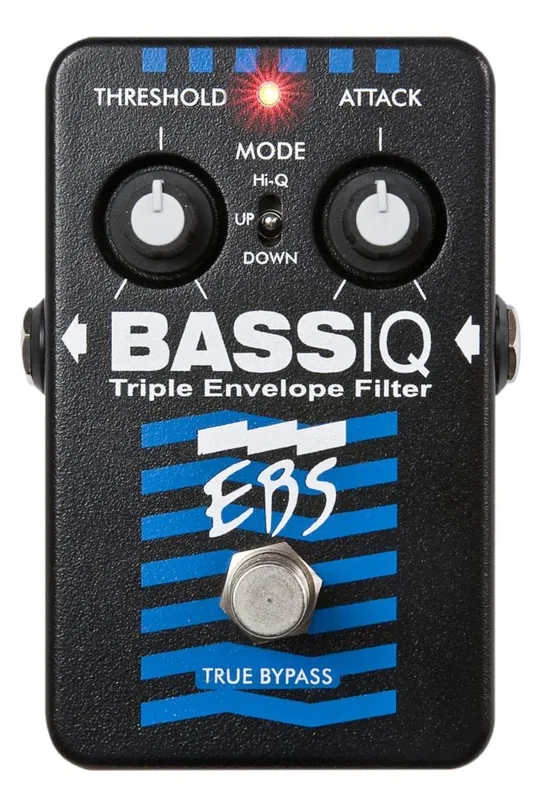


The EBS BassIQ is an analog envelope filter pedal from EBS, the Swedish bass equipment maker. An envelope filter, sometimes called an auto-wah, sweeps a filter across your tone in response to how hard you pick: play softly and the effect stays gentle, dig in and the sweep opens up. RockBoard's PedalPedia entry describes envelope filters as "great tools to create inspiring and musical effects," and the BassIQ is EBS's take on that idea for bass1.
EBS positions the current BassIQ Blue Label as covering ground from "classic auto-wah to gritty synth-bass growls," reacting dynamically to your playing2. The pedal has been around for a while, as Bass Gear Magazine put it in 2018, calling it "a fun little pedal that has been around for a while" and noting it was available through dealers worldwide3.
What it does to your sound
The BassIQ tracks the envelope of your note, the attack and decay of your picking, and uses that to sweep its filter. EBS's 2019 press release says the pedal "produces sounds ranging from classic auto-wah effects to spaced out 'Funkadelic' and synth-bass sounds"4. Three filter types shape the character of the sweep2:
- Low Pass: the classic envelope filter voice, rolling off highs as the filter closes.
- Band Pass: a narrower, more vocal sweep centered on a band of frequencies.
- Full Range: the filter works across its full 100 to 2.5k Hz range2.
A three-position mode switch sets the direction of the sweep: Down, Up-Range or Up2. The UP-R mode, according to EBS's press release, "is similar to 'UP' but interacts with an internal control that changes the range of the envelope effect to your desire"4.
Controls
The Blue Label carries three knobs2:
| Control | What it does |
|---|---|
| Q | How pronounced the filter sounds. Lower settings give a smoother, gentler effect; turn it up for a sharper, more vocal "quack"2 |
| Threshold | How sensitive the filter is to your playing. Turn it up for a lighter touch or a lower-output instrument, down if the filter reacts too strongly2 |
| Attack | Shapes how the filter responds to your note's attack2 |
Because the filter follows the signal coming from your instrument, EBS notes that different pickups, volume settings and onboard EQ can change its response2. That makes the Threshold knob the one to revisit whenever you change basses or roll your volume back.
EBS also gives placement advice: "Start with it early in the chain, before compression and drive, so it can follow your playing dynamics"2. A compressor ahead of the filter would flatten the very dynamics the pedal needs to track.
Power
The Blue Label accepts 9, 12 or 18 V DC, draws up to 55 mA, and shuts off below 6 V2. The older 2-knob version is a different story.
EBS states plainly: "don't use 12 or 18 V DC with the older 2-knob version of the BassIQ"2. If your pedal has two knobs rather than three, keep it on a 9V supply.
Versions: 2-knob, 3-knob and Blue Label
The BassIQ has gone through several forms. RockBoard's PedalPedia lists the Blue Label and a 3 Knob version, and EBS's own page refers to an older 2-knob version12. The Blue Label, announced on 2 October 2019, brought what EBS calls "a more compact design, improved response, and enhanced tone control" compared to the older version, sized to fit any pedalboard24.
| Version | Knobs | Notes |
|---|---|---|
| 2-knob (older) | 2 | Do not power at 12 or 18 V DC2 |
| 3-knob | 3 | Listed alongside the Blue Label in RockBoard's PedalPedia1 |
| Blue Label (2019) | Q, Threshold, Attack | More compact, improved response, enhanced tone control; accepts 9, 12 or 18 V DC24 |
On guitar, and synth bass sounds
EBS describes the BassIQ as having "great versatility and responsiveness. Made for bass and excellent on guitar as well"1. Since the filter tracks your instrument's signal, a guitar's different output level and pickup character will shift how the pedal responds, so the Threshold control does the adapting.
For players chasing synth-like tones, Bass Gear Magazine highlighted the BassIQ for those who "want to create synth bass sounds with your bass guitar"3, and EBS's own copy runs from auto-wah through Funkadelic-style sweeps to synth-bass growls24. The Q control is the main voice-shaper here: low settings keep the effect smooth, while higher settings produce the sharper, more vocal quack associated with synth-style filtering2.
Videos
EBSSweden
EBSSweden
EBSSweden
Questions
Can the EBS Bass IQ get synth bass sounds?
Yes. EBS describes the BassIQ Blue Label as running from classic auto-wah to gritty synth-bass growls, and its 2019 press release says the pedal produces sounds ranging from auto-wah to spaced out Funkadelic and synth-bass sounds. Bass Gear Magazine also noted it as a way to create synth bass sounds with a bass guitar. The Threshold control sets how hard you need to play to trigger the sweep.
Can I power the EBS Bass IQ at 18V?
The Blue Label version accepts 9, 12 or 18 V DC, drawing up to 55 mA and shutting off below 6 V. The older 2-knob version is different: EBS states plainly not to use 12 or 18 V DC with it, so check which version you have before plugging in a higher-voltage supply.
Does the EBS Bass IQ work on guitar?
Yes. EBS describes the BassIQ as made for bass and excellent on guitar as well. Because the filter follows the signal from your instrument, different pickups, volume settings and onboard EQ will change its response, so expect to readjust the Threshold when switching instruments.
Sources (4)
- BassIQ by EBS, RockBoard PedalPedia, 2026
- EBS BassIQ, EBS Professional Bass Equipment (ebssweden.com)
- New Video Demo of the EBS BassIQ, Bass Gear Magazine, 2018-03-29
- EBS presents the new BassIQ ‘Blue Label’ envelope filter, EBS Professional Bass Equipment, 2019-10-02