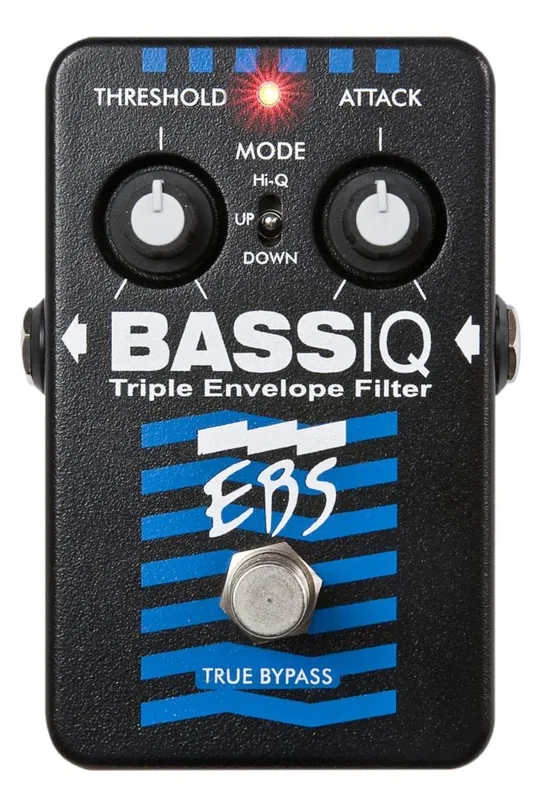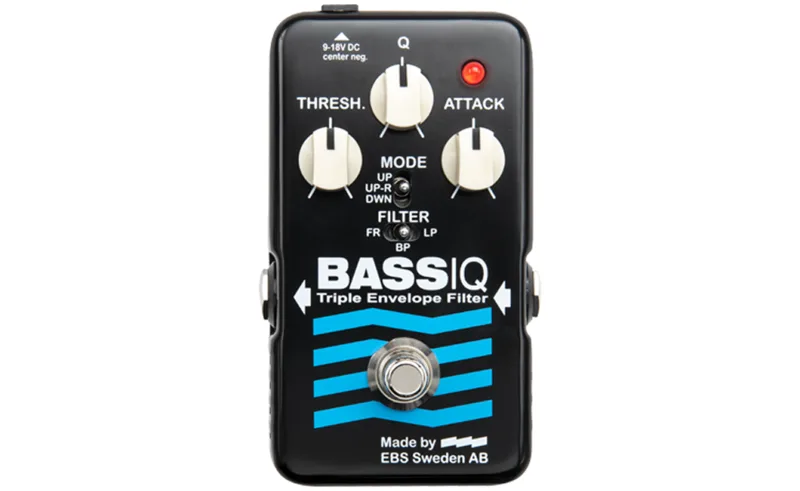


The EBS BassIQ Blue Label is an analog envelope filter pedal for bass, made by EBS. An envelope filter, sometimes called an auto-wah, listens to how hard you play and sweeps a filter in response: play harder and the filter moves, play gently and it stays put. EBS describes the BassIQ as reacting dynamically to your playing, covering ground from classic auto-wah to gritty synth-bass growls1.
The Blue Label version, introduced in October 2019, replaced an older BassIQ with a more compact design, improved response, and enhanced tone control1. EBS announced it as ready to ship on October 2, 20192.
What an envelope filter does
Instead of a fixed EQ curve, an envelope filter has a moving cutoff point driven by the volume envelope of each note you play. The result is a wah-like vocal quality that responds to touch rather than to a foot rocking a treadle. In its 2019 announcement EBS said the pedal produces "sounds ranging from classic auto-wah effects to spaced out "Funkadelic" and synth-bass sounds"2.
Because the filter tracks your instrument's output, everything upstream of the pedal matters. EBS notes that the filter follows the signal coming from your instrument, and that different pickups, volume settings and onboard EQ can change its response1. Rolling back your volume knob or switching pickups changes how readily the filter opens.
The controls: Threshold, Attack and Q
The Blue Label keeps the three-knob layout of the original: Threshold, Attack and Q1.
| Control | What it does | Range |
|---|---|---|
| Threshold | Sets how sensitive the filter is to your playing. Turn up for a lighter touch or a lower-output instrument, down if the filter reacts too strongly. | -50 to +6 dBv1 |
| Attack | Sets how quickly the filter responds to a note. Down for a quick, snappy response, up for a slower sweep. | 50 ms to 2 s (80%)1 |
| Q | Controls how pronounced the filter sounds. Lower settings give a smoother, gentler effect; turn up for a sharper, more vocal "quack". | 0.7 to 151 |
Threshold and Attack work together: Threshold decides how much signal it takes to trigger the sweep, and Attack decides how fast the sweep happens once triggered. Q is the resonance of the filter, the difference between a subtle shimmer and an exaggerated, squawky quack.
Up, Up-R and Down modes
A mode switch selects the direction of the sweep1.
- Up: sweeps the filter toward higher frequencies as you play harder, the familiar envelope-filter or auto-wah sound1.
- Up-R: works like Up, but lets you set how far the filter opens using the internal Range trimmer1.
- Down: reverses the direction, sweeping downward as you play harder1.
Up-R is the mode for players who find the full Up sweep too wide. The internal Range trimmer caps how far the filter opens, so the effect stays inside a band you choose rather than running to the top of its range1.
Low Pass, Band Pass and Full Range filters
A second switch selects the filter type, which shapes what the sweep actually does to your tone1.
- Low Pass lets the lows through while rolling off frequencies above the moving cutoff1.
- Band Pass focuses on a moving frequency band for a more focused, wah-like sound1.
- Full Range brings back the original signal's high frequencies as the filter opens fully, retaining more of your bass's top end1.
Low Pass is the setting that keeps your low end intact, since everything below the cutoff passes untouched. Band Pass is the most vocal and wah-like, but it removes content outside the moving band. Full Range is the compromise: closed, it filters like the others, but as it opens it returns your original high frequencies instead of leaving them behind1.
The filter itself sweeps from 100 Hz to 2.5 kHz, with a Q range of 0.7 to 151.
Where it goes on a pedalboard
EBS recommends starting with the BassIQ early in the chain, before compression and drive, so it can follow your playing dynamics1. That placement matters more than with most effects: a compressor ahead of it evens out the very peaks and valleys the envelope follower reads, and a distortion or fuzz pedal adds harmonics and sustain that change how the filter triggers. After the filter, the rest of the board, overdrive, delay, reverb, can carry on as usual.
Power and connections
The BassIQ Blue Label accepts 9, 12 or 18 V DC, drawing a maximum of 55 mA, and shuts off below 6 V1. Running it at 12 or 18 V is an option if your power supply offers it, though EBS does not state a tonal difference between voltages. Input impedance is 1.8 Mohms with a nominal input level of -10 dBv, and output impedance is 100 ohms1.
The pedal shuts off below 6 V, so a weak or sagging supply will silence it rather than degrade it. If the pedal appears completely dead, check the supply voltage before anything else.
If the footswitch stops working
EBS addresses this directly: if the switch appears dead, it is almost 100% because the magnet that should trigger the response has fallen out of place, and the fix does not require soldering1. The Blue Label uses relay switching rather than a mechanical footswitch in the audio path1, so a "dead" switch is a trigger problem, not a broken audio connection.
Videos
EBSSweden
EBSSweden
EBSSweden
Questions
Is the EBS BassIQ Blue Label true bypass?
Yes. EBS lists the BassIQ Blue Label as a true bypass pedal with relay switching, so with the effect off your dry signal passes through without the circuit coloring it. The dry bandwidth is rated at +0 / -2 dB from 20 Hz to 20 kHz, which covers the full range of a bass guitar.
Where should the BassIQ go on a bass pedalboard?
EBS recommends starting with it early in the chain, before compression and drive, so the filter can follow your playing dynamics. A compressor or drive pedal in front of it would flatten or reshape the dynamics the envelope follower reads, changing how the filter responds to how hard you play.
Does the BassIQ work on guitar?
The filter follows the signal coming from your instrument, so it responds to whatever you plug in. EBS notes that different pickups, volume settings and onboard EQ change its response, so a guitar or any other instrument will trigger the filter differently than a bass.
Why is my BassIQ footswitch not working?
EBS says that if the switch appears dead, it is almost always because the magnet that should trigger the response has fallen out of place. The fix does not require soldering, so it can be corrected by opening the pedal and repositioning the magnet.
What does the internal Range trimmer do?
The Range trimmer is used in Up-R mode. Up-R works like the normal Up mode, sweeping the filter toward higher frequencies as you play harder, but the trimmer lets you set how far the filter opens, capping the top of the sweep.
Sources (2)
- EBS BassIQ, EBS Professional Bass Equipment (ebssweden.com)
- EBS presents the new BassIQ ‘Blue Label’ envelope filter, EBS Professional Bass Equipment, 2019-10-02