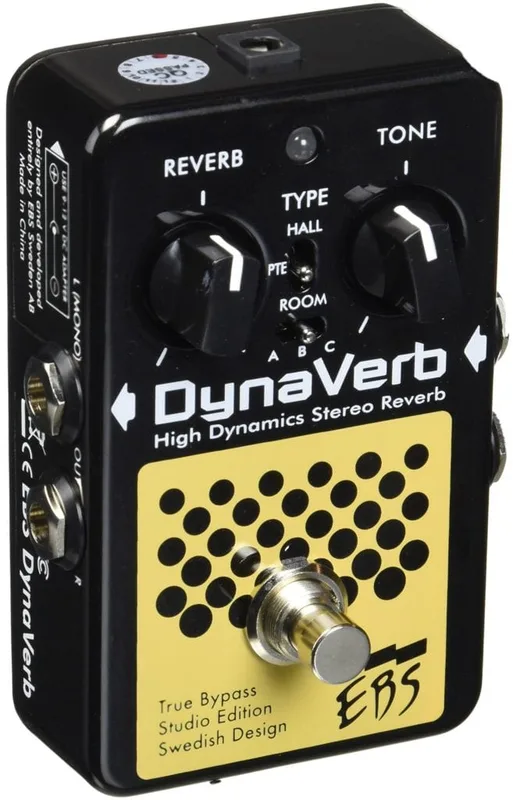
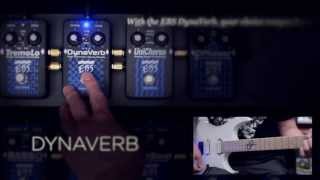

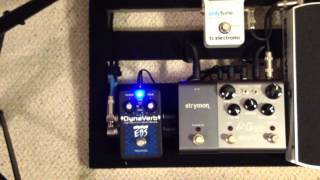
The EBS DynaVerb is a stereo digital reverb pedal from EBS, a maker best known for bass gear. EBS describes it as "studio-quality stereo reverb in a compact, user-friendly stompbox," built around 24-bit digital processing at a 48 kHz sampling frequency1. It was created for bass players, but EBS says it can enhance any instrument from guitar to keyboard and even vocals, and it is suitable for both live and studio use12.
The pedal offers nine reverb types in three banks: three Halls, three Rooms, and a fourth bank of one Reversed, one Gated, and one Spring-type effect1. The current version uses true bypass relay switching, so your dry tone passes through untouched when the effect is off1.
What the DynaVerb does
The DynaVerb is a digital reverb pedal that uses 24-bit processing at 48 kHz to create what EBS calls a high-quality full-range reverb sound1. Because it is a stereo reverb, it can be used in a stereo signal chain for a wider spatial effect, and its stereo inputs retain a dual signal path from other devices, such as the EBS UniChorus chorus pedal13.
The dry signal path keeps a flat bandwidth of +0 / -3 dB from 20 to 20k Hz, and the pedal's dynamic range is 107 dB A-weighted, with a nominal input level of -8 dBv1. EBS positions it as equally at home on stage and in the studio, and reviewer Dan Veall at Bass Gear Magazine agreed, writing that "DynaVerb is just at home in professional studio situations, too."3
The controls: Reverb, Tone and two footswitches
The front panel keeps things simple: two knobs and two footswitches.
| Control | What it does |
|---|---|
| Reverb | Sets the wet/dry mix; in parallel mode it sets the reverb's overall volume14 |
| Tone | Changes the high-frequency content of the reverb: down for a darker, softer ambience, up for a brighter one1 |
| Footswitch 1 | Selects the reverb type1 |
| Footswitch 2 | Selects the variation (A/B/C) within that type1 |
The Tone control is a low-pass filter on the reverb itself, with a range of 1 / 20 kHz minimum to maximum, so it shapes the reverb tail without touching your dry tone1. In his Bass Gear Magazine review, Dan Veall described it as adjusting the overall "hardness" of the space the effect emulates, advising players to turn it anti-clockwise if a darker reverb tail is what the sound calls for3.
There is also an internal Serial/Parallel switch. In normal in-line (serial) use, the Reverb knob sets the amount of reverb mixed with the dry signal; in parallel mode, it sets the reverb's overall volume instead14.
Nine reverbs in three banks
The Type footswitch steps through three reverb families, and the second footswitch picks one of three variations (A/B/C) within each family, giving nine reverbs in total1.
| Bank | Variations | Decay times |
|---|---|---|
| Hall | Big Hall, Small Hall, Church | 2.8s, 1.5s, 7s1 |
| Room | Room, Big Ambience, Chapel | 1.3s, unspecified, 3s1 |
| Other | Gated, Reverse, Spring | 0.8s, 1.8s, 2s1 |
The Hall bank spans a wide range. Dan Veall noted it "dishes up three Hall reverbs from a 1.5s small space, to seven seconds of deep and rich cathedral spaciousness"3. In the Other position, Veall found the "special effects": a Gated reverb for those '80s synth-pop drum sounds, a gentle Reverse reverb effect, and an articulate Spring reverb3.
The RockBoard PedalPedia entry for the DynaVerb Studio Edition describes the same three primary reverb types as Room, Plate, and Hall variations, producing spaces ranging from subtle ambiences to vast reverberant decays5. MusicRadar's Trevor Curwen, reviewing the Guitar Edition, described its room simulations as "a typical studio room, a small warm room and a large room" that "sound nicely authentic"4.
Power: 9 to 18V, 80mA
The DynaVerb runs on 9 to 18V DC regulated power, drawing 80 mA max1. EBS recommends the EBS AD-9 Pro DC adapter or the Runsten Power Supply, neither of which is included1. The RockBoard listing for the Studio Edition gives the connector as 9V DC, center negative5.
A battery is a backup option only and is not included. EBS strongly recommends using an external power supply for the pedal's operation12.
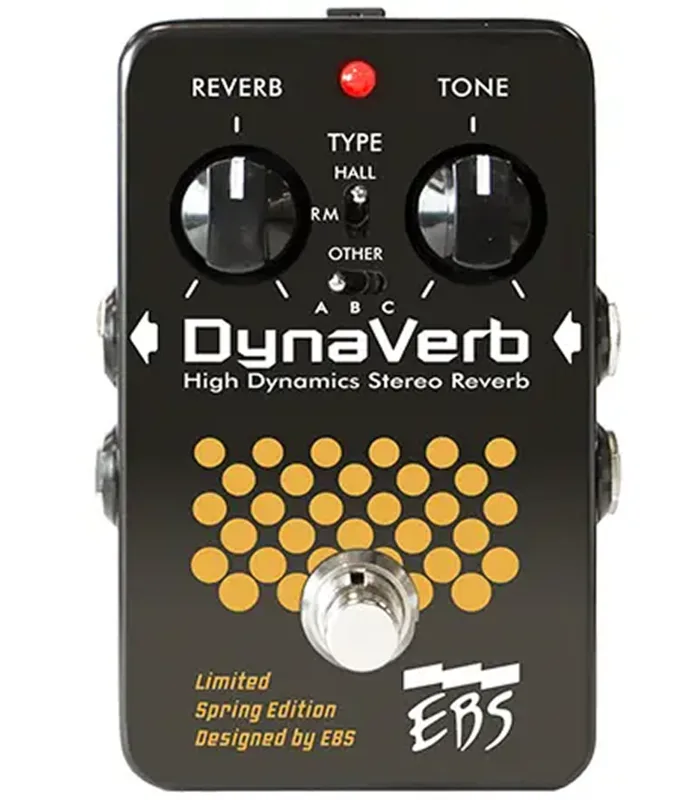
The Limited Spring Edition
In June 2023, EBS released the DynaVerb Limited Spring Edition, a special edition that adds Spring, Gated, and Reversed reverbs to the original six Room and Hall types12. It carries the same 24-bit digital processing circuitry and the same 9 to 18V DC, 80 mA max power requirement32.
The Limited Spring Edition also brought a lighter chassis: 245g (0.54 lb.), down from 400g on the original1. EBS says the pedal is created for bass but can enhance any instrument from guitar to keyboard and even vocals with its studio-quality sound in full range2.
In August 2023, BassTheWorld.com published a video with the new DynaVerb Limited Spring Edition and the UniChorus Studio Edition Rev2, including reviewer impressions and sound samples6.
What reviewers said
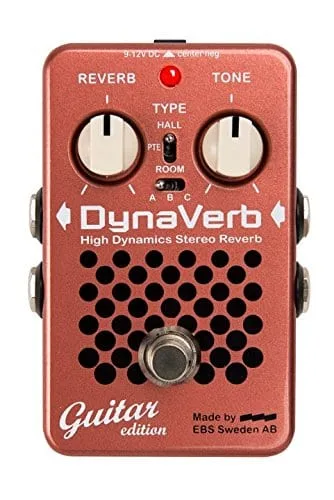
MusicRadar's Trevor Curwen reviewed the DynaVerb Guitar Edition, EBS's Red Label version for guitarists, and concluded74:
"A classy reverb that will endow your tone with an authentic sense of space or the ambience of a vintage studio recording"
The Guitar Edition itself came out of EBS's move to bring bass favorites to guitarists: MusicRadar reported in April 2015 that "Bass favourites the MultiComp GE and the DynaVerb GE are now being brought to guitarists in this Red Label line"7. On the bass side, Dan Veall's review for Bass Gear Magazine found the pedal equally convincing in professional studio use3.
Videos
EBSSweden
BassTheWorld.com
Peter Kendall Warren
Questions
Is the EBS DynaVerb true bypass?
Yes. The current DynaVerb uses true bypass relay switching, so when the effect is off the original instrument tone passes through without degradation. EBS describes it as True Bypass Signal Relay Switching on its product page.
Can the EBS DynaVerb run on a battery?
Only as a backup. The pedal is designed for 9V DC power, with a battery as a backup option that is not included, and EBS strongly recommends using an external power supply for the best results. The recommended supply is the EBS AD-9 Pro DC adapter or Runsten Power Supply, sold separately.
Does the DynaVerb work on guitar as well as bass?
Yes. EBS created the pedal for bass, but says it can enhance any instrument from guitar to keyboard and even vocals. EBS also released a Guitar Edition in its Red Label line in 2015, bringing the bass favorite to guitarists.
How do you set the EBS DynaVerb to parallel mode?
The DynaVerb has an internal Serial/Parallel switch. Opening the pedal and moving this switch to the parallel position routes the effect so the Reverb knob sets the reverb's overall volume rather than the wet/dry mix, which is how it behaves in normal in-line use.
Is the EBS DynaVerb stereo?
Yes. EBS describes the DynaVerb as a stereo reverb that can be used in a stereo signal chain for a wider spatial effect. Its stereo inputs also retain a dual signal path from other stereo devices, such as the EBS UniChorus.
Sources (7)
- EBS DynaVerb, EBS Sweden (ebssweden.com)
- EBS DynaVerb Limited Spring Edition and relaunch of the UniChorus, EBS Professional Bass Equipment, 2023-06-05
- Bassic Review, BassGearMag, 2024-03-08
- EBS Dynaverb Guitar Edition review, MusicRadar, 2015-09-30
- DynaVerb Studio Edition by EBS, RockBoard (PedalPedia), 2026
- What do the new DynaVerb and Chorus pedals sound like?, EBS Professional Bass Equipment, 2023-08-21
- Musikmesse 2015: EBS debut Red Label guitar pedals, MusicRadar, 2015-04-15