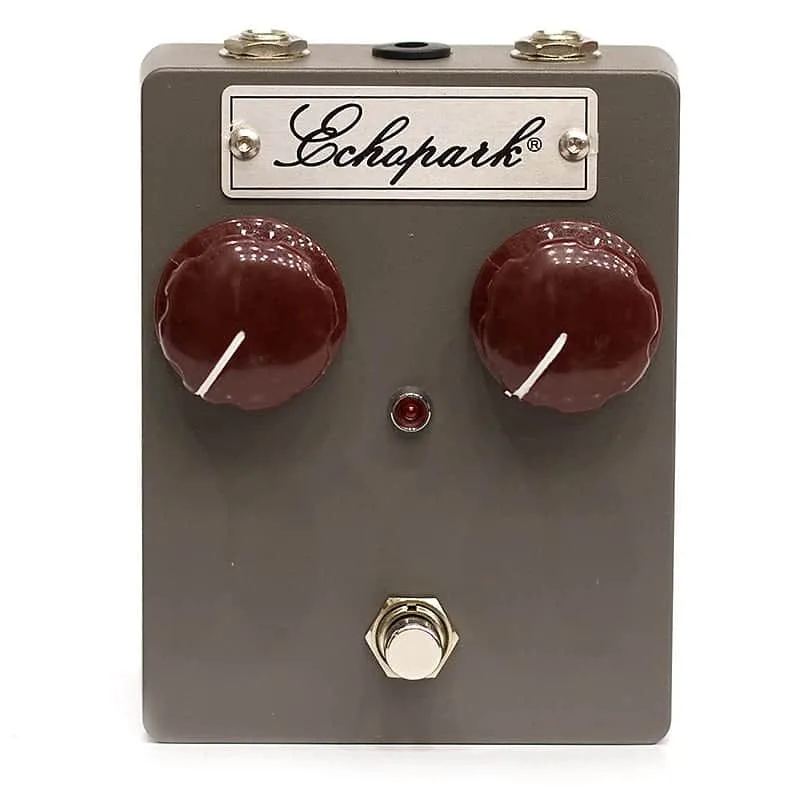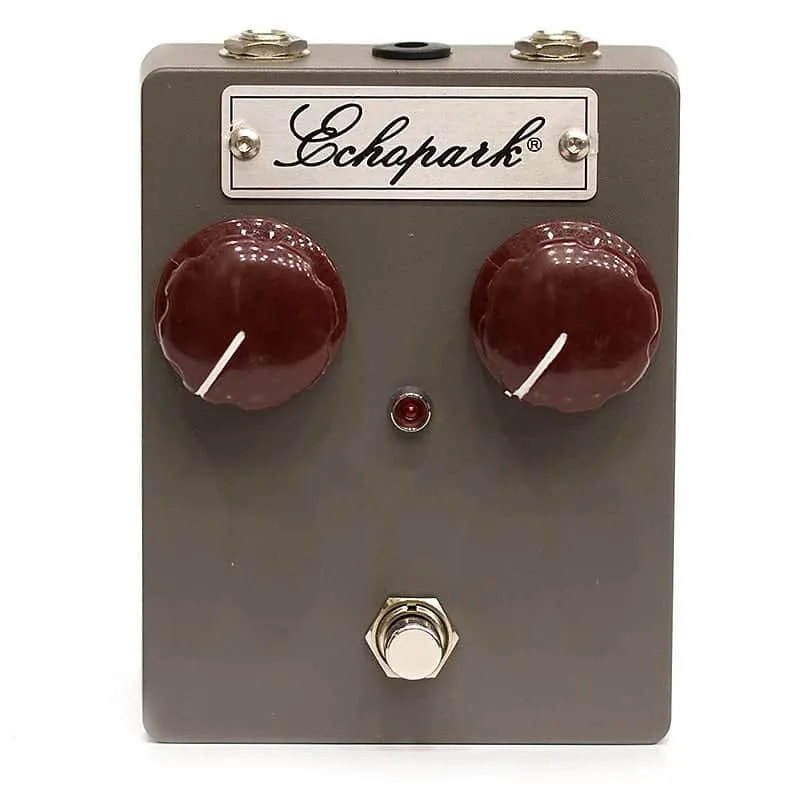


The circuit is fully hand wired, with full-sized internal pots and discrete components, housed in a no-nonsense enclosure with minimalist aesthetics: the only marking on the pedal is the Echopark name plate1. Premier Guitar described the F-1's build as "super-tidy, hand-wired circuitry in a humble, industrial gray powder coated enclosure" with big Bakelite-style knobs2.
A Fuzzrite-style germanium fuzz
The Mosrite Fuzzrite is the reference point for the F-1's sound. Delicious Audio calls the F-1 "a unique take on the Fuzzrite, using germanium transistors like the original"3. Where the original Fuzzrite offered volume and depth controls, the F-1 gives the player level and blend controls, which Guitar World's reviewer found provide a wider variety of textures1.
The blend control is where the "Dual Germanium" name comes from. It combines the first and second stages of the PNP germanium transistor1. On the related Echopark F-1 Fuzz, Premier Guitar explains the underlying topology: from 6 o'clock to 12 o'clock the gain knob uses one germanium transistor, and past the halfway point it cascades the first transistor's output into the second, adding dirt and changing the fuzz texture2. The two transistors blended together "add a bit of fizziness and sparkle to the top end without deleting any low-end beef," and at extreme settings the pedal produces an almost swirling, phased effect that recalls a vintage Fuzz Face2.
Guitar World's reviewer found the blend control can unleash a wide range of fuzz characters1:
- Harmonically rich Octavia-style fuzz
- The slashing buzz of a ripped speaker
- Mellow, violin-like swells1
The pedal also behaves well in practical playing situations. Guitar World notes that the fuzz cleans up when the guitar's volume control is turned down, and that the effect works well with both clean and distorted amp settings1. Premier Guitar's reviewer found the F-1 "excelled at driving dirty sounds into zones from fiery to outrageous" with higher-gain amps, where many fuzzes disappear or sound bad2.
"The F-1 perfectly nails the Fuzzrite's gritty, buzzy character, but the level and blend controls provide a wider variety of textures than the original's volume and depth controls."
The controls
The F-1 Dual Germanium keeps its control set to two knobs, both oversized and vintage-styled, which Guitar World found easy to grip and adjust under the pressure of a live gig1.
| Control | Position | What it does |
|---|---|---|
| Level | Left knob | Sets the amount of fuzz added to the dry signal1 |
| Blend | Right knob | Combines the first and second stages of the PNP germanium transistor1 |
On the F-1 Fuzz, Premier Guitar describes the same two-knob layout with the left knob controlling volume and the right knob controlling gain, with the gain knob cascading the first transistor's output into the second past the halfway point2. A red LED glows when the effect is engaged via the true bypass footswitch1.
A slightly more expensive version of the F-1 also features a diode clipping switch for additional textural options, according to Delicious Audio's buying guide3.
Power and bypass
The F-1's adapter jack takes a 9VDC center negative plug1, the standard configuration for most pedal power supplies. Premier Guitar notes the pedal can be run off a 9V adapter or a battery2. The pedal uses a true bypass footswitch, so the circuit is out of the signal path when disengaged1.
What reviewers said
Both published reviews of the F-1 were positive. Guitar World concluded in 2016 that Echopark's new pedals are "expressive, no-nonsense, and sensibly priced tools that instantly add a professional touch of class to your guitar's tone"1. Premier Guitar's 2023 review of the F-1 called it "a foolproof, musical, and explosive fuzz pedal that, while far from subtle, feels very integrated" with almost any amp and guitar combination, adding that few options in its price range are as inspiring or satisfying in sound and feel2. The same review noted the pedal is easy to use with killer, streamlined looks, but a bit expensive2.
Echopark's first pedal line paired the F-1 with the Soapbox boost, and the two share the same engagement indicator: an LED that glows when the effect is on, red on the F-1 and blue on the Soapbox1.
Videos
Premier Guitar
Guitar World
Echopark Guitars
Questions
Is the Echopark F-1 Dual Germanium true bypass?
Yes. Guitar World's review of the F-1 Dual Germanium notes that the LED glows brightly when the effect is engaged with the true bypass footswitch, so the pedal's circuit is out of the signal path when it is off.
What power does the Echopark F-1 need?
The F-1 runs on a 9VDC center negative adapter, and Premier Guitar notes the pedal can also be run off a 9V adapter or a battery. Any standard 9V pedal power supply with a center negative plug will work.
What pedal is the Echopark F-1 based on?
The F-1 Dual Germanium is based on the rare Mosrite Fuzzrite pedal, a 1960s fuzz that was made in both germanium and silicon versions. Echopark's take uses germanium transistors like the original and adds level and blend controls.
Does the Echopark F-1 use germanium transistors?
Yes. The F-1 uses two germanium transistors, and Guitar World's review describes a PNP germanium transistor design whose first and second stages are combined by the blend control.
Does the Echopark F-1 clean up with the guitar's volume knob?
Yes. Guitar World's review states that the fuzz effect cleans up when the guitar's volume control is turned down, and that the effect works well with both clean and distorted amp settings.
How much does the Echopark F-1 cost?
Guitar World listed the F-1 Dual Germanium at $230 in 2016, and Premier Guitar gave a $230 street price in 2023. A 2022 Delicious Audio buying guide listed the F-1 line at $225 to $265.
Sources (3)
- Review: Echopark Guitars Soapbox and F-1 Dual Germanium Pedals, Guitar World, 2016-07-08
- Echopark F-1 Fuzz Review, Premier Guitar, 2016-03-31
- Best Fuzzrite Clones And Evolutions In 2023, Delicious Audio, 2022-08-10