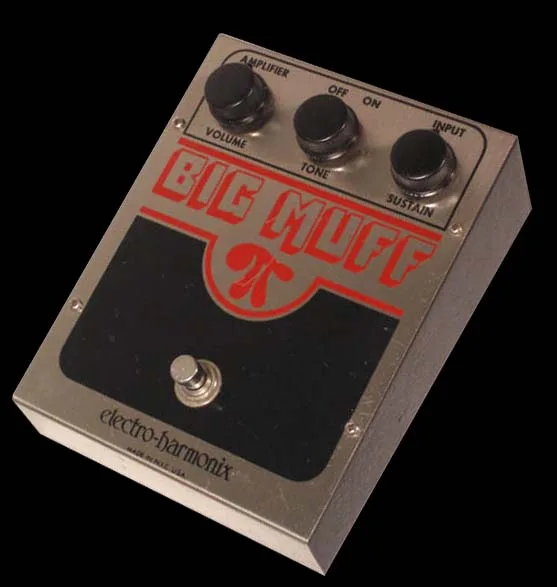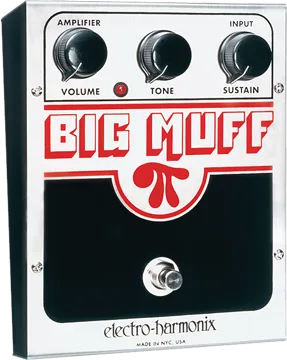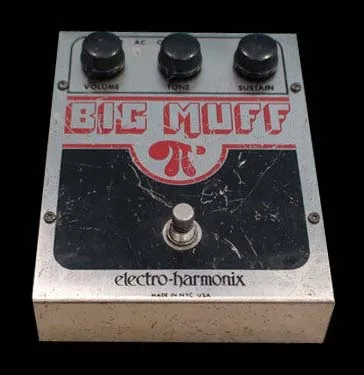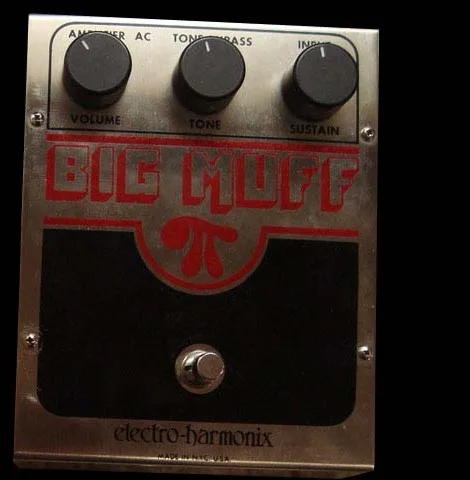

The Big Muff Pi Version 6, often called the "Tone Bypass" Big Muff, is a transistor-based fuzz/distortion pedal from Electro-Harmonix. It is a continuation of the V3 transistor circuit: while the op-amp V4 and V5 Big Muffs were being made alongside it, around 1980 the transistor version was given a new circuit board and a series of graphics changes, becoming the V61. It was the last of the Muffs made in the US for many years, built from circa 1979 to 19842.
What sets the V6 apart for players is its tone bypass switch, carried over from the V3 and V5 versions, and the fact that unlike the earlier V1, V2 and V3 Big Muffs, only one schematic was used for all V6 units, so the sound was relatively consistent from pedal to pedal13.
What the V6 Big Muff is
The V6 is the transistor Big Muff of its era. The circuit designer was Bob Myer with Mike Matthews4, and the design follows the classic five-stage Big Muff layout: an input/gain stage, a first clipping stage, a second clipping stage, a tone stage, and an output stage4. The input section is a transistor amplifier that buffers the guitar's signal and holds the gain control56, the two clipping stages each use twin silicon diodes to shape the signal62, and the output stage boosts the signal back up after the passive tone filter cuts it down76.
For the V6, the V3 tone bypass transistor circuit was reworked into a smaller board, and the board also allowed an alternate volume knob position so the same circuit could be used in the Little Big Muff3. Most V6 units used 2N5088 transistors3, 1N4148 or 1N914 clipping diodes4, and 150k linear taper pots throughout4. The V6 always used 470pF capacitors in the clipping sections, the value that governs how much treble each stage lets through45.
In sound, Kit Rae's history of the Big Muff describes the V6 as very similar to the V3, with slightly more sustain and gain on tap, slightly more grit and fuzz, and slightly more noise. Compared with the V4/V5 op-amp Big Muffs, the V6 has more gain, more bottom end, and is more reactive to pick attack and harmonics, but it is much noisier at high gain settings13.
What the tone bypass switch does
The tone bypass switch, kept from the V3 and V5 versions, lets you completely remove the tone section from the circuit3. This matters because of how the Big Muff tone stage works: the signal splits into a high-pass and a low-pass filter, and the tone potentiometer blends the two back together4. It is a passive circuit with no power connections, simple enough to build with five parts, but it costs signal level and it scoops the mids89.
"One of the characteristics of this tonestack is that it scoops the mids of your tone."
With the switch engaged, that whole section drops out of the signal path, giving a raunchy, raw and very loud tone with more midrange3. The V5 revision had used the same idea, removing the EQ section to increase output level and change the midrange response10. Guitar.com notes that the V6 is one of the variants that featured a tone bypass switch by default11, and Stompbox Book's history confirms the V6 carried on with the tone bypass control2.
A point worth knowing: this is not true bypass3. The switch only removes the tone stack while the effect is on; the pedal's signal still runs through its transistor stages, and vintage USA Big Muffs were not wired for true bypass at the footswitch4.
Two editions and the graphic color variants
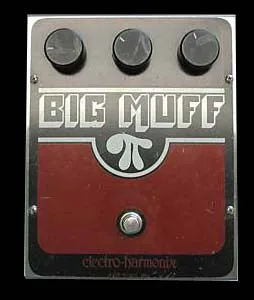
The V6 went through graphics changes during its run. Kit Rae documents two editions: a first edition with no AC marking on the front, and a second edition with AC added, with possibly a third edition carrying the tone bypass switch3. In total there were six color graphics variations, including the original standard red and black3. The pedal shipped in a brown corrugated cardboard box with red printing, and the box graphics matched the pedal graphics3.
Knobs varied too: most V6s were made with Taiwan-made flat-topped "hockey puck" knobs, and many were also made with the black Daka-Ware style knobs used on earlier versions, which appear to have been in use as late as 19843.
Power comes from a 9V battery or an AC power adaptor jack, and the top of the enclosure had to be removed to change the battery3. The adaptor jack is a 1/8" (3.5mm) plug, tip positive3, which is the opposite polarity of the center-negative standard most modern pedalboards use, so a vintage V6 needs an appropriate adaptor rather than a typical daisy chain.
The V6 in use
The V6 has a documented place in modern players' hands. Premier Guitar reported that James Murphy of LCD Soundsystem used a Version 6 Big Muff for his band's fuzz-bass tones, a unit distinguished by construction inconsistencies that made it a quirky and unique thing12. Guitar World, reviewing an EarthQuaker Devices pedal inspired by a V6, notes that the version 6 Big Muff was produced from roughly 1979 to 198413.
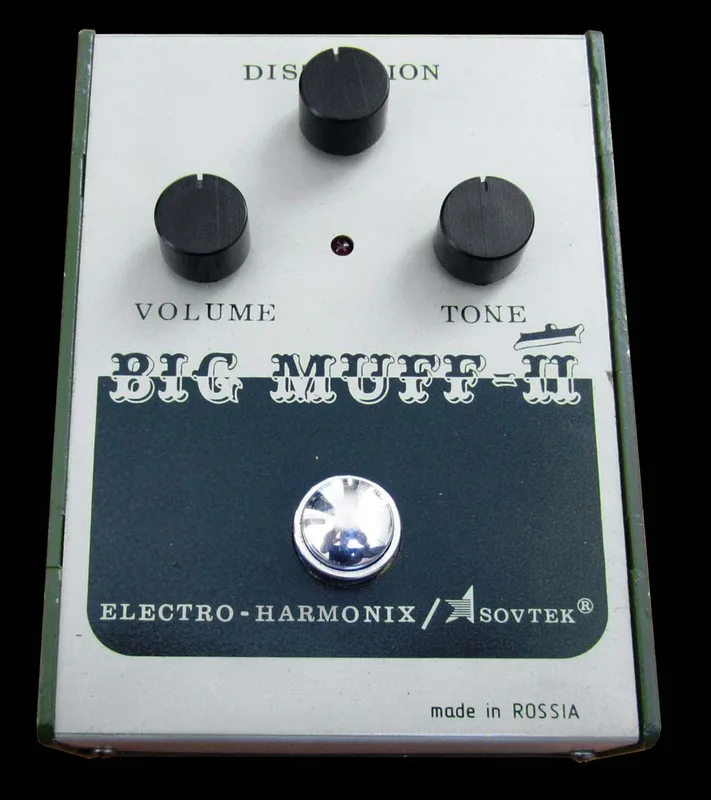
The V6 also sits at the end of a long lineage. Since its beginning around 1969/1970, the Big Muff Pi has gone through many circuit variants, but all have a scooped-mids sound144, and the circuit has been offered by countless boutique pedal manufacturers in one form or another over the years15. Later Big Muffs in the family include the Russian Big Muff Pi and the NYC reissue, with the op-amp Big Muff Pi representing the V4/V5 branch the V6 was sold alongside. For more on the family as a whole, see the Big Muff Pi page or the wider fuzz pedals category.
Videos
StewMac
Questions
When was the last original US Big Muff made?
The Version 6 was the last of the Big Muffs made in the United States for many years. It was built by Electro-Harmonix in Manhattan, New York, from roughly 1979 to 198423. After the V6, the original US-made Big Muff line ended, and later Muffs such as the Russian and NYC reissue versions followed.
What does the tone bypass switch do?
The tone bypass switch completely removes the tone section from the circuit3. Because the Big Muff tone stack is passive and scoops the mids89, bypassing it gives a louder, rawer tone with more midrange. It is not true bypass: the signal still passes through the pedal's transistor stages while the effect is on3.
Sources (15)
- Big Muff Versions_Quick Identifier, Kit Rae (kitrae.net), 2026
- Big Muff Pi, Stompbox Book, 2020-03-21
- The Big Muff History of All Versions Part 1, Kit Rae (kitrae.net), 2016-06
- BIG MUFF TRANSISTORS AND OTHER COMPONENTS, Kit Rae (kitrae.net), 2012-07
- Coda Effects, Coda Effects, 2026
- A guide to the best Big Muff-style pedals, from classic reissues to boutique oddities, Guitar.com, 2025-07-30
- Big Muff Pi Analysis, GuitarPCB
- Coda Effects, Coda Effects, 2026
- beavis audio research, beavis audio research
- Best Big Muff Pedals In 2025: Reissues, Clones & Evolutions, Delicious Audio, 2025-04-07
- EQD Chelsea Low-End Fuzz Driver review: a bass-friendly big muff, Guitar.com, 2025-07-21
- EarthQuaker Chelsea Low End Fuzz Driver Review, Premier Guitar, 2025-06-12
- EarthQuaker Devices Chelsea Low End Fuzz Driver Pedal review, Guitar World, 2025-06-30
- The Big Muff History of All Versions 3, Kit Rae (kitrae.net), 2017-09
- Electro-Harmonix Russian Big Muff Pi Pedal Mods, Premier Guitar, 2009-04-21