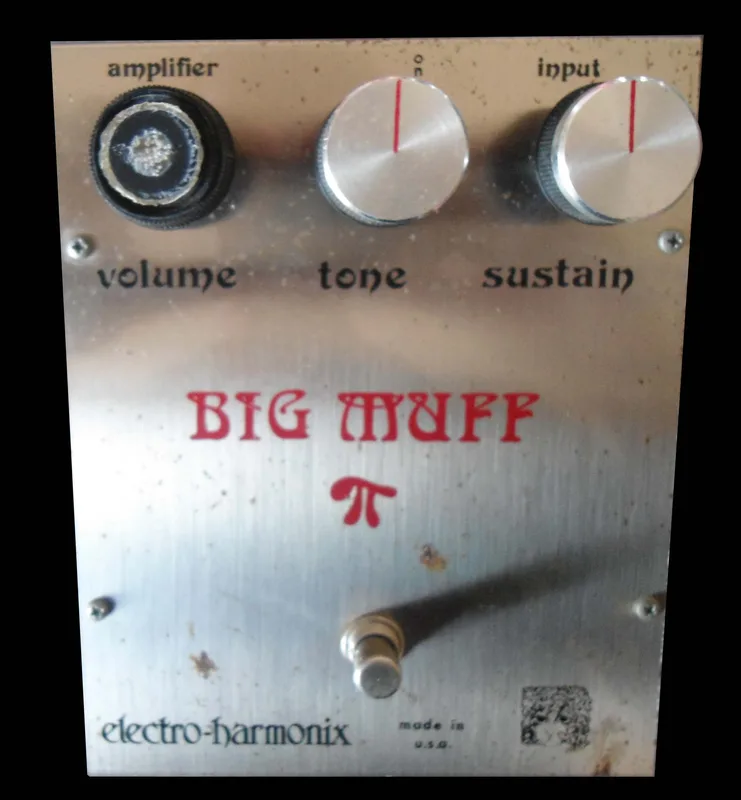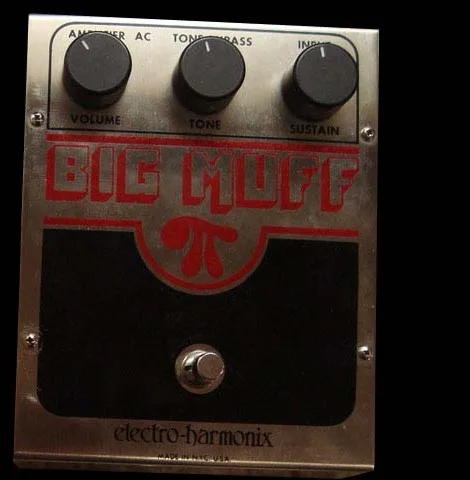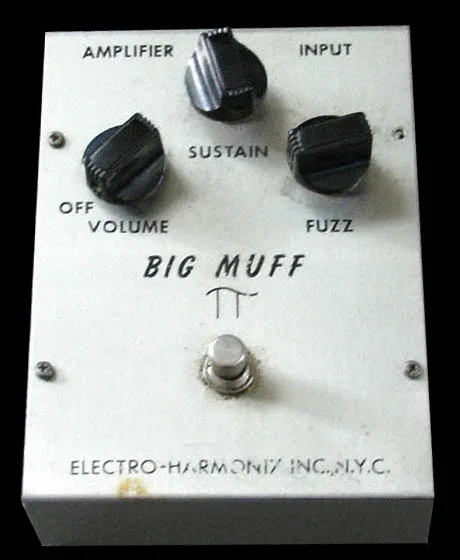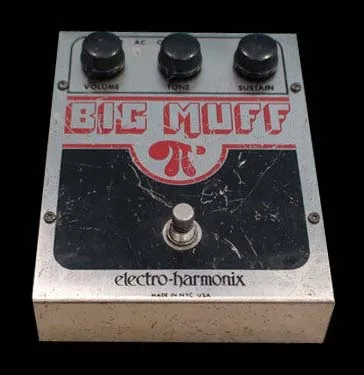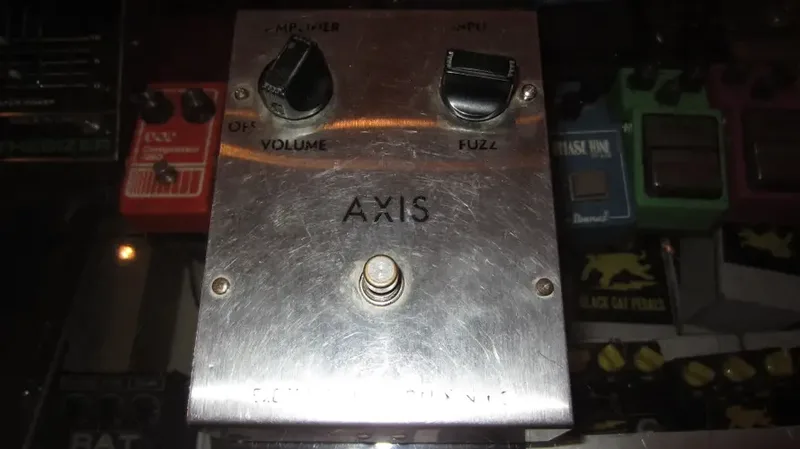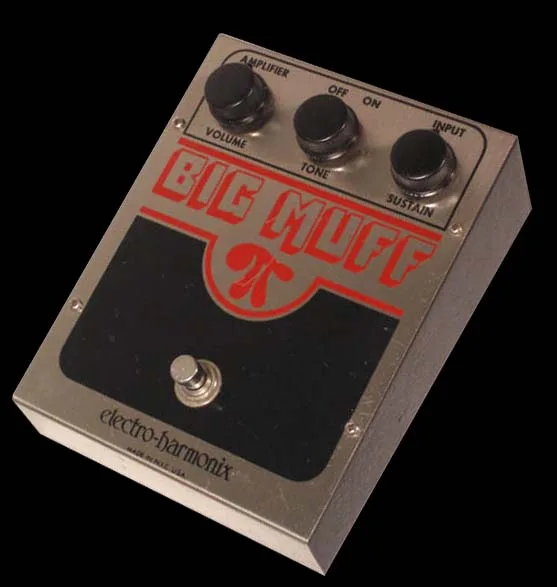

The Big Muff Pi Version 3, known to players as the "Red and Black" Big Muff, is a fuzz pedal made by Electro-Harmonix in Manhattan, New York, in the late 1970s1. In circuit terms it is a graphics change of the V2 "Ram's Head" Big Muff Pi: the boards carry the same trace pattern, all marked with the number 300323. What changed is the faceplate. Around 1977 the graphics moved to the bold red and black design the Big Muff is most associated with, a large red font framed by the knobs with a black patch below, and this version introduced the font still tied to the model today245.
The circuit was designed by Bob Myer with Mike Matthews2. Kit Rae, whose history of the Big Muff is the standard reference for these versions, counts roughly ten circuit variants across the V3's run, and describes most of them as having more sustain and a slightly more aggressive character than the typical V2, with a fairly tight and controllable low end and a very scooped midrange2. Anasounds calls it "a very bright and aggressive sound that ensures you can be heard in the mix", and a less elaborate but more efficient sound than the Ram's Head in basic rock contexts5.
When was the V3 Big Muff made?
The dating of the V3 varies a little between sources. Kit Rae's timeline lists the Big Muff Pi V3 at 19767, and his history page describes the Version 3 "Red and Black" as a USA model from circa 19763. The Stompbox Book's Derek See says Version 3 was introduced circa 1977 and built until 19794, and TONEHOME's product page likewise dates the v3, a non-IC circuit, to 19776. Anasounds splits the Red and Black era into circuits made in 1977 to 1978, very close to the Ram's Head, followed by the 1978 to 1980 op-amp version5. The safest reading for a player: the transistor V3 appeared around 1976 to 1977 and ran until about 1979, when the op-amp design took over. In 1978, the transistors were switched out for op-amp ICs in the next version of the circuit843.
Three editions
Across its run the V3 came in three editions, and all three use the exact same large circuit board trace, marked 300332. The differences are on the surface and at the jack:
| Edition | What identifies it |
|---|---|
| First | No AC letters on top3 |
| Second | AC adaptor jack added, AC marked on the front24 |
| Third | Letters AC and TONE BYPASS added on top; on/off switch changed to a Tone Bypass switch, around 1978 to 1979324 |
All three editions share some practical quirks that matter to anyone playing one today. The pot sweep is non-linear, with zero at a different place for each knob. There is no LED and no battery door, so changing the battery means opening the enclosure. Power comes from a 9V battery or the AC adapter jack on the back, and the on/off power switch sits on the back of the pedal rather than underfoot32. The footswitch itself is a Carling SPDT, and the pedal has no true bypass, so the circuit stays in the signal path when bypassed2. Vintage USA Big Muffs of this era (V1, V2, V3) use single-gang, linear taper, 24mm, 100k potentiometers1, and the V2 through V5 all used Daka Ware style pointer knobs with D shafts1.
Circuit variants
Under the red and black faceplate, the V3 is the same five-stage transistor circuit as the earlier USA Big Muffs: an input/gain stage, two clipping stages, a tone stage, and an output stage1. The input section is a transistor buffer that adapts the guitar's impedance to the first distortion stage and also amplifies the signal, with a potentiometer wired as a variable resistor setting the gain9. Each clipping stage uses twin silicon diodes placed back-to-back to clip the signal410, and the output stage boosts the signal back up to make up for the loss through the passive tone stack910.
The roughly ten circuit variants Kit Rae documents mostly come down to component substitutions2:
- Transistors: the very first V3s used PNP BC239C (TO92 package); later units used NPN 2N5088, PNP 2N5087, and NPN MPSA18, among others2. The Tone Bypass edition used MPSA18 transistors2. Kit Rae notes real vintage Big Muffs were made with both PNP and NPN transistors with no real effect on the sound either way1.
- Diodes: silicon, with blue or red cases; the V3 and V6 used 1N4148 or 1N914 diodes, and some were unmarked21.
- Capacitors: clipping cap values were almost always 1.0uF, and feedback caps almost always 470pF, though one early variant used 560pF1.
- Tone stack: the high pass resistor was most commonly 22k, but 39k was also used1.
The tone stack itself is a small passive circuit, five components with no power connections, that splits the signal into a high-pass and a low-pass filter and blends them back together with the tone potentiometer11121. Its cutoff frequencies sit in the midband, roughly 200 to 2500 Hz, which is why it scoops the mids11. That scoop is the Big Muff's signature, but it comes at a cost: Coda Effects calls the mid loss "the enemy of guitarist playing in a band"913. On a stock Big Muff, both filters still affect the midrange with the knob at 12, so the scoop never fully goes away10. The whole tone control costs about 7dB of level, around 13.5dB total at the 1kHz notch with the pot at midpoint14.
The V3 Tone Bypass
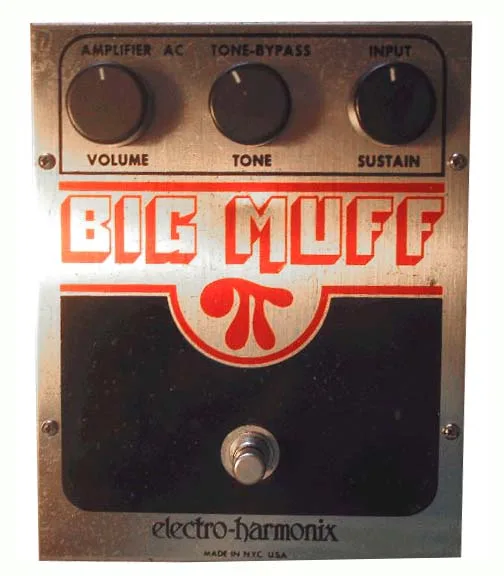
The third edition of the V3, produced around 1978 to 1979, changed the on/off switch to a Tone Bypass switch24. Switching the bypass on disables the tone circuit, and the tone knob has no effect in bypass mode2. Delicious Audio describes the same feature on the later V5: removing the EQ section increases the output level and changes the midrange response8. For a player, that is the point: it sidesteps the mid scoop that can make a Big Muff disappear in a band mix.
Kit Rae's notes on the examples he has played are direct:
"The examples of V3s I have played that included the tone bypass switch were very agressive and fuzzy in normal mode."
The Tone Bypass edition's circuit is identical to the V6 Big Muff schematic, which this version transitioned into; its component values differ slightly from most early V3s but match some V2 Big Muffs, like the circuit associated with J Mascis2. By 1978 the circuit had evolved into an unchanging standard schematic, as in the Tone Bypass V33. Howard Davis, Manager of Analog Circuit Design for Electro-Harmonix from 1976 to 1981, has stated the tone bypass feature was already in use before his design work on the op-amp version2. Guitar World's Alex Lynham likewise credits the V3 as "the Muff that introduced a tone bypass prior to the version 4 and 5 op-amp Muffs"15.
Players and legacy
Anasounds lists users of the Red and Black Big Muff including John Frusciante, Jack White, The Edge, the Black Crowes, Arctic Monkeys, and Mogwai, among others5. The circuit family it belongs to has been described in Premier Guitar as having "been heard on numerous recordings and been offered by countless boutique pedal manufacturers in one form or another over the years"16, and all generations from the Triangle Muff onward share a common four-stage silicon transistor architecture17. Gearnews has called the original Triangle Big Muff circuit "possibly the most famous fuzz pedal"18.
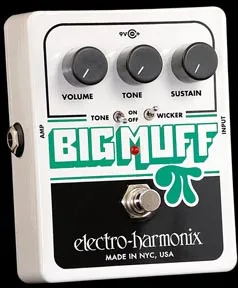
For players chasing the V3 sound today, originals are vintage items. Kit Rae notes the Tym Guitars Big Mudd, built in Australia, as one of the few boutique V3 replicas2. The later Big Muff Pi with Tone Wicker carries the tone-bypass idea forward in a modern pedal, and the Op-amp Big Muff Pi reissue covers the circuit that followed the V3.
Videos
Sweetwater
Questions
Why is it called the Red and Black Big Muff?
Around 1977 the Big Muff Pi's graphics changed to a bold red and black design: a large red font framed by the knobs at the top and a black patch at the bottom, with the red Pi symbol on a black background. This is the look the Big Muff is most associated with, and it also introduced the font still used on the model today.
What does the tone bypass switch do?
On the third edition of the V3, the on/off switch was changed to a Tone Bypass switch. Switching the bypass on disables the tone circuit entirely, so the tone knob has no effect, which increases the output level and changes the midrange response compared with the normal scooped setting.
When was the V3 Big Muff made?
Sources differ slightly on the year: Kit Rae dates the Version 3 to circa 1976, while the Stompbox Book and TONEHOME place it at circa 1977, built until 1979. The third edition with the Tone Bypass switch was produced around 1978 to 1979.
Sources (18)
- BIG MUFF TRANSISTORS AND OTHER COMPONENTS, Kit Rae (kitrae.net), 2012-07
- The Big Muff History of All Versions Part 1, Kit Rae (kitrae.net), 2016-06
- Big Muff Versions_Quick Identifier, Kit Rae (kitrae.net), 2026
- Big Muff Pi, Stompbox Book, 2020-03-21
- The history of the big muff over time, anasounds.com, 2022-06-08
- TONEHOME, TONEHOME - the World of Vintage Guitar Effects Pedals
- A Fuzz and Muff pedal Timeline, Kit Rae (kitrae.net), 2014-07
- Best Big Muff Pedals In 2025: Reissues, Clones & Evolutions, Delicious Audio, 2025-04-07
- Coda Effects, Coda Effects, 2026
- A guide to the best Big Muff-style pedals, from classic reissues to boutique oddities, Guitar.com, 2025-07-30
- Coda Effects, Coda Effects, 2026
- beavis audio research, beavis audio research
- Coda Effects, Coda Effects, 2015-09
- Big Muff Pi Analysis, GuitarPCB
- EarthQuaker Devices Chelsea Low End Fuzz Driver Pedal review, Guitar World, 2025-06-30
- Electro-Harmonix Russian Big Muff Pi Pedal Mods, Premier Guitar, 2009-04-21
- Quick Hit: Electro-Harmonix Op-Amp Big Muff, Premier Guitar, 2018-10-02
- Electro-Harmonix reissues the Triangle Big Muff Pi, 50 years after its debut, gearnews.com, 2018-09-07